
Table of Contents
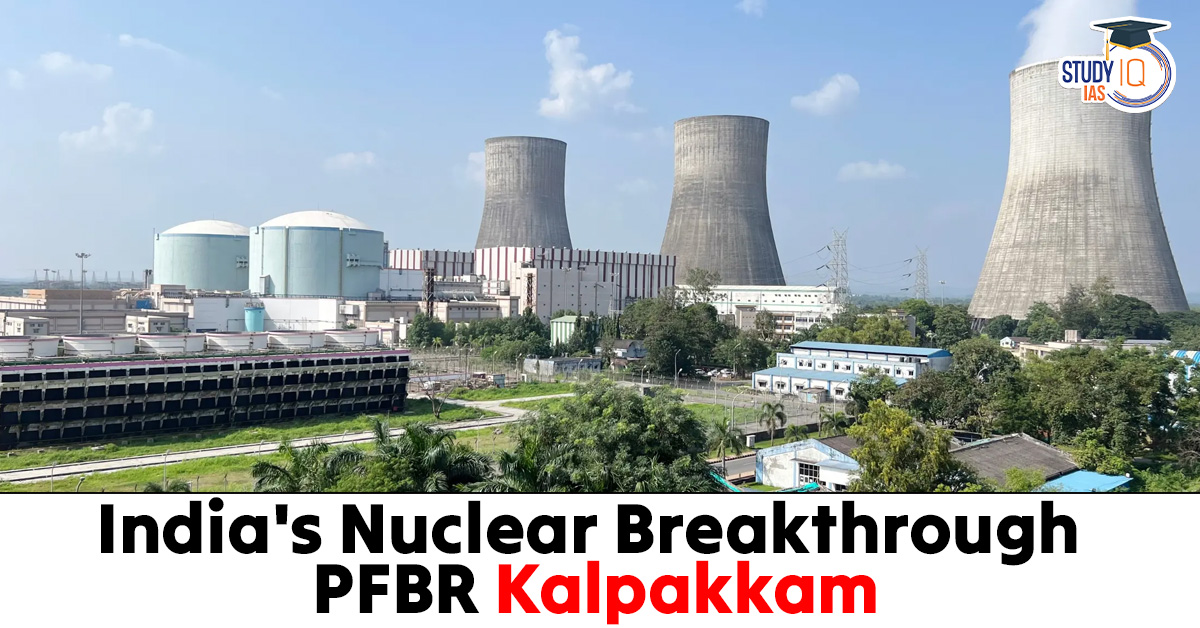
Context: India’s 500 MWe Prototype Fast Breeder Reactor (PFBR) at Kalpakkam, Tamil Nadu, achieved first criticality, marking entry into the second stage of India’s three-stage nuclear programme aimed at utilising India’s vast thorium reserves for long-term energy security
| What is Criticality |
|
About Prototype Fast Breeder Reactor (PFBR)
The Prototype Fast Breeder Reactor (PFBR) is a significant milestone in India’s nuclear energy programme, designed to enhance fuel efficiency and ensure long-term energy security. Located at Kalpakkam, the PFBR uses fast neutron technology to generate more fissile material than it consumes, making it a key component of India’s three-stage nuclear power strategy.
- Development: Indigenously designed by Indira Gandhi Centre for Atomic Research (IGCAR) and constructed by Bharatiya Nabhikiya Vidyut Nigam Limited (BHAVINI) under the Department of Atomic Energy.
- Type: Sodium-cooled Fast Breeder Reactor (FBR) that uses fast neutrons rather than moderated neutrons (unlike thermal reactors).
- Fuel: Mixed Oxide Fuel (MOX) – a combination of Plutonium-239 and Uranium-238.
- Breeding Principle: Fast neutrons convert fertile U-238 into fissile Pu-239, allowing the reactor to produce more fuel than it consumes (“breeding”).
- Thorium Integration: Future blanket may include Thorium-232 supporting Stage-III thorium reactors.
- Coolant: Uses liquid sodium (high thermal conductivity, wide temperature range, maintains fast neutron spectrum).
- Design: Pool-type sodium reactor with a closed fuel cycle allowing reprocessing and reuse of nuclear materials.
Check here all about Fast Breeder Reactor: India’s Stage Programme
Significance of PFBR for India’s Three-Stage Nuclear Programme
- Higher Fuel Efficiency: Breeder reactors can extract 80–100 times more energy from uranium compared to conventional reactors.
- Thorium Utilisation: India holds one of the world’s largest thorium reserves (~25% global share), making Stage III strategically important.
- Energy Security: Reduces dependence on imported enriched uranium.
- Low-Carbon Base-Load Power: Provides continuous clean electricity supporting India’s climate goals.
- Strategic Nuclear Capability: Strengthens expertise in fuel cycle technologies, reactor physics, advanced materials, and large-scale engineering.
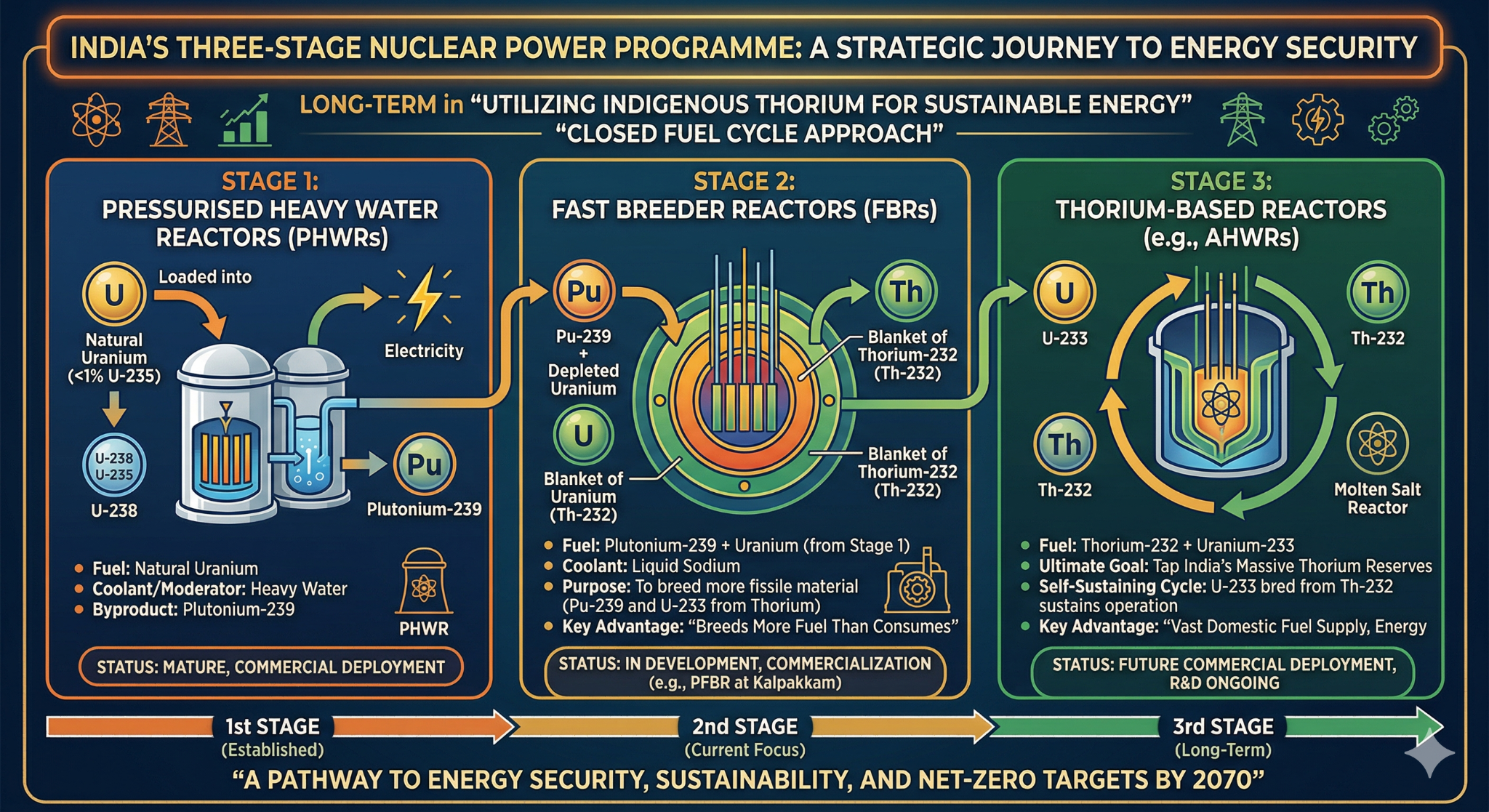
India’s Three-Stage Nuclear Power Programme
| Stage | Reactor Type | Fuel Used | Output / By-Product | Role in Programme |
| Stage I | Pressurised Heavy Water Reactor (PHWR) | Natural Uranium (U-235) | Produces Plutonium-239 in spent fuel | Current operational reactors (≈23 units; ~7.48 GWe capacity) |
| Stage II | Fast Breeder Reactor (FBR) | Pu-239 + U-238 (MOX fuel) | Breeds more Pu-239 and converts Thorium-232 → U-233 | PFBR forms the bridge stage |
| Stage III | Advanced Thorium Reactors (e.g., AHWR) | Uranium-233 + Thorium-232 | Large-scale thorium energy generation | Long-term energy independence |
Difference Between PHWR and Fast Breeder Reactor (FBR)
| Feature | PHWR (Pressurised Heavy Water Reactor) | Fast Breeder Reactor (FBR) |
| Fuel Type | Natural uranium (U-235 ~0.7%) | Plutonium-based mixed oxide fuel (MOX: Pu-239 + U-238) |
| Neutron Type | Uses slow (thermal) neutrons for fission | Uses fast neutrons (no moderator) |
| Moderator | Heavy water (D₂O) slows neutrons | No moderator used |
| Coolant | Heavy water coolant | Liquid sodium coolant (high heat transfer) |
| Fuel Utilisation | Low (~1% uranium energy extracted before spent fuel) | Much higher (~10%+ fuel utilisation) |
| Fuel Production | Produces some plutonium as a by-product | Breeds more fissile fuel than it consumes (U-238 → Pu-239) |
| Role in Nuclear Program | Stage-1 of India’s three-stage programme | Stage-2 of India’s three-stage programme |
| Purpose | Electricity generation + plutonium production | Multiply fissile fuel and prepare for the thorium stage |
| Examples in India | Kakrapar, Rajasthan, Narora reactors | Prototype Fast Breeder Reactor (PFBR), Kalpakkam |
Why Fast Breeder Reactors (FBRs) Are Challenging?
- Sodium Coolant Risks: FBRs use liquid sodium coolant, which improves heat transfer but reacts violently with air and water, requiring sealed systems and leak detection.
- Technological Complexity: Designing reactors that produce more fuel than they consume requires advanced neutron physics and fuel-cycle engineering.
- Once commissioned, India will be the second country, after Russia, to have a commercial operating FBR
- Economic Viability Issues: Breeder reactors have faced high costs and operational issues globally (France’s Superphénix shutdown; Japan’s Monju sodium leak accident).
- Closed Fuel Cycle Requirement: FBRs require reprocessing facilities to recycle plutonium fuel, increasing infrastructure and regulatory complexity.
Second Stage Plans
- Deployment of Fast Breeder Reactors: Stage-2 focuses on plutonium-fuelled FBRs to multiply fissile material for future reactors.
- PFBR as Demonstration Reactor: India’s 500 MWe PFBR at Kalpakkam is the first large breeder reactor.
- Future Expansion: Plans include six additional 600 MWe breeder reactors to expand fissile material production.
- Fuel Infrastructure: A Fast Reactor Fuel Cycle Facility (FRFCF) is being built to enable reprocessing and recycling of breeder reactor fuel.
Why It Is Key for the Third Stage
- Thorium Conversion: FBRs convert Thorium-232 into Uranium-233, the fuel for third-stage reactors.
- Fuel Multiplication: Breeder reactors increase fissile inventory by converting U-238 into Plutonium-239, expanding nuclear fuel supply.
- Energy Independence: India has large thorium reserves (~25% of global deposits) but limited uranium, making breeder reactors crucial for long-term energy security.
| Current Nuclear Power Landscape in India |
Long-Term Mission
|

 Pathogen Access and Benefit Sharing (PAB...
 Cold Spark Technology: Working, Uses and...
 Biotechnology: Potential, Regulatory Cha...













 WhatsApp





