
Table of Contents
Context
Oral remarks by the Chief Justice during a court hearing, and the clarification that followed, have reignited debate on the institutional limits of judicial speech in the digital age.
Read Also: UPSC Daily Current Affairs 2026
What Are Oral Remarks vs. Judicial Orders?
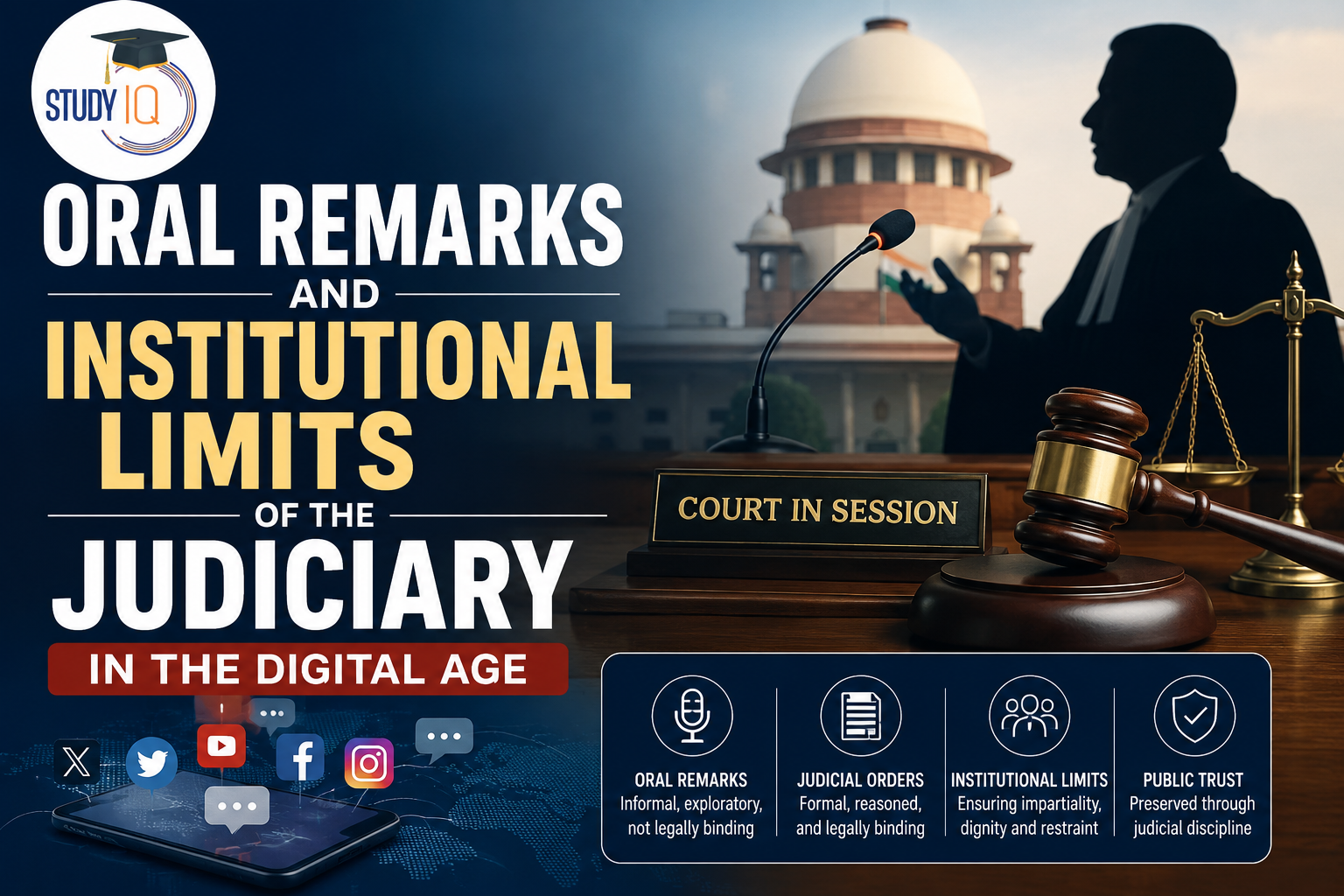
- Oral remarks are informal observations made during hearings to test arguments; not legally binding.
- Judicial orders/judgments are formal, written, reasoned, and legally binding decisions of the court.
- In the digital era, oral remarks spread instantly, often shaping public opinion before any written judgment is delivered.
- This blurs the line between courtroom exchange and authoritative judicial pronouncement.
Constitutional and Legal Framework
- Restatement of Values of Judicial Life (1997): Supreme Court guidelines requiring judges to avoid public debates or comments on matters that may come before courts.
- Judicial Discipline (Item 8): Restrains judges from commenting on political or sensitive issues that may affect impartiality.
- Benjamin Cardozo’s Judicial Standard: Benjamin Cardozo emphasized that judgments must be guided by legal principles, precedent, and constitutional values, not personal emotions.
- Core Principle: Bench remarks should test legal arguments, not become platforms for personal opinions.
- Oath of Office (Third Schedule): Judges swear to perform duties “without fear or favour, affection or ill-will,” ensuring impartial conduct.
- Article 121: Parliament cannot discuss the conduct of Supreme Court or High Court judges except during impeachment proceedings.
- Article 211: Similar restriction imposed on State Legislatures regarding judicial conduct.
- Articles 121 and 211 uphold judicial independence through mutual institutional restraint between judiciary and legislature.
Notable Instances: Oral Remarks Raising Institutional Concerns
- Justice S.A. Bobde, India (2021): During a bail hearing in a rape case, he asked whether the accused would “marry the victim,” triggering widespread criticism for appearing to trivialise sexual violence and victim dignity.
- The episode sparked debate on the sensitivity and appropriateness of judicial remarks made from the Bench.
- CJI D.Y. Chandrachud, India (2023): In the Marriage Equality case, certain oral observations during hearings differed from the final written judgment delivered later, reinforcing that oral remarks do not constitute binding judicial reasoning.
- CJI Surya Kant, India (2025): Remarks concerning the designation of senior advocates reignited discussions on judicial language, courtroom restraint, and the constitutional limits of Bench speech.
How Technology Has Changed the Stakes
- Instant Amplification: Oral observations made during court hearings often trend on social media within hours.
- Premature Public Perception: Public opinion is frequently shaped before the final written judgment is delivered.
- Reputational Harm: Institutions and individuals may face lasting reputational damage from remarks that may never form part of the official order.
- Pressure for Clarifications: Courts increasingly face demands to clarify oral observations, despite such clarifications having no formal legal status.
- Blurring of Boundaries: The distinction between exploratory courtroom exchanges and authoritative judicial pronouncements is becoming increasingly unclear in public perception.
Way Forward
- Internal Guidelines: The Supreme Court could codify specific standards for bench language, building on the 1997 Restatement and the Bangalore Principles.
- Media Literacy: Bar associations and media councils could develop shared protocols on reporting oral observations differently from judgments.
- Judicial Training: Sensitization programmes at the National Judicial Academy on the consequences of digital amplification would help orient newer judges.
- Institutional Discipline, Not Censorship: The goal is not to silence judges but to ensure that judicial authority is exercised through reasoned written orders — where accountability, precedent, and appeal all operate — and not through courtroom observations that carry none of those safeguards.
|
Read More Notes |
|
| Environment Notes | Art and Culture Notes |
| Science and Tech | History Notes |
| Geography Notes | Indian Polity Notes |
| General Knowledge | International Relation |
|
Explore StudyIQ Courses |
|
 Circular Economy in India: Benefits, Cha...
 EPFO Wage Ceiling Hike 2026: Social Secu...
 Daily Mains Articles 2026 – Updated Da...














 WhatsApp





