
Table of Contents
Context: Over the last decade, India’s digital landscape has expanded rapidly, making it one of the world’s largest online markets. Alongside this expansion, however, a complex and often non-transparent system of internet regulation and content control has evolved.
Internet Censorship in India: Introduction
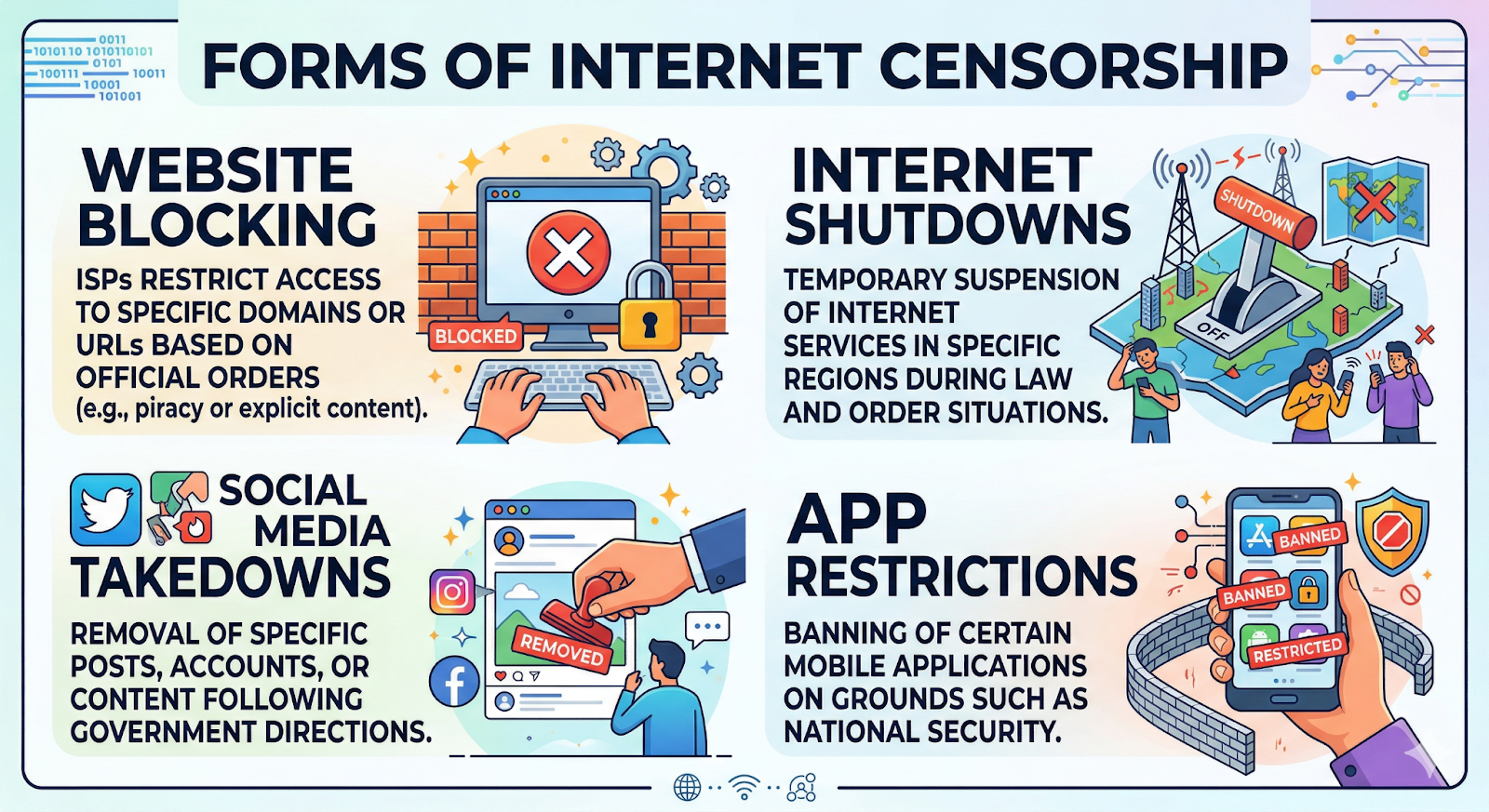
Access to the internet in India is influenced not only by cost and service quality but also by the Internet Service Provider (ISP), as different providers may restrict access to different websites. ISPs enforce blocking orders issued by the government or courts; however, variations in implementation result in differing lists of blocked sites across providers.
Constitutional Basis
- Article 19(1)(a) guarantees freedom of speech and expression, which includes online communication.
- Article 19(2) allows reasonable restrictions on grounds such as sovereignty, state security, public order, decency, and morality.
- Any restriction, including shutdowns or blocking, must satisfy the principles of reasonableness and proportionality.
Legal and Regulatory Framework
Information Technology Act, 2000
- Section 69A: Authorises the government to block online content in the interest of sovereignty, security, and public order.
- Section 66A (struck down): Earlier penalised offensive online speech; declared unconstitutional in Shreya Singhal v. Union of India (2015).
- Section 79: Provides limited liability protection to intermediaries if they follow legal directives.
IT Rules, 2021
- Require identification of the originator of messages, raising concerns about end-to-end encryption.
- Mandate the appointment of grievance redressal officers by major social media platforms.
- Criticised for imposing significant compliance obligations.
Telecommunications Act, 2023
- Replaces the earlier Telegraph Act.
- Consolidates powers related to the suspension of telecom and internet services.
Also Check: Regulating Social Media Use Among Children
Key Findings: Scale and Nature of Blocking
- A 2025 study: It examined around 294 million domains across six ISPs, highlighting major trends
- Total blocked domains: 43,083
- Uniformly blocked domains: Only 1,414 across all ISPs
- Patterns observed
- Most blocked sites relate to piracy, file sharing, pornography, and gambling.
- Greater consistency is seen in blocking sensitive content such as terrorism-related material.
- Certain platforms and publications have been uniformly restricted across ISPs.
- Issues identified
- Inconsistent implementation: ISPs do not uniformly enforce blocking orders
- Arbitrary practices: Some blocking lacks a clear legal backing
- Lack of transparency: Blocking orders are not publicly disclosed
Need for Reform
- The current system is marked by opacity and uneven enforcement. Differences in access across ISPs create an inconsistent digital environment for users. There is a growing need for:
- Greater transparency in blocking decisions
- Clear and uniform implementation standards
- Improved accountability mechanisms
- Overall, while regulating harmful content is necessary, a more transparent and consistent approach is essential to ensure that internet governance aligns with constitutional values and protects digital rights.

 Earthquake Lights Explained: Mystery Beh...
 India's Nuclear Breakthrough Prototype F...
 INS Aridhaman: India’s Nuclear Submari...













 WhatsApp





