
Table of Contents
Context:
- The Ministry of Fisheries, Animal Husbandry & Dairying highlighted the sector’s transformation, supported by a record budgetary allocation of ₹2,761.80 crore in the Union Budget 2026-27.
- This funding aims to consolidate gains from the PMMSY and Blue Revolution, focusing on technology-driven aquaculture, digital governance, and the socio-economic inclusion of over 3 crore fishers.
As the Pradhan Mantri Matsya Sampada Yojana (2020–2025) completes five years, India’s fisheries sector has become a key pillar of the Blue Economy, achieving record levels of production and exports.
Current Status of the Fisheries Sector in India (2025)
- Global Standing: India is the 2nd largest fish producer in the world (~8% of global output).
- Contribution to GVA: Fisheries contribute ~24% to India’s GDP and ~7.7% to Agriculture GVA.
- Economic Contribution: Fisheries account for 7.43% of Agricultural GVA, the highest share among all agriculture and allied sectors.
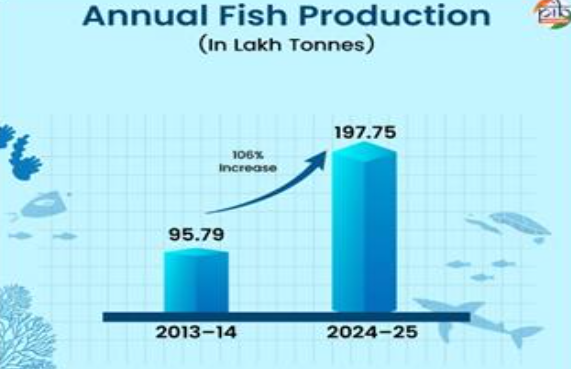
- Production Growth: Fish production rose by 106% over the last decade, reaching 197.75 lakh tonnes in FY 2024-25 compared to 95.79 lakh tonnes in FY 2013-14.
- Employment: ~3 crore people are directly or indirectly dependent.
- Exports: Fisheries exports contribute ~20% to India’s agri-exports. Seafood exports reached a record ₹62,408 crore in FY 2024-25, with frozen shrimp being the primary export commodity.
- Types of Fisheries:
- Marine Fisheries – Along the coastline.
- Inland Fisheries – Rivers, reservoirs, ponds; India is the largest inland fish producer globally.
- Aquaculture (Freshwater & Brackish water): India is the largest producer of shrimp and 2nd largest aquaculture producer
- Largest Producers (State-wise): Andhra Pradesh, West Bengal, Gujarat, Odisha, Tamil Nadu.
- Major Export Destination of Seafood:
- US
- EU
- China, Japan, Vietnam, and Thailand are also major seafood export destinations of India.
| Pradhan Mantri Matsya Sampada Yojana (PMSSY) |
Achievements in 5 years
|
Potential of India’s Fishery Sector
- Inland Reservoir Network: India possesses one of the world’s largest inland networks (31.5 lakh hectares), offering massive untapped potential for freshwater aquaculture.
- Extensive Coastline: With an 11,099 km coastline and an Exclusive Economic Zone (EEZ) of 24 lakh sq. km, India has vast marine resource potential.
- Nutritional Security: As a low-cost source of animal protein, fisheries are vital for combating malnutrition and ensuring national food security.
- Employment Catalyst: The sector supports the livelihoods of approximately 30 million people, particularly providing economic stability to marginalised coastal communities.
- Global Competitiveness: With growing demand in the US and Chinese markets, India has the potential to become the leading global hub for processed seafood and value-added fish products.
Government Initiatives
- Pradhan Mantri Matsya Sampada Yojana (PMMSY): Launched in 2020 with an investment of ₹20,050 crore to address critical gaps in fish production, quality, and technology.
- Kisan Credit Card (KCC) Expansion: Since 2019, KCC benefits have been extended to fishers, providing institutional credit to 4.39 lakh beneficiaries as of 2026.
- National Fisheries Digital Platform (NFDP): Launched in 2024 to generate digital identities for fishers and streamline access to insurance and performance-linked incentives.
- Fisheries and Aquaculture Infrastructure Development Fund (FIDF): Provides concessional finance for the creation of fishing harbours, cold chains, and landing centres.
Challenges in the Fisheries Sector
- Overfishing and Resource Depletion: Marine stocks are under severe pressure due to unregulated fishing practices. Declining catch per unit effort reduces the profitability of fishers.
- Post-Harvest Losses: Around 20% of the total fish catch is lost due to poor cold-chain and storage infrastructure.
- Climate Change and Environmental Stress: Rising sea surface temperatures, frequent cyclones, and ocean acidification threaten marine ecosystems. Coastal erosion and saline intrusion disrupt traditional fishing livelihoods.
- Fragmented and Informal Sector: The Majority of fishers are small-scale operators with limited access to formal credit, insurance, and social security. Absence of organised markets forces distress sales.
- Low Technology Penetration: Modern aquaculture technologies like RAS, IoT-based water quality monitoring, and drones remain confined to pilot projects.
- Export and Quality Challenges: Inadequate compliance with international quality standards & Lack of modern processing and packaging facilities reduce export competitiveness.
- Institutional and Policy Gaps: Overlapping jurisdictions between the centre and States delay regulatory reforms.
| Technology Integration in Fisheries Production |
|
Way Forward
- Sustainability First: Balance between higher production and ecological protection.
- Strengthening Value Chains: Expand cold storage, processing units, and export hubs.
- Social Security Nets: Universalise insurance and pension schemes for fishers.
- Women-Centric Approaches: Expand women-led cooperatives and FFPOs.
- Blue Economy Strategy: Integrate fisheries with marine tourism, shipping, and renewable energy.
- Research & Innovation: Encourage R&D in genetics, breeding, and climate-resilient species.
- International Standards: Strengthen traceability, certification, and quality compliance for exports.

 India Forex Reserve 2026: Record $785.7 ...
 Index of Service Production (ISP): Need,...
 Rise of Orange Economy in India: Key Sec...












 WhatsApp





