
Table of Contents
Context: India’s sea-based nuclear deterrence has strengthened with the commissioning of INS Aridhaman, reinforcing India’s nuclear triad capability (land, air, sea delivery systems).
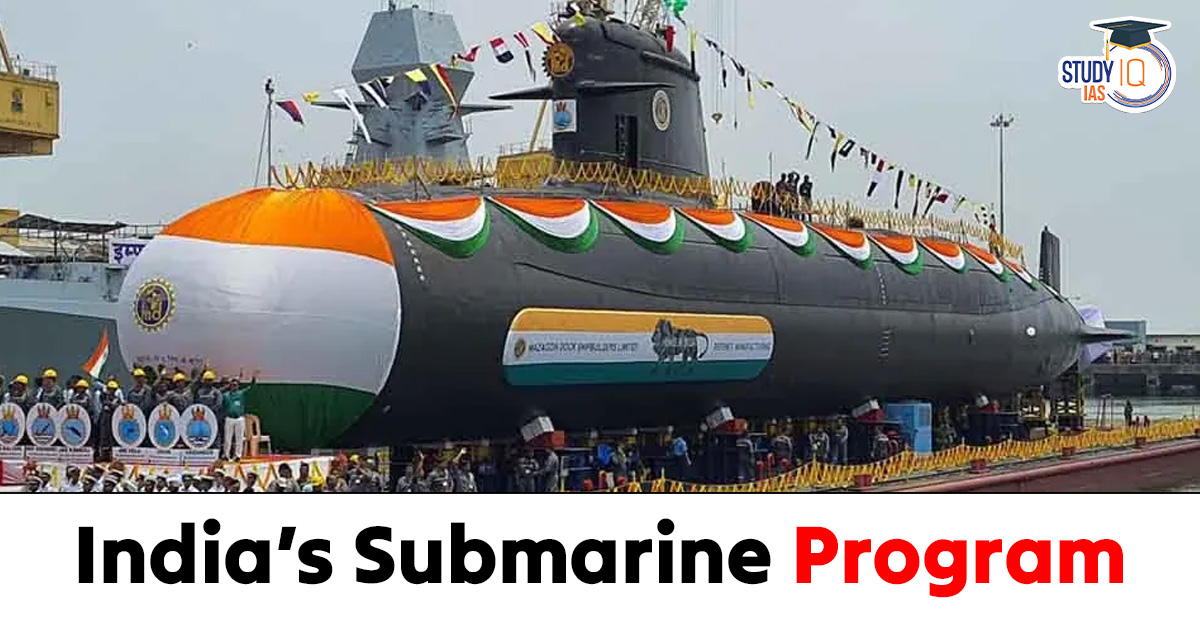
India’s Nuclear Submarine Programmes And Strategic Deterrence
| Programme | Details |
| Arihant Class SSBNs | India’s indigenous nuclear ballistic missile submarines under the Advanced Technology Vessel project form the sea leg of India’s nuclear triad.
|
| SLBM Missile Systems | Submarine-launched ballistic missiles include K-15 Sagarika (~750 km) and K-4 (~3500 km), with future K-5 and K-6 longer-range SLBMs under development. |
| Nuclear Attack Submarine Programme SSN | Indigenous nuclear attack submarines are being planned for conventional naval warfare, sea control and anti-submarine operations (expected ~2036). |
| Conventional Submarine Modernisation | Kalvari class Scorpene submarines under Project 75 and planned Project 75I submarines with Air Independent Propulsion technology. |
| Strategic Infrastructure | Development supported by Ship Building Centre, Visakhapatnam, BARC reactor design, DRDO missile integration and Indian Navy Strategic Forces Command. |
Strategic Importance of the Nuclear Triad
- Credible Second-Strike Capability: Sea-based nuclear weapons ensure retaliation even if land-based assets are destroyed (key principle of credible minimum deterrence).
- Survivability and Stealth: SSBNs remain hidden underwater for long durations, making them difficult for adversaries to detect or destroy.
- Strategic Stability: Triad capability stabilises deterrence among nuclear powers (possessed by the US, Russia, China, UK, France and India).
- Counters China’s expanding submarine presence in IOR and Pakistan’s evolving nuclear delivery systems.
- Sea Lane Security: Supports protection of critical maritime trade routes in the Indian Ocean (Hormuz, Malacca, energy shipping lanes)
- Multi-domain Warfare Preparedness: Modern conflicts increasingly span land, air, cyber, and maritime domains, making sea-based nuclear deterrence essential.
- Indigenous Capability: Strengthens India’s self-reliance in strategic technologies (nuclear reactors, SLBMs, submarine design under ATV project).
- Technological Spillover: Boosts domestic expertise in nuclear engineering, stealth technology, missile systems, metallurgy and advanced shipbuilding.
Check here: List of Missiles of India

 India Withdraws COP33 UNFCCC Host Bid: R...
 Delhi-Dehradun Wildlife Corridor: Featur...
 Tropical Cyclone Vaianu: Formation, Feat...













 WhatsApp





