
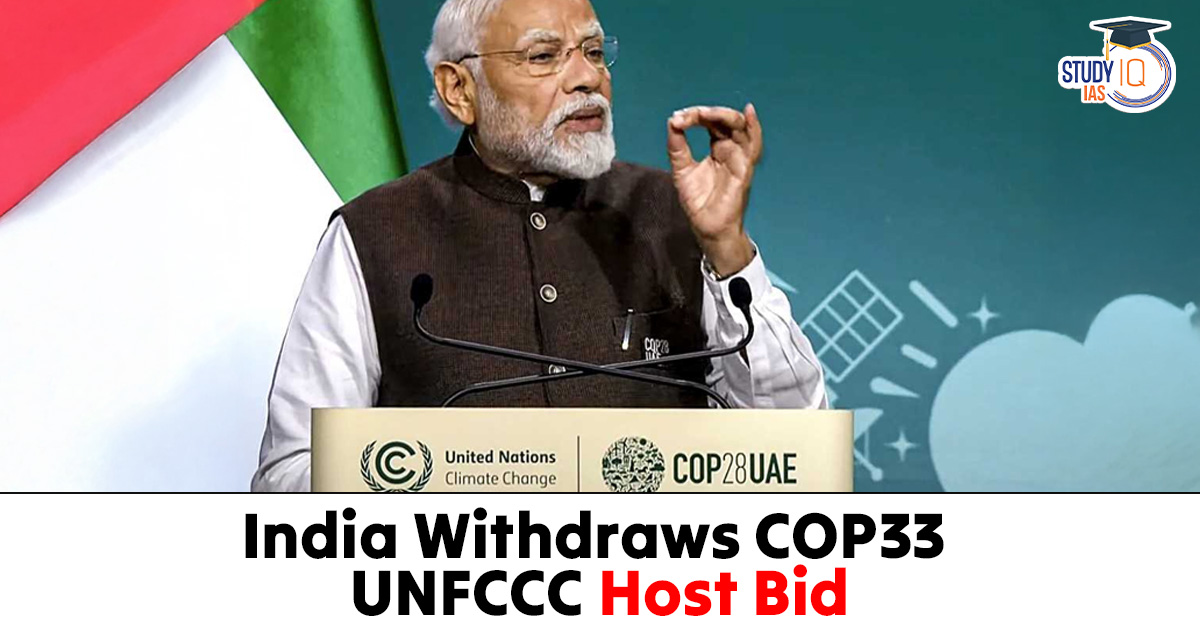
Context: In a significant recalibration of its international climate strategy, India has decided not to pursue its earlier offer to host the 2028 UN Climate Change Conference (COP33).
Strategic Rationale: Why India Withdraws COP33 UNFCCC Host Bid
The Shift to a “Development-First” Paradigm
India’s withdrawal reflects a strategic hardening of its stance, moving away from a “mitigation-centric” global approach toward one that prioritises domestic growth.
- Carbon Space vs. Temperature Goals: India has questioned the feasibility of the 5°C and 2°C targets, arguing these goals unfairly restrict the “carbon space” needed for developing nations to eradicate poverty.
- Adaptation as the Best Insurance: The current policy maintains that rapid economic development is the most effective way to build societal resilience against climate impacts, prioritising adaptation over aggressive emission cuts.
- The “Major Power” Trajectory: Following the examples of the U.S. and China, India is prioritising its industrial and energy security before committing to high-pressure international mandates.
The “Host’s Dilemma” and Conflict of Interest
The role of a COP President is to be a neutral mediator, a position that would have directly conflicted with India’s increasingly vocal national interests.
- Hardening on Climate Finance: India has shifted from seeking “mobilized” private funds to demanding the direct “provision” of public resources from developed nations under Article 9.1 of the Paris Agreement.
- Energy Security vs. Fossil Fuel Phase-out: As the host, India would have been pressured to lead the transition away from fossil fuels, a move that could jeopardise its energy stability in a volatile geopolitical climate.
- The 2028 Global Stocktake (GST): Since COP33 coincides with the critical second GST, the President is expected to deliver a “high-ambition” outcome.
- India feared being boxed into leading by example with commitments that might hamper its own economic growth.
Scientific and Geopolitical Variables
External factors made the 2028 timeline particularly disadvantageous for an Indian presidency.
- The IPCC AR7 Timeline: There is a global push to expedite the Seventh Assessment Report (AR7) by 2028. India opposes this, fearing that a grim scientific report would be used to force the third-largest emitter into fresh, legally binding commitments.
- The “U.S. Factor” and Trust Deficit: With the U.S. periodically cooling toward the Paris Agreement, India is wary of doing more while historical emitters retreat. Furthermore, the widening trust gap between the Global North and South makes forging a consensus nearly impossible for any host.
- Preserving Policy Space: Ultimately, India chose to protect its sovereign policy space rather than succumb to the international scrutiny and pressure that naturally accompanies the COP Presidency.

 Delhi-Dehradun Wildlife Corridor: Featur...
 India’s Nuclear Submarine Programmes A...
 Tropical Cyclone Vaianu: Formation, Feat...












 WhatsApp





