
Table of Contents
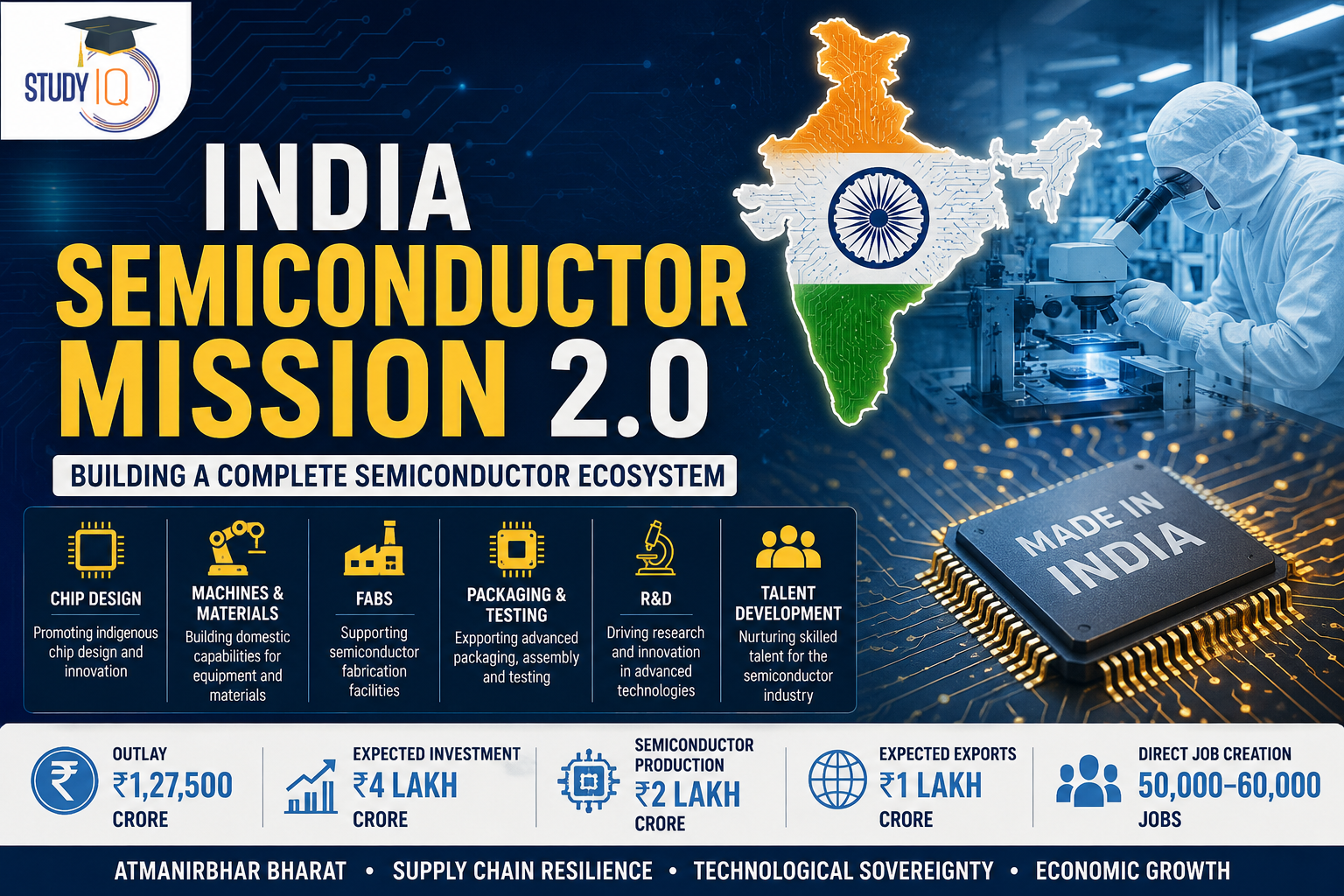
India Semiconductor Mission 2.0: The India Semiconductor Mission (ISM) 2.0 marks a major step in India’s efforts to establish a self-reliant and globally competitive semiconductor ecosystem. With an outlay of approximately ₹1,27,500 crore, the second phase expands government support beyond semiconductor fabrication to include chip design, equipment, materials, packaging, research and development, and talent development.
Semiconductors are critical for smartphones, automobiles, computers, telecommunications, defence systems, artificial intelligence and other strategic technologies. Strengthening domestic semiconductor capabilities is therefore important for India’s economic growth, technological sovereignty and supply-chain resilience.
Read Also: UPSC Daily Current Affairs 2026
What is India Semiconductor Mission 2.0?
ISM 2.0 seeks to develop capabilities across the entire semiconductor value chain, rather than concentrating only on fabrication facilities.
The six major pillars of ISM 2.0 are:
- Chip Design: Support for indigenous semiconductor design, particularly in strategically important applications.
- Machines and Materials: Promotion of domestic manufacturing of semiconductor equipment, chemicals, gases, wafers and substrates.
- Fabs: Financial assistance for establishing semiconductor fabrication facilities.
- Packaging and Testing: Expansion of assembly, testing and advanced packaging capabilities.
- Research and Development: Support for advanced semiconductor technologies and innovation.
- Talent Development: Creation of a specialised workforce for the semiconductor industry.
Investment Support under ISM 2.0
The scheme provides significant financial incentives to encourage private investment:
- Silicon fabrication units: Capital support of up to 40%.
- Compound semiconductor and discrete fabs: Support of up to 35%.
- Specified display fabs and semiconductor packaging units: Support of up to 35%.
- Wafers, substrates, chemicals, gases, testing and R&D facilities: Support of up to 30% of capital expenditure.
- Equipment, sub-assemblies and components: Additional production-linked incentives of 2–10% of the bill of materials.
Government assistance for eligible projects will be released on a pari-passu basis, meaning support will broadly correspond to the capital invested by the project.
Support for Semiconductor Start-ups
ISM 2.0 also focuses on India’s semiconductor design start-ups and MSMEs.
Eligible companies can receive seed funding of up to ₹15 crore, with additional government co-investment possible beyond this threshold. The government may also take minority stakes in Indian semiconductor start-ups by matching private investment.
The scheme further provides royalty financing, under which supported companies pay a portion of their net revenue until the government recovers a specified multiple of its financial support.
Focus on R&D and Skilled Talent
Semiconductor manufacturing requires highly specialised expertise in areas such as chip architecture, fabrication, packaging, equipment and materials.
ISM 2.0 provides support of up to 75% of project cost for R&D and talent-development initiatives. This is intended to strengthen India’s existing engineering and chip-design capabilities while creating a larger pool of semiconductor professionals.
ISM 1.0 vs ISM 2.0
The first phase of the India Semiconductor Mission had an allocation of ₹76,000 crore and resulted in the approval of 12 projects, involving around ₹1.64 lakh crore of cumulative investment.
ISM 2.0 seeks to build on this foundation by developing a more integrated ecosystem covering upstream materials and equipment, chip design, fabrication, packaging, testing, R&D and skilled manpower.
Expected Outcomes
The government expects ISM 2.0 to:
- Attract approximately ₹4 lakh crore in cumulative investment.
- Generate semiconductor production worth around ₹2 lakh crore.
- Achieve approximately ₹1 lakh crore in exports.
- Create around 50,000–60,000 direct jobs.
Significance of India Semiconductor Mission 2.0
The semiconductor industry is strategically important because supply-chain disruptions can affect several sectors simultaneously. India’s traditional strength lies in semiconductor design and engineering talent, while domestic manufacturing capacity has historically remained limited.
ISM 2.0 attempts to bridge this gap by creating an integrated ecosystem within India. It can help:
- Reduce dependence on imported semiconductor components.
- Improve supply-chain resilience.
- Promote indigenous chip technologies.
- Encourage semiconductor start-ups and private investment.
- Create high-skilled employment.
- Strengthen India’s role in the global semiconductor value chain.
- Support strategic sectors such as defence, telecommunications, automobiles and AI.

 Special Summary Revision (SSR) 2026–27...
 Global Hunger Index 2026: India Ranks 10...
 France Protests 2026: Cost of Living, Sc...














 WhatsApp





