
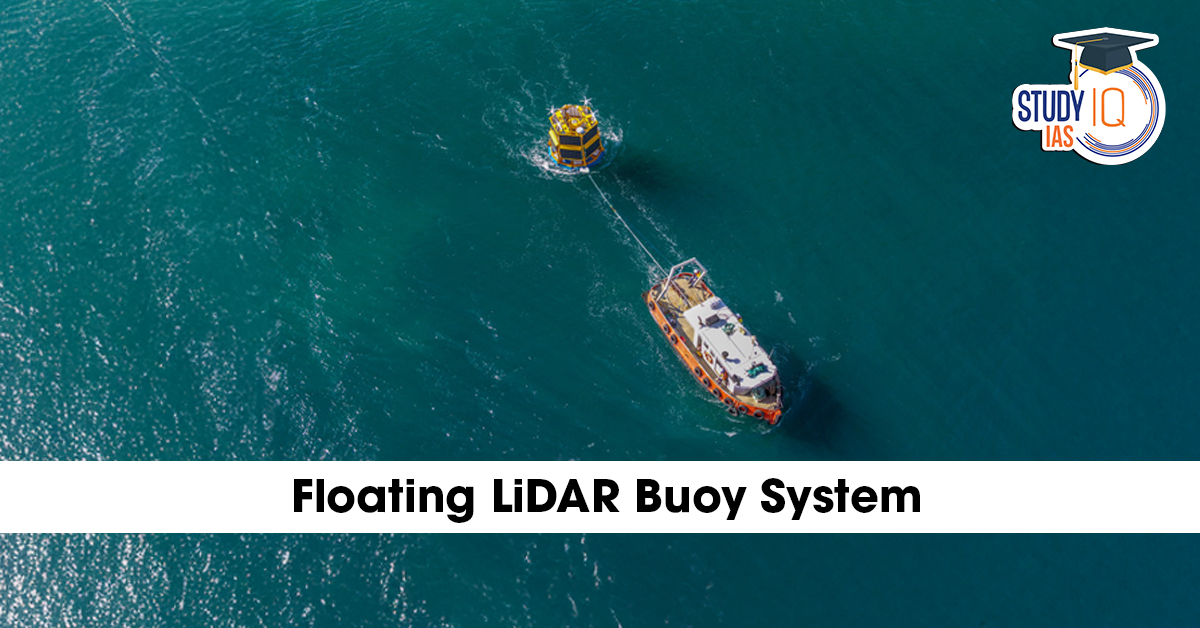
Context: India has achieved a major milestone in marine science with the successful testing of a Floating LiDAR Buoy System by the National Institute of Ocean Technology (NIOT) under the Ministry of Earth Sciences.
Floating LiDAR Buoy System Technology
- LiDAR-Based Remote Sensing: The system uses Light Detection and Ranging (LiDAR), which emits laser pulses into the atmosphere and analyses the reflected signals to measure wind speed, direction, and profiles.
- Floating Buoy Platform: Mounted on a floating ocean buoy, enabling data collection in deep-sea and remote regions where traditional instruments are ineffective.
- High-Altitude Wind Measurement: Can measure wind profiles up to 300 metres above sea level, providing multi-layer atmospheric data.
- Real-Time Data Collection: Generates continuous and high-resolution data, improving accuracy compared to conventional meteorological tools.
Key Applications
- Weather Forecasting: Enhances accuracy of forecasts, especially for cyclones and storms (e.g., better prediction of Arabian Sea cyclones).
- Offshore Wind Energy: Helps identify high-potential wind zones, supporting India’s offshore wind energy projects (e.g., Gujarat & Tamil Nadu coasts).
- Climate Research: Improves understanding of ocean-atmosphere interactions, crucial for climate modelling and monsoon studies.
- Marine and Navigation Safety: Provides real-time data for safe navigation and disaster preparedness.
Significance for India
- Indigenous Technological Capability: Reduces dependence on foreign ocean observation systems, boosting Atmanirbhar Bharat.
- Blue Economy Growth: Supports sectors like offshore energy, fisheries, and marine research.
- Disaster Management: Strengthens early warning systems for cyclones and extreme weather events.
Strategic Advantage
- Enhances India’s capabilities in ocean surveillance and maritime domain awareness

 Advanced Air Defence Radars: Types, Comp...
 Ion Chromatography, Working and Applicat...
 Broadly Neutralising Antibodies (bNAbs):...








 WhatsApp





