
Table of Contents
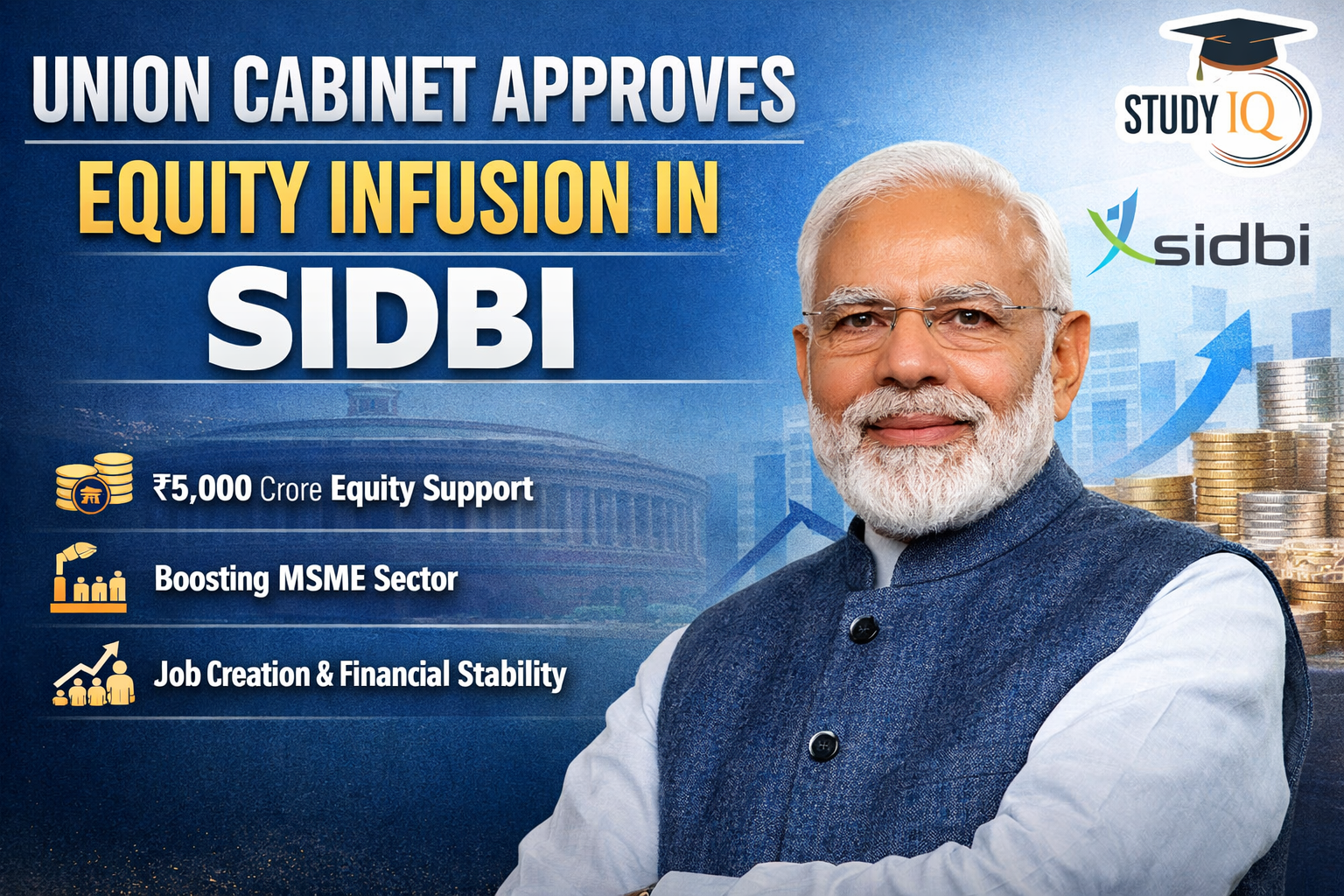
The Union Cabinet, chaired by Prime Minister Narendra Modi, has approved an equity infusion of ₹5,000 crore in the Small Industries Development Bank of India (SIDBI). This decision is a landmark step towards strengthening India’s MSME ecosystem, enhancing credit availability, generating employment, and ensuring long-term financial stability for SIDBI. The equity support will be provided by the Department of Financial Services (DFS) under the Ministry of Finance in a phased manner over three financial years.
This move reflects the government’s commitment to accelerating inclusive economic growth by empowering Micro, Small and Medium Enterprises, which form the backbone of India’s economy.
About the Equity Infusion in SIDBI
The total equity infusion of ₹5,000 crore will be released in three tranches:
| Tranche | Amount | Financial Year |
|---|---|---|
| Tranche 1 | ₹3,000 crore | FY 2025–26 |
| Tranche 2 | ₹1,000 crore | FY 2026–27 |
| Tranche 3 | ₹1,000 crore | FY 2027–28 |
The funds will be infused as share capital, strengthening SIDBI’s balance sheet and enhancing its lending capacity, especially towards MSMEs.
Why Equity Infusion in SIDBI is Important
1. Expansion in MSME Beneficiaries
With this capital infusion, SIDBI will be able to extend financial assistance to about 102 lakh MSME beneficiaries, compared to 76.26 lakh MSMEs in FY 2024–25. This significant jump will ensure wider financial inclusion and better credit penetration.
2. Employment Generation
As per estimates, each MSME generates employment for around 4.37 persons. The incremental financial support is expected to create approximately 1.12 crore new jobs by FY 2027–28, making this initiative a strong driver of employment growth.
3. Strengthening CRAR (Capital to Risk Weighted Assets Ratio)
With increased directed credit to MSMEs and the development of digital and collateral-free lending products, SIDBI’s capital requirements are rising.
The equity infusion will help SIDBI maintain:
-
CRAR above 10.50% even under high-stress scenarios
-
CRAR above 14.50% under Pillar 1 and Pillar 2 norms
This ensures financial resilience and regulatory compliance.
4. Maintaining a Healthy Credit Rating
A robust CRAR improves SIDBI’s credit profile, helping it maintain a strong credit rating. This is crucial for:
-
Meeting regulatory capital norms
-
Building investor confidence
-
Ensuring sustainable growth
5. Access to Lower-Cost Funding
A strong capital base and credit rating enable SIDBI to raise funds at competitive interest rates from domestic and international markets. The benefit of lower borrowing costs is ultimately passed on to MSMEs through affordable credit.
About Small Industries Development Bank of India (SIDBI)
-
Established: 1990
-
Act: Small Industries Development Bank of India Act, 1989
-
Role: Principal Financial Institution for the promotion, financing and development of MSMEs in India
Shareholding Pattern (Before Equity Infusion)
-
Government of India – 20.85%
-
State Bank of India – 15.65%
-
Life Insurance Corporation of India – 13.33%
-
Remaining shares are held by public sector banks and insurance companies.
Functions of SIDBI
SIDBI performs a multi-dimensional role in strengthening the MSME sector:
-
Principal Financial Institution
It leads the financing and development of MSMEs across India. -
Coordination Role
It coordinates with institutions engaged in financing and promoting MSMEs.
Modes of Financial Support by SIDBI
1. Indirect Lending
-
Through Banks, SFBs, NBFCs, MFIs and Fintechs
-
Ensures wider reach and multiplier effect in MSME financing
2. Direct Lending
-
Targets credit gaps in the MSME sector
-
Uses innovative and demonstrative loan products
3. Fund of Funds
-
Promotes entrepreneurship and startups
-
Encourages innovation-driven enterprises
4. Promotion and Development
-
Entrepreneurship development programs
-
Credit-plus initiatives
-
Handholding and capacity building
5. Facilitator Role
-
Acts as a Nodal Agency for various MSME-oriented government schemes
Impact of Equity Infusion on India’s Economy
The equity infusion in SIDBI will:
-
Strengthen MSME credit flow
-
Boost entrepreneurship and startups
-
Support Make in India and Atmanirbhar Bharat initiatives
-
Generate large-scale employment
-
Enhance financial inclusion
-
Improve ease of doing business for small enterprises
Conclusion
The Union Cabinet’s approval of ₹5,000 crore equity infusion in SIDBI is a strategic move to reinforce India’s MSME financing architecture. By strengthening SIDBI’s capital base, maintaining a healthy CRAR, and ensuring affordable credit availability, the government is laying a solid foundation for sustainable MSME growth. This decision will not only expand financial support to over 1 crore MSMEs but also create more than 1 crore jobs, making it a powerful catalyst for inclusive and resilient economic development.
 Mineral Resources in Venezuela: Gold, Ir...
 Mascots for Census 2027 in India: Theme,...
 The Legality of The U.S.-Israel Strikes ...











 WhatsApp





