
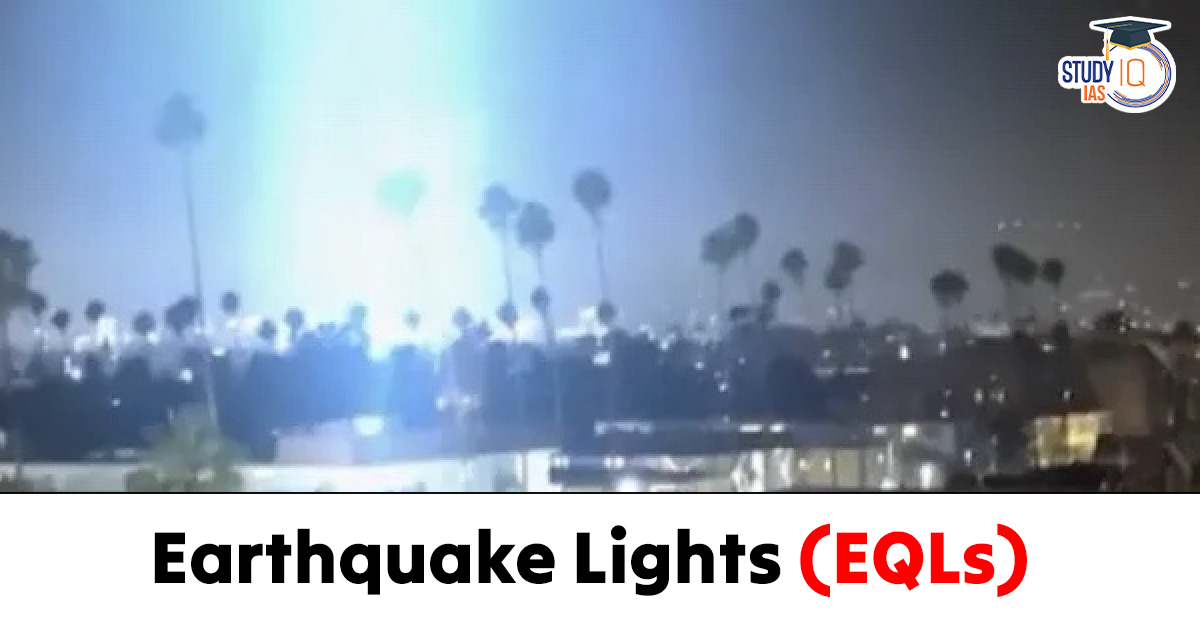
Context: Researchers are using geological physics to explain “Earthquake Lights” (EQL), the mysterious bluish flashes seen during the Turkey-Syria tremors.
About Earthquake Lights (EQLs)
Earthquake lights are luminous aerial phenomena that appear in the sky in areas of tectonic stress, seismic activity, or volcanic eruptions. They can manifest as:
- Stationary Glows: Similar to the Aurora Borealis but hovering near the ground.
- Flashes: Quick, lightning-like bursts that appear to emerge from the earth rather than the clouds.
- Floating Orbs: Luminous spheres that can persist for several minutes.
Scientific Theories behind EQLs
- P-Type Semiconductor Effect: Extreme pressure on rocks like basalt breaks their chemical bonds. This releases “holes” of positive electrical charge that rush to the surface, ionising the air and creating a visible glow.
- Triboluminescence: This is light created by friction. As tectonic plates grind, pull apart, or crush together, the energy from breaking mineral bonds is released as flashes of light.
- Piezoelectric Effect: When quartz crystals are compressed by seismic stress, they generate high-voltage electric fields. Scientists believe this electricity might be strong enough to light up the sky.
- Atmospheric Ionization: Earthquakes can squeeze radon gas out of the crust. This gas ionises the surrounding air, which can form floating “plasma balls” or glowing orbs near the ground.

 Internet Censorship in India: Rules, Law...
 India's Nuclear Breakthrough Prototype F...
 INS Aridhaman: India’s Nuclear Submari...










 WhatsApp





