Table of Contents
Context: Over 2,900 people lost their lives due to hydro-meteorological disasters in 2024-25, as reported by the Union Home Ministry.
- 408 died in Himachal Pradesh, 373 in Madhya Pradesh, 355 in Kerala, 230 in Gujarat, and 206 in Maharashtra.
- 185 people lost their lives in Karnataka, 131 in Rajasthan, 128 in Assam, and 125 in Chhattisgarh.
Disaster Management Act, 2005, defines a disaster as a “catastrophe, mishap, calamity or grave occurrence“ arising from natural or man-made causes that result in substantial loss of life, destruction of property, or damage to the environment.
What is Disaster Management?
- Disaster management refers to the systematic approach of planning, organising, coordinating, and implementing measures to prevent, prepare for, respond to, and recover from disasters.
- It involves a range of activities and strategies aimed at reducing the impact of disasters on human lives, infrastructure, and the environment.
- It includes the total of all activities, and measures which can be taken up before, during and after a disaster. A typical disaster management continuum consists of:
- A pre-disaster Risk Management Phase: Includes prevention, mitigation and preparedness.
- Post-disaster Crisis Management Phase: Includes relief, response, rehabilitation, reconstruction and recovery.
Evolving Landscape of Disasters
- Increased Frequency and Intensity: Disasters, especially those linked to extreme weather events, have become more frequent and intense in the last 20 years.
- Climate Change as a Catalyst: Climate change plays a major role in exacerbating the impacts of these disasters.
- Emergence of New Threats: Previously overlooked events like heat waves have become major threats.
Rise of Multi-Hazard Disasters
The most concerning trend is the increase in multi-hazard disasters, where one event triggers a series of others, leading to catastrophic consequences.
- Example: Heavy rainfall causes glacial lake outbursts, landslides, and subsequent flash floods.
- Recent Case: Cyclone Remal’s heavy rainfall triggered multiple landslides in the Northeast, resulting in at least 30 deaths.
Empowering Disaster Management
- To effectively address these challenges, disaster management agencies need to be empowered with:
- Proactive Role: A shift towards proactive measures rather than reactive responses.
- Increased Resources: More funding and support to enhance their capacity.
- Capacity Building: Continuous training and development to improve skills and knowledge.
- Mitigating Man-Made Influences: While natural events cannot be prevented, man-made factors contributing to disasters, such as unregulated construction, can be minimised through stricter regulations and enforcement.
- Building Disaster Resilient Infrastructure: India is investing heavily in infrastructure development, and it is crucial to incorporate disaster resilience into all new constructions. Existing infrastructure also needs to be retrofitted to withstand future disasters.
- India’s Leadership in Disaster Resilience: India has established the Coalition for Disaster Resilient Infrastructure (CDRI), an international organisation dedicated to promoting disaster-resilient infrastructure globally. The country should prioritise developing effective models at home to showcase to the world.
| National Disaster Management Authority (NDMA) |
Aim
Responsibilities and Functions
Related Authorities
|
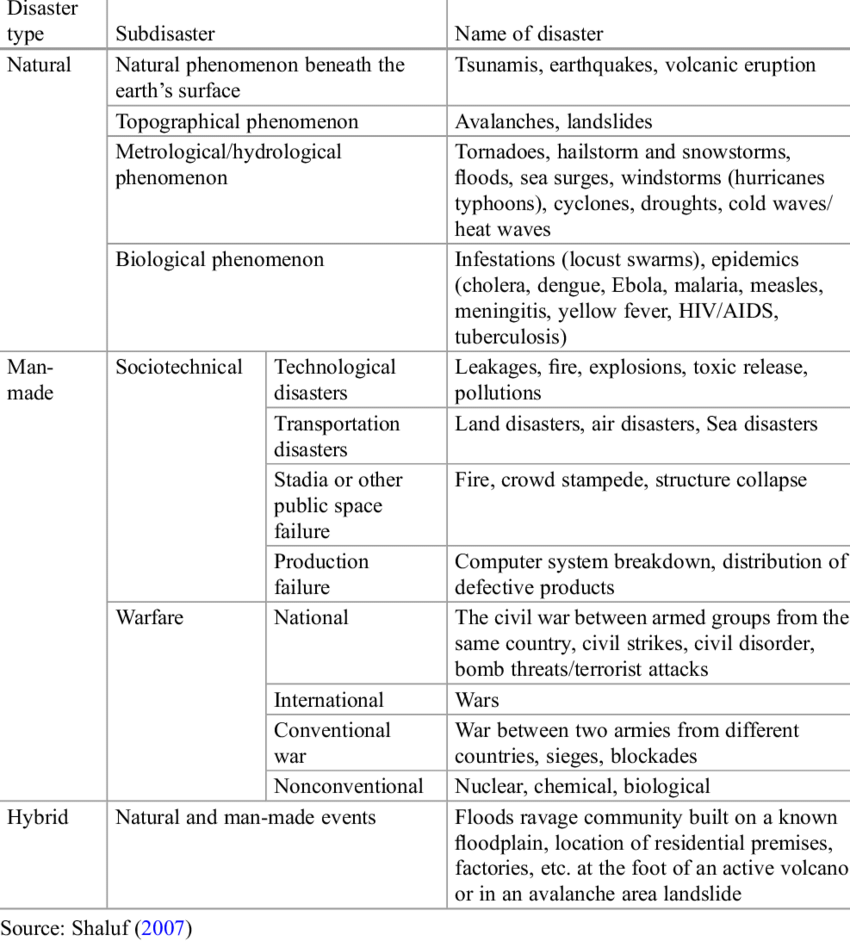
Classification of Disasters
Based on the Source
- Natural Disasters: They are caused by natural phenomena (meteorological, geological or even biological origin). Examples of natural disasters are cyclones, tsunamis, earthquakes and volcanic eruptions, which are exclusively of natural origin.
- Landslides, floods, drought, and fires are socio-natural disasters since their causes are both natural and manmade.
- Anthropogenic Disasters: They occur due to human intervention or negligence. These are associated with industries or energy generation facilities and include explosions, leakage of toxic waste, pollution, dam failure, wars or civil strife, etc.
Based on Duration
- Rapid Onset Disasters: They are characterised by the sudden and acute intensity of the impact during a short period. Earthquakes, cyclones, floods, and tsunamis fall under the category of rapid-onset disasters.
- Slow Onset Disasters: Also termed as ‘Creeping Emergencies’, can be predicted much further in advance and unfold over months or even years. Climate change (global warming), desertification, soil degradation, and droughts would fall under the category of slow-onset disasters.
Natural Disaster Events in India in 2024
- Cyclone Remal: This severe cyclonic storm impacted the eastern coast, causing widespread damage to infrastructure and agriculture.
- Wayanad Landslides: Triggered by heavy rainfall, multiple landslides occurred in Kerala’s Wayanad district, resulting in significant loss of life and property.
- Assam Floods: Intense monsoon rains led to severe flooding in Assam, affecting over 400,000 people and displacing thousands.
- Himachal Pradesh Cloudbursts: Sudden cloudbursts in Himachal Pradesh caused flash floods and landslides, leading to numerous fatalities and infrastructural damage.
- Gujarat Floods: Heavy monsoon rains resulted in severe flooding in Gujarat, leading to significant displacement and damage.
Disaster Management in India
Legal and Institutional Framework in India: The Government of India enacted the Disaster Management (DM) Act, 2005, which envisaged the creation of a three-tier structure comprising the National Disaster Management Authority (NDMA), State Disaster Management Authorities (SDMAs) and District Disaster Management Authorities (DDMAs).
| Levels | Institutions |
| Institutional Framework at the National Level |
|
| Institutional Framework at State Level |
|
| Institutional Framework at the District Level |
|
| Local Authorities |
|
Government Initiatives for Disaster Management
- New Schemes: The first scheme, valued at Rs 5,000 crore, aims to expand and modernise fire services in states. The project intends to enhance firefighting capabilities, upgrade equipment, and improve infrastructure to effectively respond to fire emergencies.
- The second scheme, worth Rs. 2,500-crore aims to reduce the risk of urban flooding in the seven most populous metros: Mumbai, Chennai, Kolkata, Bengaluru, Hyderabad, Ahmedabad and Pune.
- The third scheme, worth Rs 825 crore, is the National Landslide Risk Mitigation Project.
- It aims to address the issue of landslides in 17 states and Union Territories by implementing measures to prevent and mitigate landslides, ensuring the safety of vulnerable communities.
- Flood Management: Wetlands function as natural sponges that trap and slowly release surface water, rain, snowmelt, groundwater and flood waters.
- 271 wetlands have been identified in the Northeast by ISRO for flood management in the country.
- Floods have also been controlled by planting saplings on the banks of 13 major rivers, which are prone to floods.
- Response Team: Incident Response System has been implemented in 20 states and UTs.
- Participation: The government has set a target of preparing around one lakh youth volunteers in 350 high-risk, disaster-prone districts.
- The government is also awarding the Subhas Chandra Bose Aapda Prabandhan Puraskar to individuals and organisations who have contributed to the field of disaster management.
- National Disaster Mitigation Fund: It is a fund managed by the Central Government for meeting the expenses for emergency response, relief and rehabilitation due to any threatening disaster situation or disaster.
| Disaster Management Amendment Bill 2024 |
|
Concerns related to the proposed Amendments
- Constitutional Scrutiny: The Bill falls under Entry 23 of the Concurrent List in the Seventh Schedule, which covers “social security and social insurance, employment and unemployment” rather than “Disaster Management” which is not listed in the Seventh Schedule.
- Overlapping Authorities: The Bill introduces additional authorities, which could create confusion and bureaucratic delays that might impede effective rescue and relief operations.
- The Kerala Chief Minister and Home Minister have clashed over early warning systems related to the Wayanad tragedy due to overlapping authorities.
- Violation of State Jurisdiction: The Bill grants excessive rulemaking powers to the Central government through delegated legislation, potentially infringing on the legislative powers reserved for States and overlapping with State jurisdiction.
Way Forward
- Updating Key Definitions: Section 2 of the Act should be revised to explicitly define terms like ‘hazards,’ ‘prevention,’ and ‘mitigation,’ ensuring clarity and consistency across the Act.
- Increasing Autonomy and Authority: Enhancing the NDMA’s efficiency requires granting it greater financial and administrative powers. Elevating NDMA to a government department or ministry could significantly boost its effectiveness.
- Include Disaster Management in Concurrent List: The Administrative Reforms Commission’s 3rd Report- “Crisis Management: From Despair to Hope” suggested adding a new entry “Management of Disasters and Emergencies, natural or man-made” to List III (Concurrent List) of the Seventh Schedule.
- Capacity Building: This should include:
- Developing a Comprehensive Training and Capacity-Building Program
- Developing Human Resources to boost Operational Capacity
- Building Local Capacity with regular training and adequate resource allocation
- Advancing Disaster Management Research: Invest in research for disaster risk management, emphasising cutting-edge technologies like AI, remote sensing, and big data analytics.
- Develop National Rapid Response Frameworks: To ensure swift and coordinated action during crises, with a well-defined command structure and effective resource allocation.
- Eg., Adopt a 72-hour critical response plan inspired by Japan’s model to ensure prompt rescue operations and effective coordination.

 US Treasury Yields at 25-Year High: Impa...
 National Coastal Mission 2.0 (NCM 2.0): ...
 New CAFE Norms 2027–32: Key Features, ...














 WhatsApp