
Table of Contents
Context: Southern states have raised apprehensions that the delimitation process may adversely impact their share of representation in Parliament. There has been a renewed debate about delimitation after the issue was raised by the Chief Minister of Tamil Nadu. The debate on fresh delimitation of legislative constituencies has intensified, raising multiple concerns and possible solutions.
The ongoing debate around the readjustment of Lok Sabha seats following the new Census is being widely misrepresented as delimitation in public discourse. Population disparities between northern and southern states have sparked demands to increase Parliament’s strength, raising concerns over regional representation and equity.
More In News
- A proposed solution suggests freezing the number of parliamentary seats but increasing the number of Assembly seats in States with growing populations.
- This is considered more democratic because:
- MLAs are the first point of contact for constituents.
- MPs represent their constituents at the national policy level.
What is Delimitation Exercise?
- Delimitation is the process of redrawing boundaries of Parliamentary and Assembly constituencies to ensure equal representation based on population changes.
- It also involves fixing the number of seats allocated to each state in the Lok Sabha and State Assemblies.
- The process is carried out by an independent body called the Delimitation Commission.
Importance of Delimitation
- Ensures Equal Representation: Each constituency should have roughly the same population size to ensure fair voting power.
- Reflects Population Growth Trends: Helps in adjusting representation as populations increase or decrease over time.
- Prevents Political Imbalance: Without delimitation, some areas may have more MPs per voter, leading to under-representation
| Legal and Constitutional Basis for Delimitation |
Related Constitutional Amendments
|
What is the Process of Readjustment of Lok Sabha Seats?
- As per Article 82 of the Constitution, the Lok Sabha seats are to be readjusted based on the population figures of each Census.
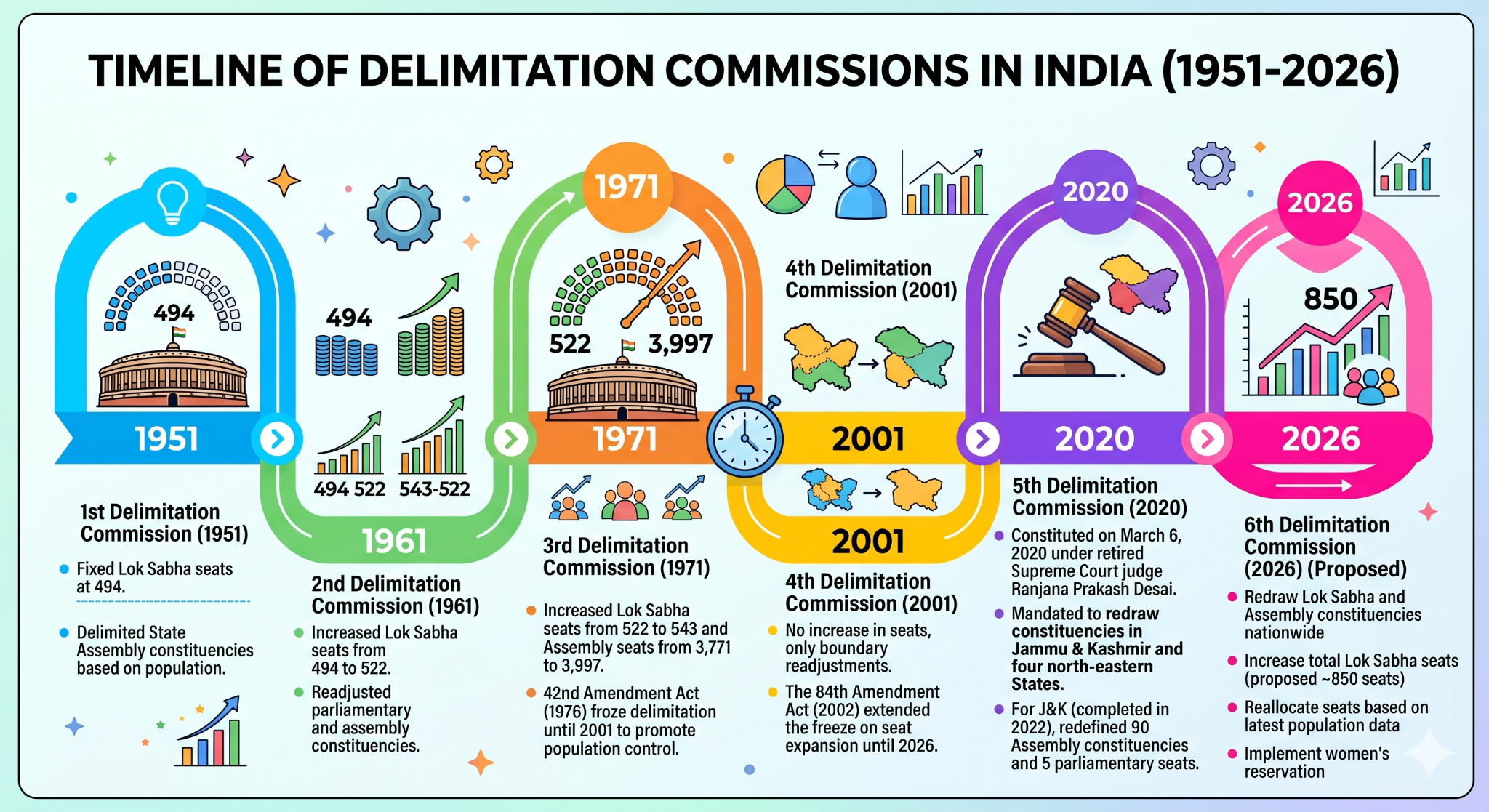
- However, the number of Lok Sabha seats has been frozen since the 1971 Census (population: 54.79 crore) and will remain so till 2026, as per a constitutional amendment.
- As of 2025, the population has risen to an estimated 141 crore, highlighting a need for seat readjustment to reflect demographic realities.
History of the Delimitation Exercise in India
- The delimitation of parliamentary constituencies in India has been linked to population growth.
- From 1951 to 1971, the number of Lok Sabha seats increased in response to population growth. The population per Lok Sabha seat rose from 3 lakh in 1951 to 10.1 lakh in 1971, when the number of seats reached 543.
- However, in 1976, the number of seats was frozen based on the 1971 Census to encourage population control measures.
- This freeze was extended until 2026, and with that deadline approaching, the need for revisiting seat allocation has sparked concerns, especially among southern states that have successfully controlled population growth.
Delimitation Commission: Composition and Powers
- Delimitation Commission is a temporary body set up by the Government of India whenever delimitation is required.
- Delimitation Commission’s orders are laid before the Lok Sabha and the legislative assemblies concerned, but they cannot affect any modifications in the orders. (UPSC Prelims 2012).
| Aspect | Details |
| Appointment | The delimitation commission is appointed by the President of India and works in collaboration with the Election Commission of India |
| Members |
|
Powers and Functions
- Redraws constituency boundaries based on the latest Census data.
- Allocates seats fairly among states and constituencies.
- Consult political parties and stakeholders before finalizing boundaries.
- Decisions cannot be challenged in court (Article 329).
Significance of the Delimitation Exercise
- Proportional representation: The delimitation process ensures that each segment of the population is represented fairly. The Delimitation Commission redraws constituencies based on the latest Census data so that each seat represents an equal number of people.
- Prevents political imbalance: Without delimitation, some areas may have more MPs per voter, leading to under-representation
- Reservation for SCs and STs: The exercise also designates constituencies to be reserved for Scheduled Castes (SCs) and Scheduled Tribes (STs) in regions with significant populations from these communities, ensuring their political inclusion.
- Neutral and independent process: Although established through legislation, the Delimitation Commission functions autonomously, free from political influence. Its decisions are final and cannot be challenged in Parliament or courts, safeguarding its impartiality.
- “One Vote, One Value”: The process reinforces the democratic ideal of equal weight for every vote by ensuring uniformity in population distribution across constituencies.
Do We Need Increased Parliament Strength? (Arguments Against)
- No Proven Link Between More MPs and Better Governance: Past experience shows that increasing the number of MPs does not lead to better law-making or debates.
- Legislative effectiveness depends more on the quality, not quantity, of representatives.
- High Financial and Administrative Costs:
- More MPs = more housing, staff, transport, allowances, and administrative infrastructure.
- This leads to a huge cost to the exchequer with little or no value addition.
- Bloated Executive: As per Article 75(1A), 15% of Lok Sabha can be Ministers.
- More MPs could push cabinet size up to 90–100, leading to patronage politics, not inefficient governance.
- Risk of North-South Divide: Fresh delimitation using population data will reduce southern states’ representation due to their success in population control.
- Northern states will gain seats, creating regional imbalance and political resentment.
- Constitutional Provisions Need Rethinking: Articles 81 & 82 need amending to cap Lok Sabha’s strength permanently at 550.
- The principle of population proportionality is no longer workable due to unequal demographic trends.
Key Concerns with Delimitation
Redrawing the Political Map
The new delimitation framework removes the earlier freeze based on the 1971 Census and mandates seat allocation according to population proportions. Under Article 81(2)(a), representation must reflect population share rather than maintaining historical balance.
Regional Redistribution of Power
The most significant gains are concentrated in northern States such as Uttar Pradesh, Bihar, and Rajasthan.
- Collectively, the Hindi heartland’s share in the Lok Sabha is projected to rise from 38.1% to 43.1%.
Decline of Southern and smaller states
- Southern States’ share falls from 24.3% to 20.7%
- North-Eastern States decline from 4.4% to 3.8%
- Eastern States also see a marginal reduction
Demography vs Development
A key issue emerging from the delimitation exercise is the tension between population size and developmental performance.
- States such as Kerala and Tamil Nadu, which invested heavily in health, education, and family planning, now face a reduction in their parliamentary share. Meanwhile, States with higher fertility rates, such as Bihar and Uttar Pradesh, stand to gain.
Expansion of the Lok Sabha
Increasing the Lok Sabha’s size to 850 seats has wide-ranging implications:
- Larger States gain a disproportionate number of additional seats
- National policymaking may become more influenced by a few populous regions
- While the expansion improves representation numerically, it also risks concentrating political influence geographically.
Impact on Federal Balance
The proposal alters the balance between the two Houses of Parliament:
- The Lok Sabha will become significantly larger, while the Rajya Sabha remains unchanged
- In joint sittings, the Lok Sabha’s numerical dominance increases from 2.2 times to about 3.3 times that of the Rajya Sabha.
Flexibility in Delimitation Decisions
The proposed constitutional amendment gives Parliament the authority to:
- Decide the timing of delimitation
- Choose which Census data to use
- Since these decisions require only a simple majority, the ruling government gains significant influence over the delimitation process. This raises concerns about the potential politicisation of representation.
Link with Women’s Reservation
The delimitation exercise is closely tied to implementing 33% reservation for women in the Lok Sabha under the Nari Shakti Vandan Adhiniyam, 2023.
- While this marks a progressive step toward gender inclusion, it also means that the regional redistribution of seats and gender representation will occur simultaneously, compounding political shifts.
Impact on Parliamentary Functioning
A larger Lok Sabha presents operational challenges:
- Reduced opportunities for individual MPs to participate in debates and lower chances of being selected for questions or discussions due to limited sitting days (fewer than 70 annually)
Expansion of the Executive
The size of the Council of Ministers is capped at 15% of the Lok Sabha and with 850 seats, the Council could expand significantly, leading to a larger executive.
Delimitation and Concerns of Southern States: Possible Solutions
- Southern States fear a power imbalance due to fresh delimitation, which may reduce their political influence.
- Suggested solution: Redistribute Rajya Sabha seats equally among the five geographic zones:
- Northern, Central, Eastern, Western, and Southern zones.
North-South Population Contrast
- Northern States like Uttar Pradesh and Bihar saw abnormally high population growth due to ineffective family planning:
- Uttar Pradesh: 8.38 crore (1971) → 24.1 crore (2025)
- Bihar: 4.21 crore (1971) → 13.1 crore (2025)
- Southern States like Kerala and Tamil Nadu successfully implemented population control, showing lower growth:
- Kerala: 2.14 crore (1971) → 3.6 crore (2025) → only 68% increase
Issues Highlighted by Southern States
- Southern leaders fear losing political representation if seat readjustment is done purely on a population basis.
- A strict population-based formula would reward States with high population growth (due to policy failure), giving them disproportionate power.
- For example:
- Uttar Pradesh could jump from 80 to 240 seats
- Kerala would rise modestly from 20 to 36, despite successful governance.
Ideal Solution Suggested
- Use Kerala’s 68% population growth as a benchmark for all States.
- Increase Lok Sabha seats by 68% uniformly across all States to maintain balance and fairness.
- Uttar Pradesh: 80 → 134 seats
- Kerala: 20 → 34 seats
- Tamil Nadu: 39 → 66 seats
- This approach raises the total Lok Sabha strength to 912, maintaining federal equity and not penalizing States with successful population control.
- Though it deviates from Article 81(2)(a) (equal population-to-seat ratio), the principle of equity and federal fairness takes precedence.
Status of Zonal Councils
Most Zonal Councils have not met since 2023.
- Exception:
- Western Zonal Council met in February 2025.
- Southern Zonal Council last met in 2022 (planned meeting in January 2025 in Chennai).
Role of Zonal Councils
- Initially meant for resolving inter-state disputes.
- They now handle broader governance issues (e.g., Aadhaar, good governance).
- Suggestion:
- Free zonal councils from the Home Ministry.
- Strengthen coordination with the Inter-State Council (dormant since 2016).
Major Risks from Delimitation
- Political Imbalance: Power shift toward large northern States → Weakens influence of more developed States.
- Communal Division: Religious-based electoral boundaries → Deepens social divisions.
- Eg., Jammu and Assam delimitations show bias towards creating smaller population constituencies to benefit majoritarian communities.
| Lessons from Recent Delimitation Exercises |
Jammu and Kashmir Delimitation (2022)
Assam Delimitation (2023)
|
Solutions for Balanced Delimitation
- Expanding Lok Sabha Strength: Given India’s growing population, capping representation at 543 seats is outdated.
- If past trends are followed, the total seats should increase to 753 by 2026, ensuring fairer representation.
- Balancing Representation via Population Density: Instead of absolute population, using population density (people per sq. km) can ensure a fair distribution of seats.
- This method is already used in the Northeast, where states with smaller populations have higher representation.
- Demographic Performance-Based Allocation: Just like the 15th Finance Commission, delimitation should reward states with better population control by ensuring they do not lose political representation.
- Weighted Representation Formula: A hybrid approach considering population size, density, demographic progress, and governance indicators can help balance regional disparities.
- Reforming Financial Devolution: Fiscal transfers should not solely depend on population size.
- States that have managed their population growth well should receive incentives instead of being penalized.
- Addressing the Per-Capita Hangover: Moving beyond per-capita measures and incorporating regional needs, economic performance, and demographic attributes will ensure equitable financial and political distribution.
Conclusion
- A purely population-based delimitation will create a political power imbalance.
- Communal demarcation of constituencies will lead to polarization and threaten the foundation of India’s pluralistic federalism.
- Both trends constitute a serious challenge to the unity and integrity of India.

 Anti-Defection Law: Origin, Provisions o...
 Central Information Commission (CIC): Ap...
 Panchayati Raj Institutions (PRI): Evolu...











 WhatsApp





