
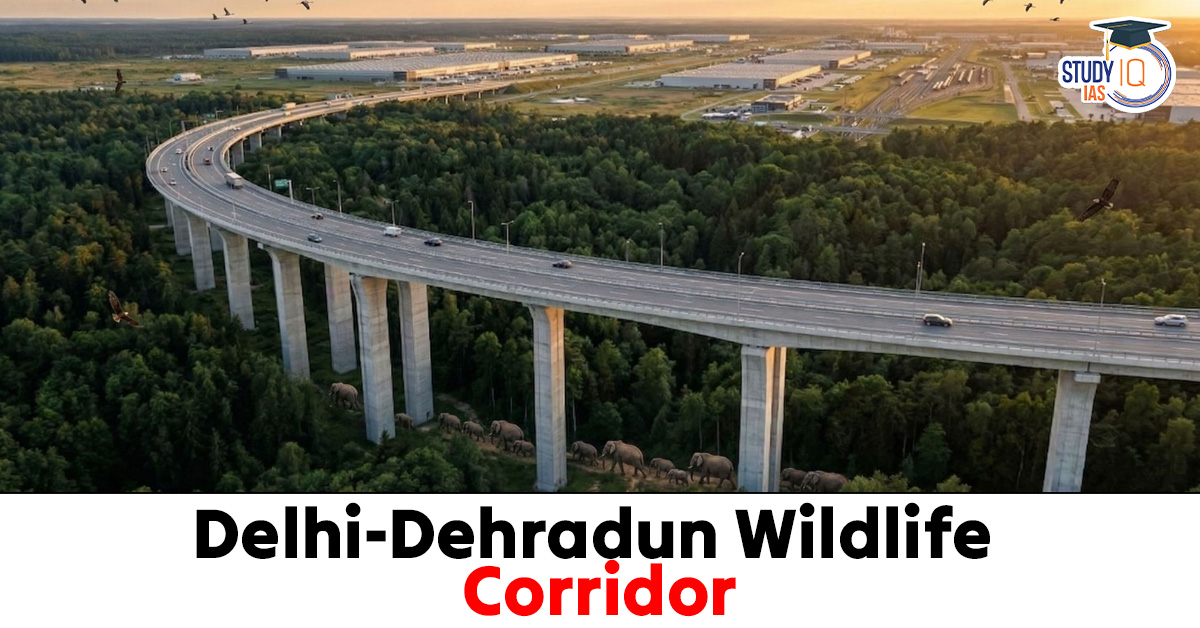
Context: Ahead of the official inauguration on April 14, 2026, a joint study by the Wildlife Institute of India (WII) and the National Highway Authority of India (NHAI) has validated the functional success of Asia’s largest wildlife elevated corridor.
About Delhi-Dehradun Wildlife Corridor
- The specialized animal underpass stretch is 12 km long, part of an 18-km eco-sensitive section between Ganeshpur (UP) and Asharodi (Uttarakhand).
- The road is elevated to a height of 7 meters, specifically designed to allow the passage of Asian Elephants, which require significant overhead clearance to feel secure.
- Target Species: The corridor protects a high-biodiversity zone home to Tigers, Asian Elephants, Leopards, Greater Hornbills, and King Cobras.
- Regional Connectivity: This corridor is vital for the Shivalik-Elephant Reserve, maintaining the migratory path between the Yamuna and Ganges rivers for the north-western elephant population.
Significance
- Recent Wildlife Institute of India (WII) studies recorded over 40,000 images of wild animals using the corridor in just 40 days, including 60 documented instances of elephants
- The most frequent users identified include the Golden Jackal, Nilgai, Sambar, Spotted Deer (Chital), and smaller mammals like the Indian Hare.
- The project utilised Audiomoth acoustic recorders to study how traffic noise affects movement; results showed that while jackals are noise-tolerant, elephants and deer prefer quieter segments.
| Eco-bridges |
|

 India Withdraws COP33 UNFCCC Host Bid: R...
 India’s Nuclear Submarine Programmes A...
 Tropical Cyclone Vaianu: Formation, Feat...













 WhatsApp





