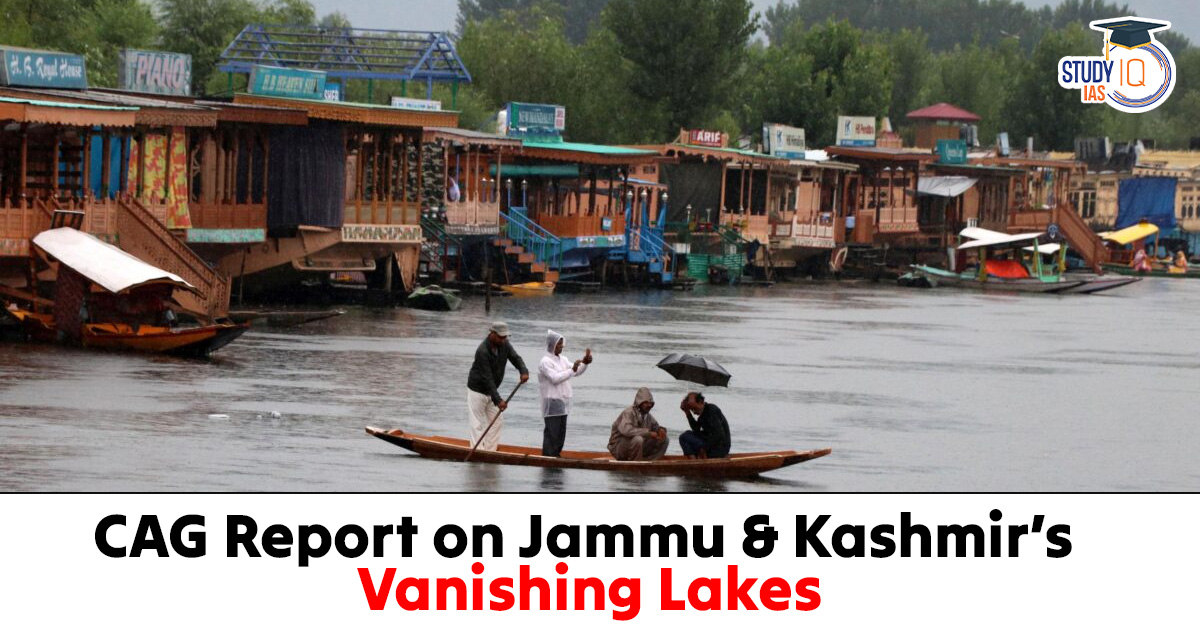
Context: A recent report by the Comptroller and Auditor General (CAG) of India has sounded a dire alarm regarding the aquatic health of Jammu & Kashmir.
Key Highlights of CAG Report on Jammu & Kashmir’s Vanishing Lakes
- 315 lakes (45% of the total) have vanished entirely, erasing 1,537 hectares of water area.
- 203 lakes (29%) saw their water area decrease by over 1,314 hectares.
- In 63 lakes, the water area has shrivelled by 50% or more, placing them at immediate risk of total extinction.
- Major threats: Encroachment, construction works, and shifting land-use patterns have led to increased aquatic vegetation and a loss of open water area.
- Impact: Lakes act as “flood balancing reservoirs.” Their shrinkage was cited as a major cause for the catastrophic September 2014 floods in J&K
Lakes in Jammu and Kashmir
| Lakes |
Details |
| Wular Lake (Bandipora) |
- One of the largest freshwater lakes in Asia; formed by tectonic activity.
- Status: A designated Ramsar Site (Wetland of International Importance).
- Hydro-Role: Fed by the Jhelum River, it acts as a massive natural sponge for the valley.
- Livelihood: Provides nearly 60% of J&K’s fish yield and is a major source of water chestnuts (singhara).
|
| Dal Lake (Srinagar) |
- Known as the “Jewel in the Crown of Kashmir“, a post-glacial lake with four main basins-Gagribal, Lokut Dal, Bod Dal, and Nagin.
- Unique Feature: Famous for its Houseboats, Shikaras, and the Floating Vegetable Market.
- Floating Gardens: Local communities create “Radh“ (floating gardens) made of matted weeds and silt to grow vegetables.
- Crisis: Faces severe eutrophication (nutrient overload) due to urban sewage and runoff.
|
| Hokersar (Srinagar outskirts) |
- A world-renowned bird sanctuary and a critical wetland.
- A vital stop on the Central Asian Flyway for millions of birds from Siberia and Europe.
- Hydrology: Serves as the primary flood-absorption basin for the Doodhganga flood channel.
- Threat: Rapidly shrinking due to siltation and encroachment by paddy fields.
|
| Manasbal Lake (Ganderbal) |
- Considered the deepest lake in Kashmir (approx. 13 meters).
- Famous for the abundance of Lotus (Nelumbo nucifera) flowers during July and August.
- Heritage: Located near the remains of Darogabagh, a 17th-century Mughal fort (Jharokha Bagh).
- A major haunt for aquatic birds; it has no major outgoing stream, being primarily fed by internal springs.
|
| Surinsar Lake (Jammu) |
- Often grouped with Mansar, it is located about 24 km from Jammu city.
- Legend says it was created by an arrow shot by the Mahabharata warrior Arjun.
- Environment: Surrounded by thick mangrove and pine forests; it is a protected sanctuary for freshwater turtles.
- Status: Together with Mansar, it is a designated Ramsar Site (Surinsar-Mansar Lakes).
|
| Mansar Lake (Jammu) |
- A high-altitude freshwater lake situated on the forest-covered hills of the Shivalik range.
- Religious Site: A major pilgrimage spot; a temple dedicated to Sheshnag (the Lord of Serpents) is located on its eastern bank.
- Biodiversity: Home to seasonal migratory birds, various fish species, and the spotted pond turtle.
|
Sharing is caring!


 Annual Survey of Incorporated Services S...
 US-Israel-Iran Conflict 2026: Causes, Ir...
 Delhi's Air Pollution Mitigation Action ...













 WhatsApp





