Table of Contents
Context
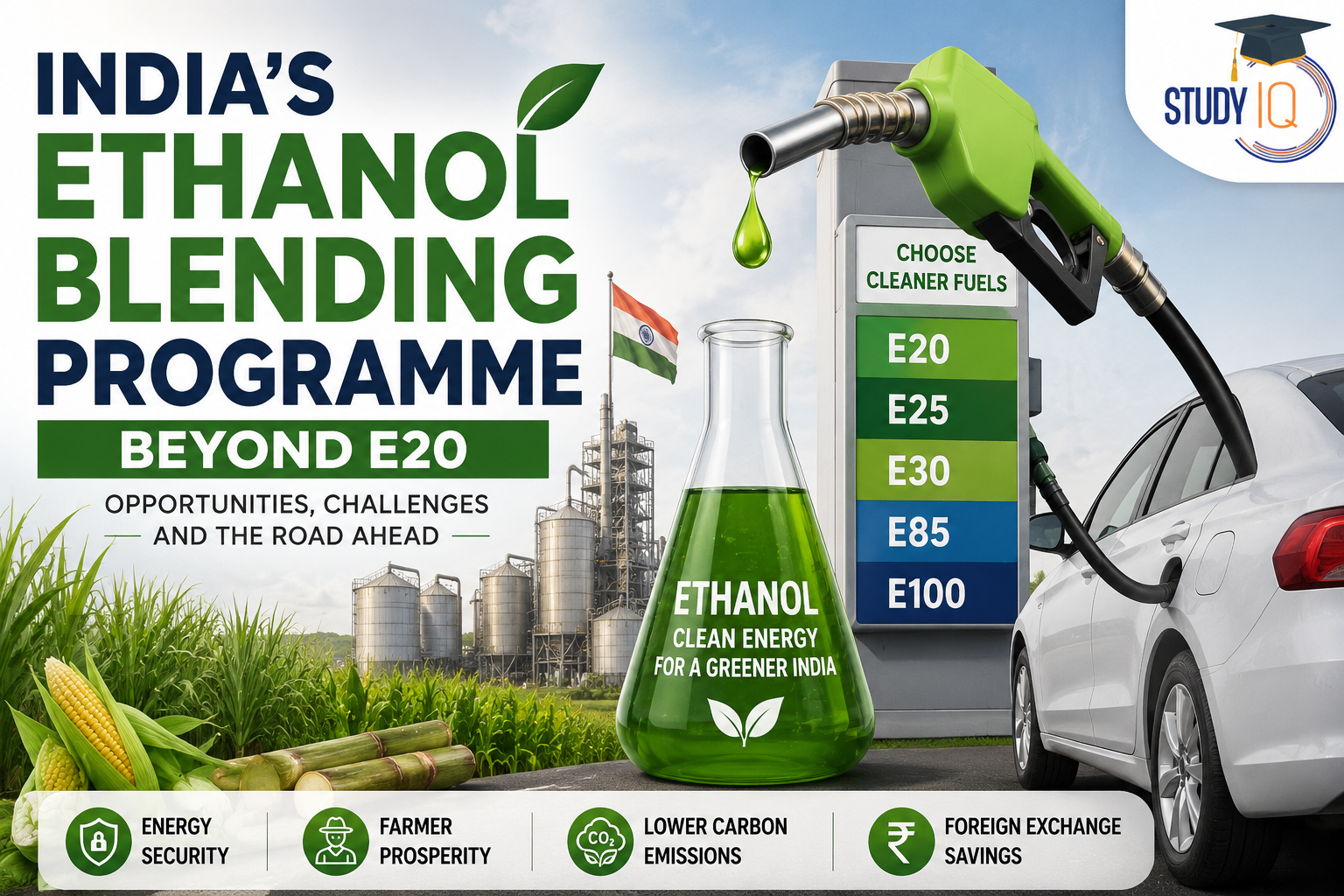
The government has exempted higher ethanol blends (E22-E30) from central excise duty and proposed recognising E85 and E100 fuels under Central Motor Vehicles Rules. The push beyond E20 reflects both energy security imperatives and the political economy of agricultural surpluses.
Why Is India Pushing for Higher Ethanol Blending?
- Reducing Import Dependence: India’s heavy reliance on imported crude makes the economy vulnerable to geopolitical price shocks and supply disruptions.
- g., The West Asia conflict drove up crude prices sharply.
- Earning Foreign Exchange Savings: Every percentage point rise in ethanol blending displaces crude imports, directly conserving foreign exchange.
- g., India’s crude import bill routinely exceeds $100 billion annually.
- Supporting the Agricultural Sector: Higher ethanol demand creates a stable institutional buyer for farmers growing sugarcane, maize, and other feedstocks,
- g., The agricultural lobby from Maharashtra and Uttar Pradesh has actively pushed for higher ethanol blending targets, as sugarcane farmers face significant overcapacity.
- Reducing Carbon Emissions: Ethanol is a cleaner-burning fuel than petrol.
- E85 and E100 fuels alongside flex fuel vehicles can significantly reduce lifecycle carbon emissions from the transport sector.
- Promoting Energy Security and Strategic Autonomy: Domestic ethanol production from agricultural feedstocks insulates India from OPEC pricing decisions
- g., Brazil’s ethanol programme, today provides 30%+ of its transport fuel from domestic sources.
What Are the Key Challenges in Transitioning Beyond E20?
- Engine Damage to Non-Compliant Vehicles: Ethanol has a higher water content than petrol, making it corrosive to engine parts not designed for high ethanol blends.
- Drop in Fuel Efficiency: Higher ethanol blends reduce mileage because ethanol has lower energy density than petrol, with consumers already reporting a 5-12% drop after the E10 to E20 transition.
- Cold Start Problems: Ethanol burns at a higher temperature than petrol, making vehicles running on high ethanol blends difficult to start in cold weather conditions.
- This is a practical concern for consumers in states like Himachal Pradesh, and Uttarakhand.
- Rapid Recertification Burden on Automakers: Moving from E20 to E25 requires fresh engine calibration, corrosion resistance testing, and homologation for all existing vehicle models.
- Infrastructure Constraints of Oil Marketing Companies (OMCs): OMCs like Indian Oil and Bharat Petroleum can offer only two ethanol blend grades at any given time. This limits consumer choice and complicates the rollout of multiple blends simultaneously.
- Flex Fuel Vehicle (FFV) Ecosystem Is Underdeveloped: The transition to E85 and E100 fuels requires a mature FFV market.
What Is the Way Forward?
- Phased Transition with Adequate Lead Time: The government must give consumers, automakers, and fuel retailers sufficient notice before raising the base blend to E25.
- g., Brazil rolled out its ethanol programme in phases, ensuring existing vehicle owners were not disadvantaged at any stage.
- Introduce Consumer Choice at the Pump: Petrol stations should offer multiple blend grades so consumers can choose based on their vehicle type and efficiency preference.
- g., Brazilian law mandates a choice between blended petrol and E100 at nearly every pump, giving consumers pricing and efficiency control.
- Price Incentives for Higher Ethanol Blends: Higher ethanol blends must be priced lower than standard petrol to drive consumer adoption.
- g., Brazil’s flex fuel cars became a mass-market success because government price support made ethanol blends consistently cheaper than petrol at the pump.
- Government Mandates for Automakers: Clear regulatory mandates must require automakers to produce FFV-compatible vehicles with defined timelines, rather than leaving the transition to market forces alone.
- g., Brazil combined automaker mandates with public awareness campaigns to achieve near-universal FFV adoption.
- Diversify Ethanol Feedstock Beyond Sugarcane: Over-dependence on sugarcane makes the programme vulnerable. Maize, rice straw, and cellulosic ethanol must be scaled up.
- Commission Independent Vehicle Compatibility Studies: The government must fund multi-year studies on the real impact of higher blends on non-compliant engines
Latest UPSC Updates
| Resource | Link |
|---|---|
| UPSC Prelims Result 2026 | Check Here |
| UPSC Exam Calendar 2027 | View Calendar |
| UPSC Question Paper 2026 | Download PDF |
| UPSC Prelims Answer Key 2026 | Check Answer Key |
| UPSC Cut Off 2026 | View Cut Off |
| UPSC Syllabus 2026 | Read Syllabus |
| Daily Current Affairs 2026 | Read Updates |
| StudyIQ UPSC IAS Foundation 2027 (English) | Join Course |
| StudyIQ UPSC IAS Foundation 2027 (Hindi) | Join Course |
| StudyIQ UPSC IAS Foundation 2027 (Bilingual) | Join Course |
 Species in News: Cheetah | Project Cheet...
 Quantum Computing: RRI Scientists Demons...
 Artificial Intelligence in Warfare: How ...














 WhatsApp