
Table of Contents
Context
AI-driven robotics is transforming India’s healthcare, agriculture, and manufacturing sectors by enhancing precision, efficiency, and sustainability, in line with the goals of ‘AI for All’ and the Digital India initiative.
|
Understanding AI in Robotics |
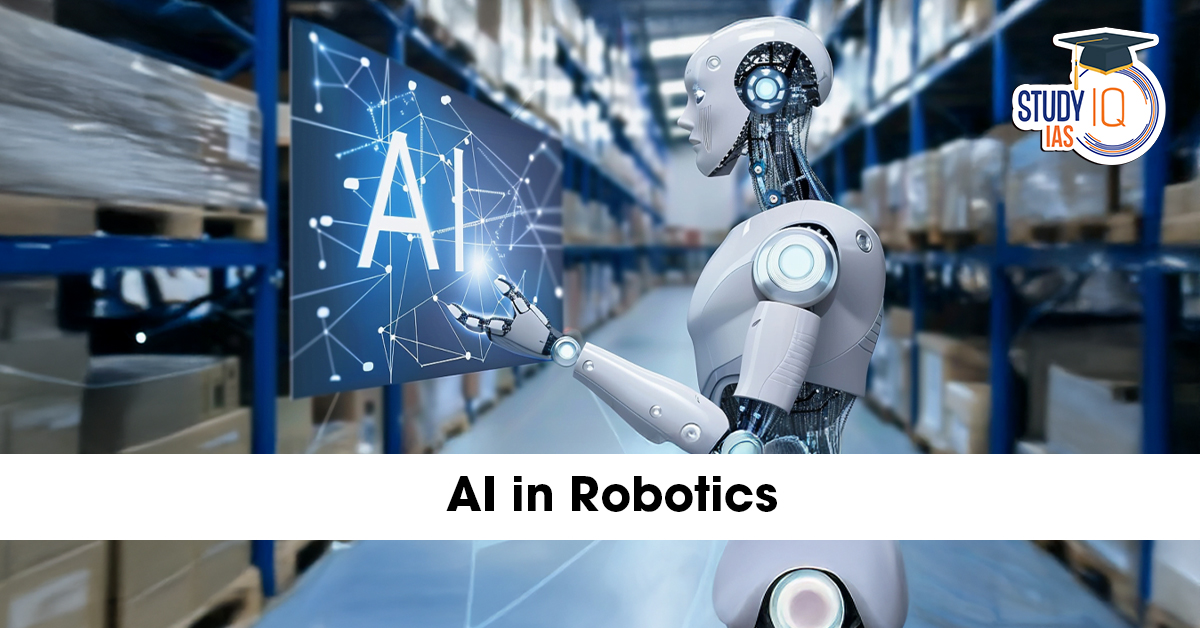
In essence, AI transforms robots from mechanical tools to adaptive partners, capable of independent problem-solving and contextual decision-making. |
Applications of AI in Robotics Across Sectors
Healthcare
- Robotic-assisted surgeries use AI for micro-level accuracy, reducing errors and recovery time.
- Eg: AAI-integrated surgical robots in Indian hospitals like Apollo and AIIMS are being used for knee and spine surgeries, achieving better outcomes and quicker recovery.
- Rehabilitation robots assist patients with mobility impairments through adaptive learning systems.
- Hospital service robots handle disinfection, medicine delivery, and logistics, freeing up medical staff for patient care.
- Elderly and Home Care Automation: Service robots equipped with speech recognition and emotion detection assist the elderly in daily tasks, medication reminders, and remote health monitoring.
Agriculture
- Soil health and crop monitoring: AI-powered drones and robots analyse soil nutrients, pest attacks, and water needs in real time.
- Automated harvesting and planting: Robots ensure uniform planting and efficient harvesting, reducing manual labour.
- Predictive analytics: Machine learning models forecast weather and disease outbreaks to prevent crop loss.
- Eg: Under Telangana’s “Saagu Baagu” initiative, over 7,000 farmers adopted AI-driven agritech tools for soil health monitoring and disease prediction – nearly doubling productivity and income.
Logistics and E-Commerce: Intelligent Supply Chains
- Autonomous warehouse robots optimise space use, track inventory, and manage fulfilment operations with human-like agility.
- Self-driving delivery bots and AI route optimisers are reducing turnaround times and costs in last-mile delivery.
- Demand prediction algorithms help e-commerce companies like Amazon, Flipkart, and Reliance Retail manage inventory more efficiently.
- Eg: Indian robotics startups like GreyOrange and Addverb deploy AI-based warehouse systems for major retailers, enhancing operational speed and accuracy.
Manufacturing
- In manufacturing, AI-enabled robots – or “cobots” (collaborative robots) – are redefining productivity:
- They learn from human movements to adjust speed and precision dynamically, ensuring worker safety.
- Predictive AI models identify machine failures before they occur, minimising downtime.
- Automated quality checks with computer vision ensure product consistency.
Emerging AI Trends in Robotics
| Trend | Description |
| Conversational GenAI & Voice-First Interfaces | Robots interact with humans using natural language, simplifying complex commands. |
| Domain-Specific LLMs | Tailored AI models for specific sectors (healthcare, defence, aviation) to improve precision and context. |
| AI Agents & AI Assistants | Intelligent robots act as decision-support partners, capable of handling dynamic challenges. |
| Composite AI & Lifecycle-Based Systems | Integration of multiple AI models ensures continuous learning and system evolution. |
| Sovereign & Secure AI | Focus on data privacy and localised AI ecosystems. India’s initiatives like BharatGPT and IndiCASA dataset (IIT Madras) ensure AI sovereignty and contextual relevance. |
| Affordable AI | Open-source and no-code AI platforms are making robotics accessible to MSMEs and startups, democratising innovation. |
Significance for India
- Economic Transformation: AI-driven automation could add $500 billion to India’s GDP by 2030.
- Labour Productivity: Intelligent machines can enhance efficiency in agriculture and manufacturing without displacing workers.
- Make in India and Atmanirbhar Bharat: Indigenous robotics and AI innovation can reduce import dependence in automation hardware.
- National Security: AI-powered drones and autonomous systems can support defence, border management, and disaster relief.
- Social Impact: Robotic healthcare and agri-solutions improve accessibility and inclusion in rural areas.
Challenges and Concerns
- Job Displacement Anxiety: Misconceptions about AI replacing humans may hinder adoption.
- Data Security: Vulnerability to breaches and misuse of personal or industrial data.
- Ethical Dilemmas: Need for accountability when autonomous systems make critical decisions.
- Skill Gaps: Lack of AI–robotics expertise across developing economies.
- Cost Barriers: High initial investment for small businesses in developing countries.
- Energy Footprint: Increased computing demands could offset environmental gains if powered by non-renewable energy.
Way Forward
- Human-Centric Design: Keep human welfare at the core of AI-robotics development.
- AI Literacy & Workforce Training: Integrate robotics education into mainstream curricula.
- Ethical AI Frameworks: Establish global norms for transparency, fairness, and accountability.
- Green Robotics: Use renewable energy and eco-design principles to reduce carbon footprint.
- Public–Private Collaboration: Encourage partnerships for scaling innovation responsibly.
- Policy Reform: Enact adaptive regulations that balance innovation with social safety nets.
 UPSC Forest Service Mains Exam Date 2026...
 HPSC HCS Mains Result 2026 Declared: Che...
 UPPSC PCS Mains Result 2026 Declared: Do...














 WhatsApp





