Table of Contents
Context
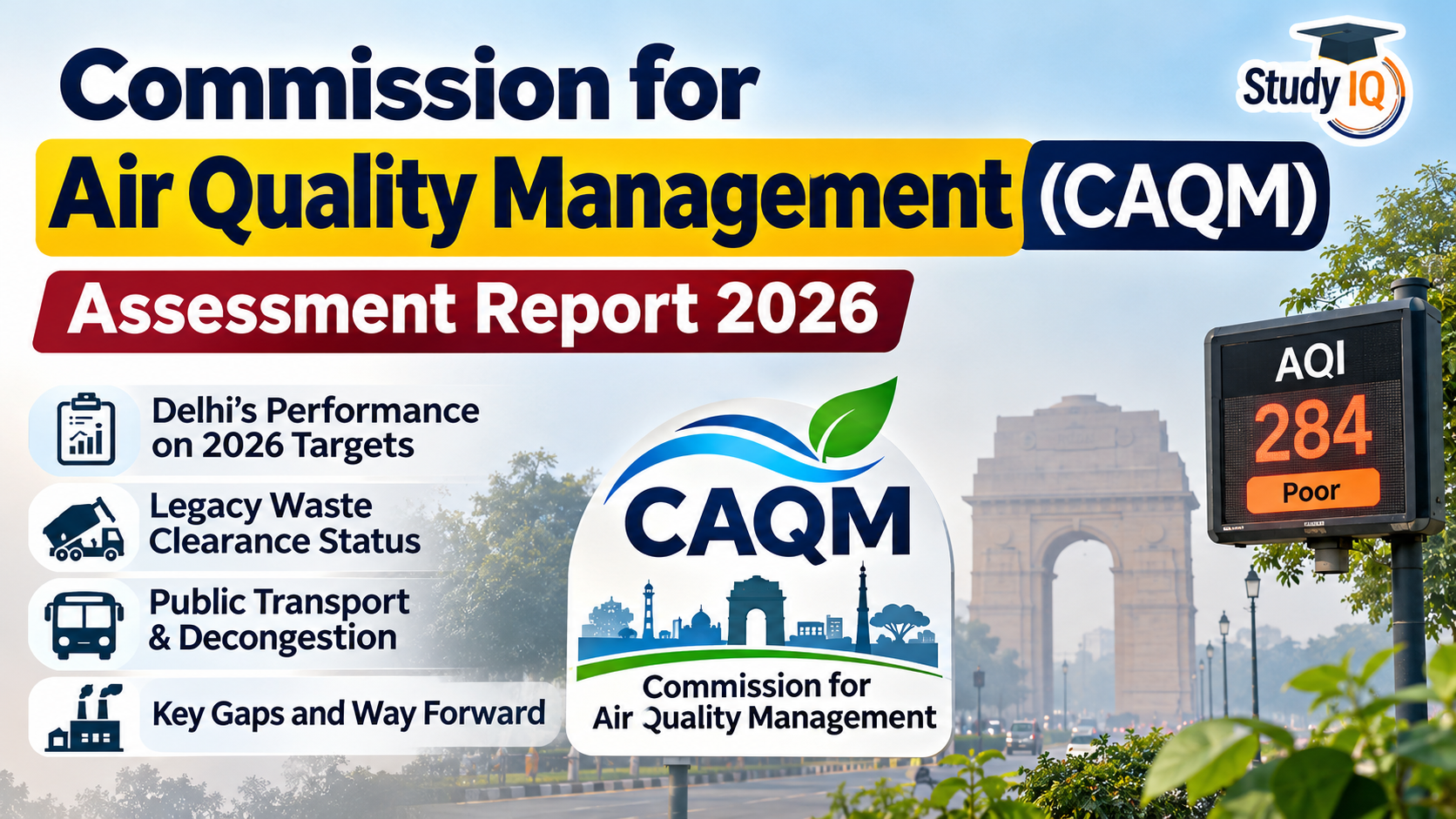
On 22 November 2026, the CAQM released an assessment report on how Delhi and the neighbouring States performed against their 2026 action plan targets (data up to 31 October). Delhi scored well on monitoring and inspections but lagged on landfill clearance.
Findings of the Report: Delhi
- Targets Met: 100% on continuous ambient air quality monitoring stations (19 installed) and EV charging stations. Industrial inspections stood at 1,609 against a target of 979.
- Legacy Waste: Only 67% (Okhla), 57% (Bhalswa) and 42% (Ghazipur) of targets were cleared. Ghazipur cleared 16.53 lakh tonnes against 39.12 lakh tonnes. About 52.7 lakh tonnes remain across the three sites.
- Public Transport: 1,703 buses were added against 2,395 (about 71%).
- Parking and Decongestion: 15 of 266 targeted parking lots were built. All 34 short-term decongestion points were done, but only 8 of 28 long-term points.
- Other Gaps: Green crematoria and mechanical road sweepers lagged behind target.
About CAQM
- Nature: A statutory body constituted under the Commission for Air Quality Management in National Capital Region and Adjoining Areas Act, 2021 (Act No. 29 of 2021).
- Origin: It was first set up through an ordinance in October 2020, which lapsed in March 2021. It was re-promulgated in April 2021 and replaced by the Act, which received Presidential assent on 12 August 2021.
- Objective: Better coordination, research, identification and resolution of problems related to air quality in the NCR and adjoining areas.
- Coverage: The NCR and adjoining areas of Haryana, Punjab, Rajasthan and Uttar Pradesh.
- Administration: The nodal ministry is the Ministry of Environment, Forest and Climate Change (MoEFCC).
- Predecessor: It replaced the Supreme Court-mandated Environment Pollution (Prevention and Control) Authority (EPCA), set up in 1998.
Key Features
- Composition: A full-time Chairperson, a Member-Secretary, ex officio members from the Centre and the five States, and technical and NGO members.
- Overriding Powers: Within its jurisdiction, the Commission is the sole authority on air quality management. Its directions prevail over those of State Pollution Control Boards on these matters.
- Powers (Section 12): It can restrict polluting activities, set emission and discharge parameters, inspect premises, and issue binding directions.
- GRAP: It enforces the Graded Response Action Plan (GRAP), a stage-wise set of curbs linked to AQI levels.

 Bagheera AT1 Anti-Tank Guided Missile: F...
 India’s Indo-Pacific Strategy 2026: Ke...
 First SCO Civilisational Dialogue Forum ...














 WhatsApp