Table of Contents
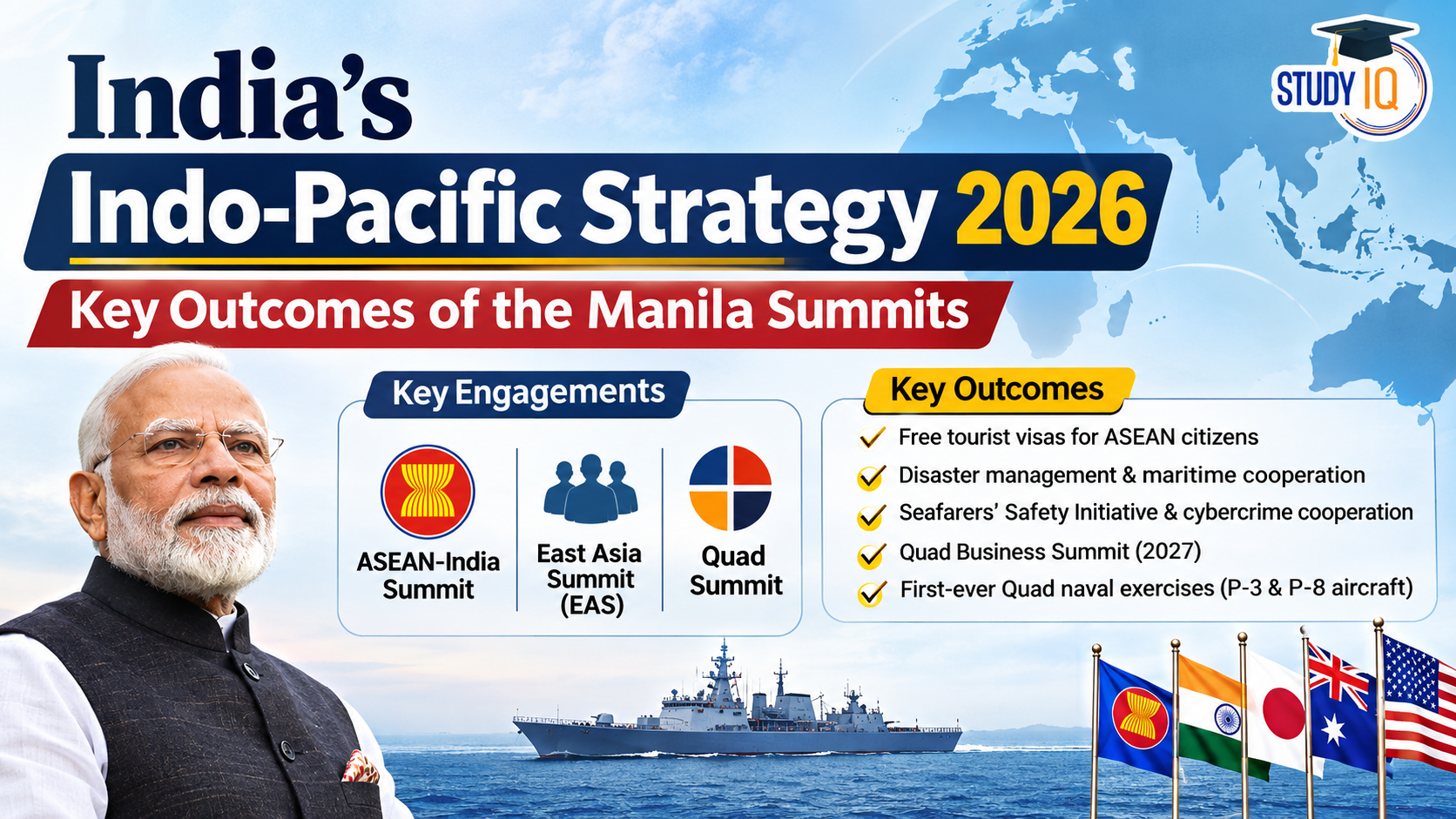
India’s Indo-Pacific strategy received fresh momentum through Prime Minister Narendra Modi’s participation in three major diplomatic engagements in Manila in November 2026: the ASEAN-India Summit, the East Asia Summit (EAS), and the Quad Summit. These meetings highlighted India’s commitment to strengthening regional partnerships, promoting maritime security and maintaining a stable, rules-based Indo-Pacific order.
At a time of intensifying US-China competition, geopolitical uncertainty and disruptions in global supply chains, India’s engagement with ASEAN, Japan, Australia and other regional partners reflects its broader strategy of diversifying diplomatic and economic relationships.
Why Were the Manila Summits Important?
The Manila meetings were significant for India’s Act East Policy and its expanding Indo-Pacific engagement.
-
They reinforced India’s diplomatic engagement with Southeast Asian countries.
-
They provided an opportunity to strengthen India-Philippines relations.
-
They reaffirmed the relevance of the Quad amid uncertainty over US commitment to the Indo-Pacific.
-
They highlighted cooperation on maritime security, disaster management and cybercrime.
-
They supported India’s objective of building trusted partnerships beyond traditional strategic alliances.
The summits also demonstrated India’s preference for a multipolar regional order based on cooperation, stability and respect for international law.
1. Key Outcomes of the ASEAN-India Summit
The ASEAN-India Summit focused on strengthening economic, diplomatic and maritime cooperation between India and Southeast Asian countries.
Major outcomes included:
-
Visa Facilitation: Announcement of free tourist visas for ASEAN citizens visiting India.
-
Disaster Management: New cooperation initiatives to strengthen disaster preparedness and emergency response.
-
Maritime Cooperation: Greater coordination to promote maritime security and regional stability.
-
Economic Engagement: Continued emphasis on strengthening trade and investment relations.
Unresolved Issue: ASEAN-India Trade in Goods Agreement
The revision of the ASEAN-India Trade in Goods Agreement (AITIGA) remained an important unresolved issue. Updating the agreement is necessary to address trade imbalances, improve market access and strengthen economic integration.
ASEAN accounts for approximately 11% of India’s global trade, with bilateral trade reaching around $128 billion in 2025–26, according to the supplied report.
2. East Asia Summit: Focus on Maritime and Cybersecurity Cooperation
The East Asia Summit brought together major regional and global powers, including India, China, Japan, the United States, Russia and South Korea.
Two important initiatives emerged:
-
Seafarers’ Safety Initiative: Promoting joint training, emergency response and improved safety for seafarers.
-
Cybercrime Prevention: Strengthening cooperation to address cyber threats and emerging digital security challenges.
These initiatives reflect the growing importance of non-traditional security threats in the Indo-Pacific region.
3. Quad Summit 2026: Strengthening Indo-Pacific Cooperation
The Quad, comprising India, the United States, Japan and Australia, remains an important platform for promoting a free, open and inclusive Indo-Pacific.
Despite concerns about the grouping’s future, the Manila Summit announced several initiatives for 2027.
Key Announcements:
-
Quad Business Summit: A proposed platform to strengthen business partnerships, trade and investment among member countries.
-
Quad Naval Exercises: Plans for the first-ever Quad naval exercises involving P-3 and P-8 maritime patrol aircraft.
-
Maritime Security: Greater cooperation to improve maritime domain awareness and regional security.
However, uncertainty remains regarding India’s opportunity to host the next Quad Summit and the future leadership schedule.
4. India’s Indo-Pacific Strategy: The Bigger Strategic Picture
India’s engagement in Manila reflects a broader effort to diversify its strategic partnerships and reduce excessive dependence on individual global powers.
The strategy is driven by several developments:
-
US-China Competition: Increasing strategic competition between Washington and Beijing is reshaping regional security and economic relationships.
-
Supply Chain Diversification: India is seeking reliable supply chains for critical minerals, semiconductors, artificial intelligence and advanced technologies.
-
Economic Security: Cooperation with ASEAN, Japan and South Korea can help India access new markets and strengthen economic resilience.
-
Maritime Security: Protecting sea lanes and ensuring freedom of navigation remain essential for India’s trade and energy security.
-
Global South Cooperation: India aims to strengthen its role as a bridge between developed economies and developing countries.
5. Other Important Diplomatic Developments
India is simultaneously expanding its engagement with other strategic partners.
-
India-EU Relations: Progress towards an India-European Union Free Trade Agreement to strengthen economic cooperation.
-
India-Japan Relations: The India-Japan 2+2 Dialogue highlighted defence cooperation and trusted strategic partnerships.
-
India-Canada Relations: Efforts to strengthen bilateral engagement.
-
Multilateral Cooperation: India’s participation in initiatives such as the Partnership for Multilateralism (P4M) reflects its commitment to strengthening global governance.
6. Significance of the Manila Summits for India
The Manila engagements are significant in several ways:
-
Strengthen India’s Act East Policy and regional connectivity.
-
Enhance India’s strategic presence in the Indo-Pacific.
-
Promote cooperation on maritime security and disaster management.
-
Improve economic resilience through diversified supply chains.
-
Strengthen India’s position as an important regional power.
-
Support a multipolar international order based on cooperation and international law.
Challenges Ahead
Despite diplomatic progress, India faces several challenges:
-
Persistent trade imbalances with ASEAN countries.
-
China’s growing economic and military influence in the Indo-Pacific.
-
Uncertainty surrounding the long-term commitment of major powers to regional institutions.
-
Limited progress in trade agreement negotiations.
-
The need to balance strategic autonomy with deeper defence and economic partnerships.
Conclusion
The Manila Summits 2026 represent an important step in the evolution of India’s Indo-Pacific strategy. Through ASEAN, the Quad and the East Asia Summit, India is strengthening regional cooperation while protecting its strategic autonomy.
India’s emphasis on trusted partnerships, supply chain resilience, maritime security and economic diversification reflects a pragmatic response to an increasingly fragmented global order.
Going forward, India’s ability to convert diplomatic engagements into concrete economic, technological and security outcomes will determine the effectiveness of its Indo-Pacific vision.
 First SCO Civilisational Dialogue Forum ...
 Core Sector Growth October 2026: ICI Rec...
 World Fisheries Day 2026: Theme, History...









 WhatsApp