Table of Contents
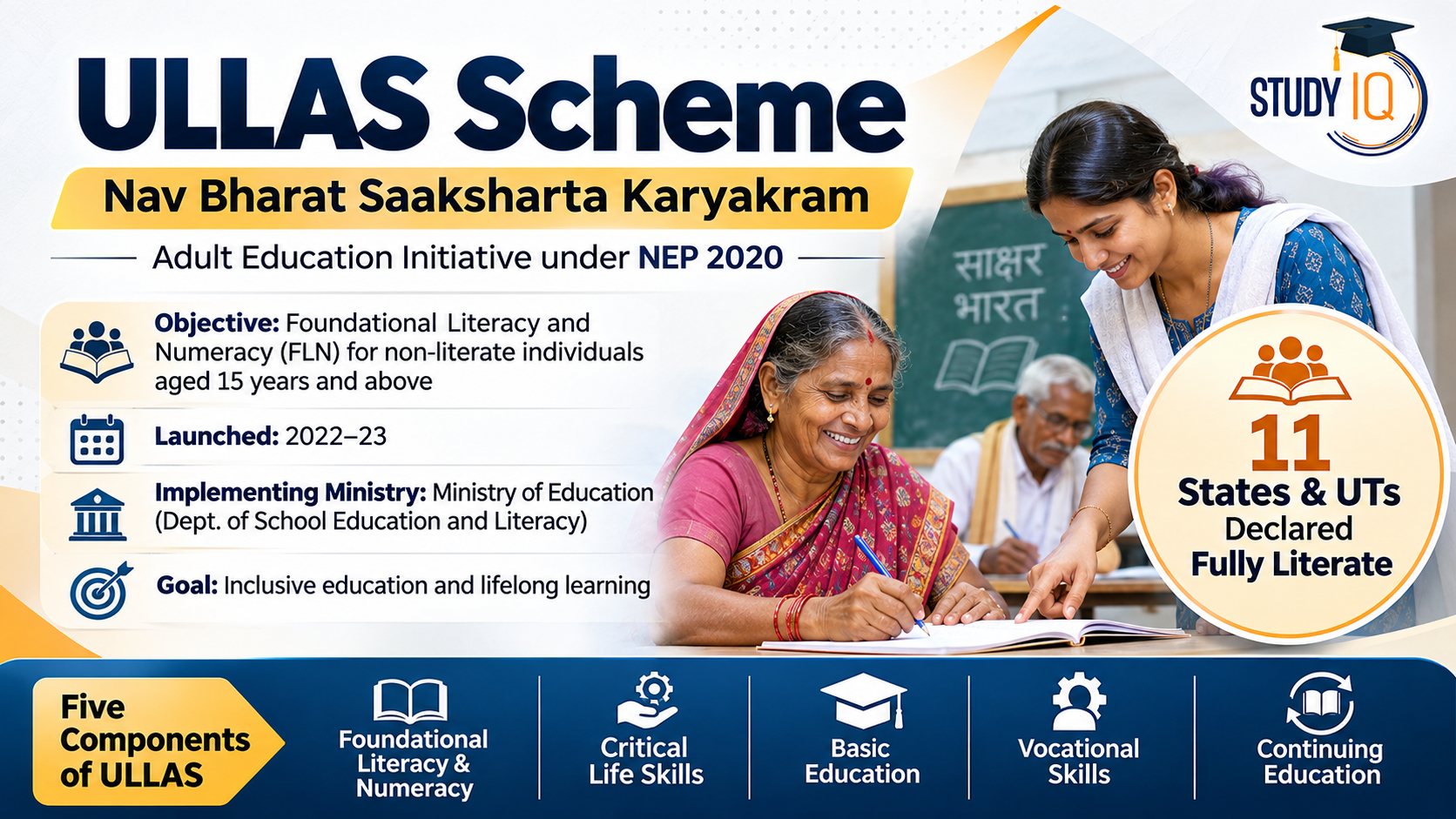
India has made significant progress in adult education through the ULLAS – Nav Bharat Saaksharta Karyakram, a centrally sponsored initiative aligned with the National Education Policy (NEP) 2020. Recently, 11 States and Union Territories have declared themselves fully literate under the programme.
The initiative focuses on providing foundational literacy and numeracy (FLN) to non-literate individuals aged 15 years and above. It aims to promote inclusive education, lifelong learning, digital empowerment and socio-economic development.
The achievement represents an important step towards India’s goal of building an educated, empowered and knowledge-based society.
What is the ULLAS Scheme?
ULLAS stands for Understanding of Lifelong Learning for All in Society. It is a centrally sponsored adult education programme implemented by the Department of School Education and Literacy under the Ministry of Education.
-
Implementation: Since 2022–23.
-
Target group: Non-literate individuals aged 15 years and above.
-
Policy alignment: National Education Policy (NEP) 2020.
-
Primary objective: Achieving foundational literacy and numeracy among adults.
-
Approach: Digital learning, community participation and volunteer-based teaching.
The scheme provides opportunities to individuals who could not access formal education during their childhood or earlier years.
11 States and UTs Declared Fully Literate
As many as 11 States and Union Territories have declared themselves fully literate under the ULLAS programme.
List of 11 Fully Literate States and Union Territories
The following States and UTs have declared themselves fully literate:
| Category | States/Union Territories |
|---|---|
| States (6) | Mizoram, Goa, Tripura, Himachal Pradesh, Sikkim and Uttarakhand |
| Union Territories (5) | Ladakh, Chandigarh, Andaman and Nicobar Islands, Jammu and Kashmir and Lakshadweep |
Criteria for Full Literacy
-
A literacy rate of 95% or above is considered equivalent to achieving full literacy.
-
Achieving 100% literacy is practically difficult due to factors such as advanced age and certain intellectual disabilities.
-
Therefore, the 95% benchmark provides a practical standard for recognising full literacy.
Key Achievements and Progress of the ULLAS Scheme
The ULLAS programme has recorded significant progress in adult education across India.
Important achievements include:
-
90.96 lakh learners: More than 90.96 lakh learners aged 15 years and above have appeared for the Foundational Literacy and Numeracy Assessment Test (FLNAT) during 2026–27 so far.
-
4.15 crore learners: Approximately 4.15 crore learners across 34 States and UTs have appeared for the assessment.
-
Success rate: The overall success rate is above 90%.
-
Digital registrations: More than 4.17 crore learners have registered on the ULLAS mobile application.
-
Volunteer participation: Around 52.89 lakh volunteer teachers have registered on the platform.
State-wise Performance
Madhya Pradesh has emerged as the leading State in terms of the number of adult learners assessed under the programme.
| State | Adult learners assessed |
|---|---|
| Madhya Pradesh | 20.43 lakh |
| Rajasthan | 18.18 lakh |
| Odisha | 12 lakh |
| Telangana | 7.54 lakh |
| Maharashtra | 6.5 lakh |
| Tamil Nadu | 4.5 lakh |
These figures highlight the growing participation of adult learners in India’s literacy initiatives.
Five Components of the ULLAS Scheme
In accordance with NEP 2020, ULLAS follows a comprehensive approach to adult education through five major components.
1. Foundational Literacy and Numeracy (FLN)
This component focuses on developing basic reading, writing and mathematical abilities among non-literate adults.
2. Critical Life Skills
It promotes essential life skills, including:
-
Financial literacy
-
Digital literacy
-
Legal awareness
-
Health and family welfare
-
Awareness of essential public services
3. Basic Education
It provides opportunities for adults to acquire equivalent foundational and elementary education and continue their educational journey.
4. Vocational Skills
This component focuses on developing employable skills and improving livelihood opportunities through skill development.
5. Continuing Education
It encourages lifelong learning by providing opportunities for further education, knowledge acquisition and skill development.
Implementation Mechanism of ULLAS
The ULLAS programme adopts a hybrid implementation model combining digital platforms with community-based learning.
Its major implementation features include:
-
Target beneficiaries: Non-literate individuals aged 15 years and above.
-
Volunteerism: Educated citizens are encouraged to work as volunteer teachers.
-
Institutional support: Schools and Higher Education Institutions (HEIs) serve as platforms for adult learning.
-
Digital learning: The ULLAS mobile application facilitates registration and learning activities.
-
Community participation: Local communities are encouraged to support adult education and improve learning outcomes.
What is FLNAT?
The Foundational Literacy and Numeracy Assessment Test (FLNAT) is an assessment mechanism under the ULLAS programme.
It evaluates the basic reading, writing and numeracy abilities of adult learners.
Key features include:
-
It assesses foundational literacy and numeracy skills.
-
It is conducted twice a year.
-
Successful candidates receive literacy certificates from the National Institute of Open Schooling (NIOS).
-
It helps measure the learning outcomes of adult education initiatives.
Impact of ULLAS on India’s Literacy Rate
According to the government figures cited in the programme update, India’s literacy rate has increased to 81.1%, compared with 74.04% recorded in Census 2011.
The ULLAS programme contributes to this progress by addressing educational exclusion among adults who missed formal schooling opportunities.
Its broader impact includes:
-
Improving basic educational capabilities among adults.
-
Promoting financial and digital inclusion.
-
Increasing women’s participation in economic activities.
-
Improving awareness of government schemes and constitutional rights.
-
Encouraging intergenerational learning within families.
-
Supporting India’s human capital development.
Significance of the ULLAS Scheme
1. Inclusive Development
The programme provides educational opportunities to disadvantaged and marginalised sections of society, helping reduce educational inequalities.
2. Women Empowerment
Adult literacy enables women to become more financially independent, understand their legal rights and participate in family and community decision-making.
3. Economic Empowerment
Foundational and vocational skills can improve employability, productivity and livelihood opportunities.
4. Digital Inclusion
Digital literacy helps individuals access online government services, digital banking and other technology-based facilities.
5. Democratic Participation
Literacy improves awareness of constitutional rights, government policies and civic responsibilities, thereby strengthening democratic participation.
6. Human Capital Development
An educated population contributes to economic productivity, social development and the creation of a knowledge-based economy.
Challenges Associated with the ULLAS Scheme
Despite its achievements, the programme faces several implementation challenges.
-
Learning Retention: Ensuring that adult learners retain and apply their newly acquired literacy skills in everyday life.
-
Digital Divide: Limited access to smartphones, internet connectivity and digital learning resources in rural and remote areas.
-
Regional Disparities: Differences in educational infrastructure and literacy levels across States and regions.
-
Social Barriers: Gender inequality, poverty, social exclusion and household responsibilities can restrict adult participation.
-
Quality Assessment: Ensuring that literacy certification reflects practical reading, writing and numeracy abilities rather than merely examination performance.
-
Limited Participation: Motivating working adults and elderly individuals to participate in structured learning programmes.
Way Forward
To achieve sustainable adult literacy, India needs to move beyond literacy certification towards continuous learning and practical skill development.
The following measures can strengthen the programme:
-
Strengthen Community Learning Centres: Establish accessible learning centres in rural and underserved areas.
-
Promote Regional Languages: Provide locally relevant educational materials in regional and tribal languages.
-
Increase Women’s Participation: Encourage flexible learning schedules and community support for women learners.
-
Improve Digital Accessibility: Expand access to affordable smartphones, internet connectivity and digital learning platforms.
-
Strengthen Monitoring: Develop effective monitoring mechanisms to evaluate learning retention and practical application.
-
Integrate Vocational Education: Connect adult literacy with employment-oriented skill development and livelihood programmes.
Conclusion
The declaration of 11 States and Union Territories as fully literate under the ULLAS programme marks an important milestone in India’s adult education journey.
However, literacy should not be viewed merely as the ability to read and write. It must also enable individuals to participate meaningfully in economic, social and democratic life.
By combining foundational literacy, digital inclusion, vocational skills and lifelong learning, ULLAS can contribute significantly towards achieving the vision of Viksit Bharat 2047.
For India, the next challenge is to ensure that literacy becomes a continuous process of empowerment rather than a one-time educational achievement.
Frequently Asked Questions (FAQs)
Q1. What is the full form of ULLAS?
ULLAS stands for Understanding of Lifelong Learning for All in Society.
Q2. When was the ULLAS scheme implemented?
The programme has been implemented since 2022–23 by the Department of School Education and Literacy under the Ministry of Education.
Q3. Who are the target beneficiaries of the ULLAS scheme?
Non-literate individuals aged 15 years and above.
Q4. How many States and UTs have declared themselves fully literate under ULLAS?
Eleven States and Union Territories have declared themselves fully literate.
Q5. What is the benchmark for achieving full literacy?
A literacy rate of 95% or above is considered equivalent to achieving full literacy.
Q6. What is FLNAT?
FLNAT stands for Foundational Literacy and Numeracy Assessment Test. It assesses the reading, writing and numeracy skills of adult learners.
Q7. Which institution provides literacy certificates to successful FLNAT candidates?
The National Institute of Open Schooling (NIOS).
Q8. How many components does the ULLAS scheme have?
The scheme has five components: Foundational Literacy and Numeracy, Critical Life Skills, Basic Education, Vocational Skills and Continuing Education.
Q9. Which State leads in the number of adult learners assessed under ULLAS?
Madhya Pradesh, with 20.43 lakh adult learners assessed.
Q10. Which policy is ULLAS aligned with?
The National Education Policy (NEP) 2020.
 Awa Tribe: Location, Language, Lifestyle...
 Air Pollution in India: Causes, Challeng...
 Cyclone Akvan 2026: Landfall Forecast, W...




 WhatsApp