Table of Contents
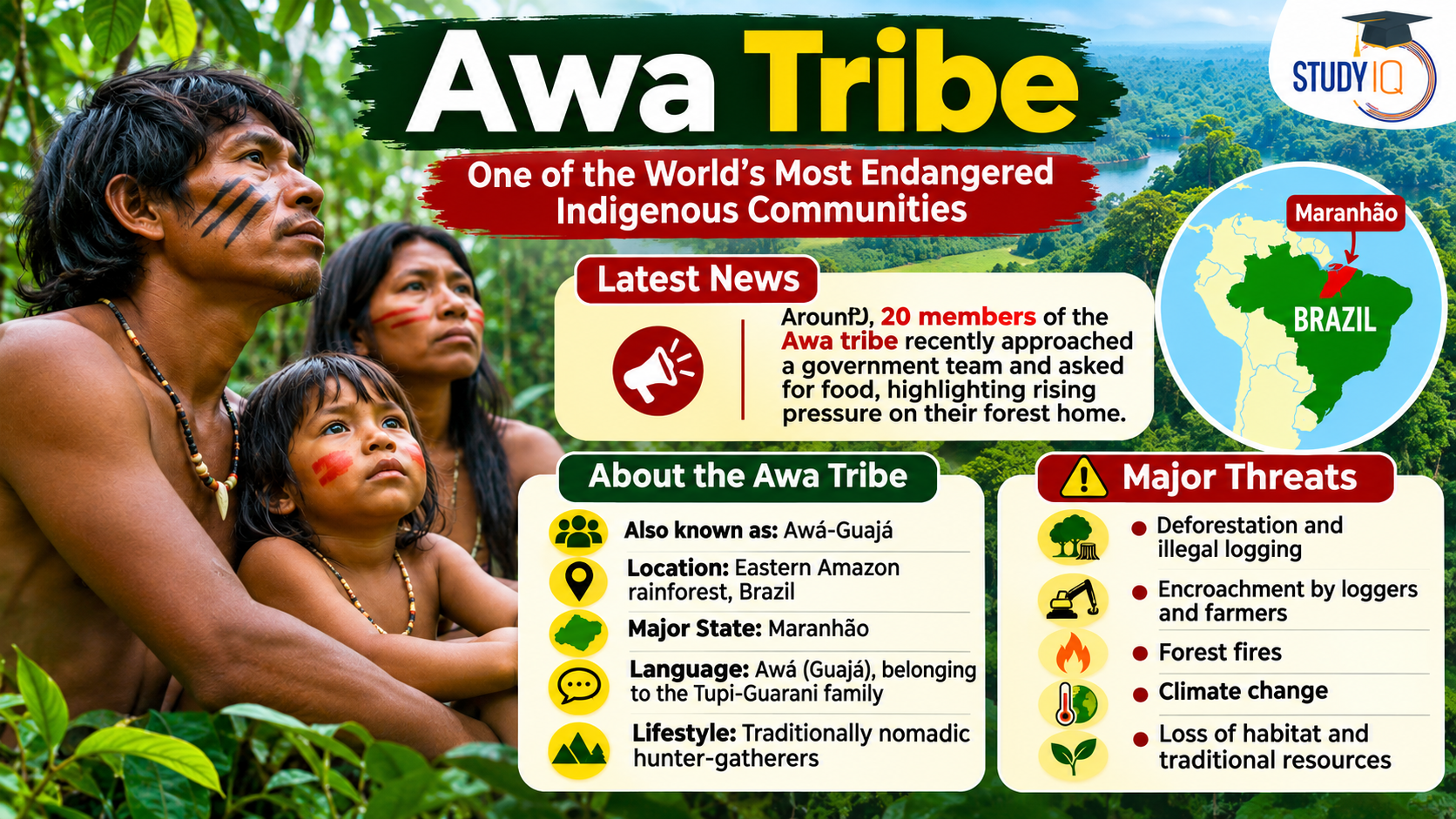
The Awa Tribe, also known as the Awá-Guajá, has recently attracted attention after around 20 members of this isolated Indigenous community approached a government team seeking food. The incident has raised concerns about the growing threats to their forest habitat and traditional way of life.
The Awá are among the world’s most endangered Indigenous communities. Their survival is closely connected to the Amazon rainforest, which provides them with food, medicines, shelter and cultural identity.
About the Awa Tribe
The Awá, also known as the Awá-Guajá, are an Indigenous community living in the eastern Amazon rainforest of Brazil, primarily in the state of Maranhão.
They are particularly known for their traditional nomadic hunter-gatherer lifestyle and their efforts to maintain isolation from mainstream society.
Key facts about the Awá Tribe:
-
Location: Eastern Amazon rainforest, Brazil.
-
Major State: Maranhão.
-
Alternative Name: Awá-Guajá.
-
Language: Awá (Guajá), belonging to the Tupi-Guarani language family.
-
Traditional Lifestyle: Nomadic hunter-gatherers.
-
Cultural Connection: Deep spiritual and cultural relationship with forests.
-
Status: One of the world’s most endangered Indigenous communities.
Geographical Distribution of the Awa Tribe
The Awá primarily inhabit the eastern Amazon region of the Brazilian state of Maranhão.
Their traditional territories are surrounded by tropical rainforest ecosystems that support rich biodiversity. The forests provide essential resources, including wild fruits, animals, medicinal plants and materials for shelter.
The Amazon rainforest plays a central role in maintaining their traditional lifestyle and cultural practices.
Lifestyle and Cultural Practices
The Awá have traditionally followed a nomadic hunter-gatherer lifestyle. They move through forest areas in search of food and other natural resources.
Their livelihood depends heavily on hunting, gathering fruits, collecting honey and using forest plants.
Some important characteristics of their lifestyle include:
-
Hunter-Gatherer Economy: They traditionally depend on hunting wild animals and gathering forest products.
-
Forest Dependency: The rainforest provides food, medicines and other essential resources.
-
Nomadic Lifestyle: Traditionally, they move between different forest locations.
-
Cultural Identity: Their customs, knowledge systems and spiritual beliefs are closely connected to nature.
-
Voluntary Isolation: Some Awá groups have chosen to maintain limited or no contact with outsiders.
Historical Background of the Awa Tribe
The Awá have faced external threats and territorial invasions for generations.
European settlers began encroaching on their traditional lands during the 19th century. This expansion forced many members of the community to move deeper into forests to escape outside threats.
During the mid-1980s, Brazil provided designated settlement areas for the community.
However, their territories continued to face pressure from illegal logging, agricultural expansion and other forms of encroachment. These threats, along with deadly encounters with outsiders, have contributed to the severe decline of the community.
Why Is the Awa Tribe Under Threat?
The survival of the Awá is increasingly threatened by environmental destruction and human activities.
1. Deforestation
Illegal logging and forest clearance are destroying their natural habitat. This reduces the availability of food and other essential forest resources.
2. Illegal Encroachment
Loggers, farmers and other illegal intruders have entered traditional Indigenous territories, threatening the community’s safety and access to forest resources.
3. Forest Fires
Fires destroy vegetation, wildlife habitats and important forest resources, directly affecting the traditional livelihood of the Awá.
4. Climate Change
Changing rainfall patterns, rising temperatures and ecosystem disturbances are adding pressure to the Amazon rainforest.
5. Threats to Cultural Identity
The destruction of traditional territories also threatens Indigenous languages, cultural practices, traditional knowledge and community identity.
Why Is the Recent Incident Important?
The recent interaction involving around 20 members of the Awá community seeking food from government officials highlights the growing vulnerability of isolated Indigenous populations.
Their decision to approach outsiders may indicate increasing pressure on their traditional food sources and forest habitat.
However, contact with isolated Indigenous communities must be handled carefully because exposure to outside diseases can pose serious health risks.
Their right to decide whether and when to establish contact with outsiders must be respected.
Protection of Indigenous Communities
Protecting the Awá requires coordinated efforts to safeguard their ancestral territories and cultural identity.
Important measures include:
-
Preventing illegal logging and land encroachment.
-
Strengthening protection of Indigenous territories.
-
Controlling forest fires and deforestation.
-
Respecting the principle of voluntary isolation.
-
Providing emergency assistance without forcing permanent contact.
-
Supporting Indigenous rights and traditional knowledge systems.
Brazil’s Indigenous protection institutions, including FUNAI (National Foundation of Indigenous Peoples), play an important role in protecting Indigenous communities and their territories.
UPSC Relevance
GS Paper 1: Distribution of major natural resources and geographical features.
GS Paper 2: Vulnerable sections of society, Indigenous rights and government interventions.
GS Paper 3: Environmental conservation, biodiversity, deforestation and climate change.
Important Prelims Facts:
| Topic | Information |
|---|---|
| Awá Tribe | Awá-Guajá |
| Country | Brazil |
| Region | Amazon Rainforest |
| State | Maranhão |
| Language | Awá (Tupi-Guarani family) |
| Traditional Occupation | Hunter-gatherers |
| Major Threats | Deforestation, fires and illegal encroachment |
| Protection Agency | FUNAI |

 Air Pollution in India: Causes, Challeng...
 Cyclone Akvan 2026: Landfall Forecast, W...
 Quad Summit 2026: Outcomes, India's Role...














 WhatsApp