Table of Contents
Context: Why Is Quad Summit 2026 in the News?
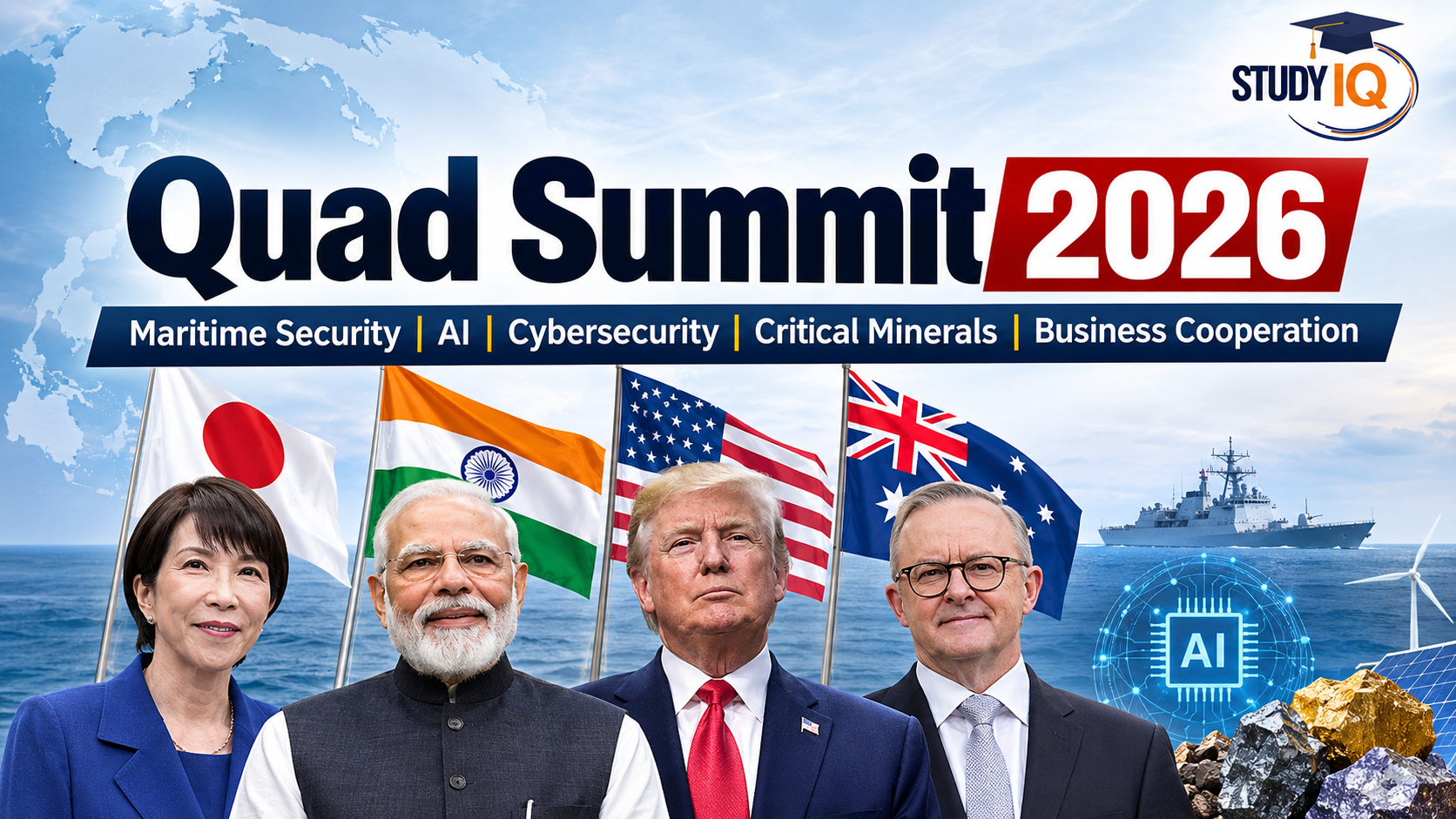
The leaders of India, the United States, Japan, and Australia announced a series of new initiatives at the Quad Leaders’ Summit held in Manila, Philippines, on November 17, 2026, on the sidelines of the East Asia Summit.
The summit brought together Indian Prime Minister Narendra Modi, US President Donald Trump, Japanese Prime Minister Sanae Takaichi and Australian Prime Minister Anthony Albanese. It was the first Quad Leaders’ Meeting since 2024.
The summit focused on strengthening maritime security, artificial intelligence (AI), cybersecurity, critical mineral supply chains, counterterrorism and economic cooperation.
The announcement of the inaugural Quad Business Leaders’ Forum in Mumbai in early 2027 and the proposed joint maritime surveillance exercise in 2027 reflects the grouping’s transition towards more operational and outcome-oriented cooperation.
The meeting also carried geopolitical significance as it took place ahead of US President Donald Trump’s scheduled trilateral engagement with Chinese President Xi Jinping and Russian President Vladimir Putin.
Understanding the Quadrilateral Security Dialogue (QUAD)
The Quadrilateral Security Dialogue (Quad) is a strategic partnership involving four major Indo-Pacific countries:
- India
- United States
- Japan
- Australia
The grouping seeks to promote a free, open, inclusive, stable, and prosperous Indo-Pacific based on international law, sovereignty, territorial integrity and freedom of navigation.
Evolution of the Quad
The development of the Quad can be understood through the following milestones:
- 2004: India, the United States, Japan and Australia coordinated humanitarian assistance following the Indian Ocean tsunami.
- 2007: Japanese Prime Minister Shinzo Abe proposed greater strategic cooperation among the four democracies, leading to the emergence of the Quad.
- 2017: The grouping was revived on the sidelines of the ASEAN Summit in Manila after remaining inactive for several years.
- 2021: The first-ever Quad Leaders’ Summit was held virtually, elevating the grouping to the leaders’ level.
- 2024: The leaders met in Wilmington, United States, to strengthen cooperation across multiple strategic and economic areas.
- 2026: The Manila Summit announced new initiatives covering maritime surveillance, AI, cybersecurity, critical minerals and business cooperation.
Nature and Objectives of the Quad
The Quad is not a formal military alliance and does not have a collective defence commitment similar to NATO.
Instead, it functions as a flexible strategic partnership based on cooperation in areas of shared interest.
Its major objectives include:
- Maintaining a free and open Indo-Pacific.
- Ensuring freedom of navigation and overflight.
- Strengthening maritime domain awareness.
- Promoting secure and diversified supply chains.
- Enhancing cooperation in critical and emerging technologies.
- Supporting disaster management and humanitarian assistance.
- Strengthening regional connectivity and economic resilience.
- Upholding international law and a rules-based international order.
Key Outcomes of the Quad Summit 2026
1. Indo-Pacific Maritime Surveillance Collaboration
Maritime security emerged as one of the most important areas of cooperation at the Manila Summit.
The four leaders announced the Indo-Pacific Maritime Surveillance Collaboration, an initiative aimed at strengthening maritime domain awareness and information sharing across the Indo-Pacific.
Under this initiative, patrol aircraft from the four countries are scheduled to participate in a maritime exercise in 2027.
The exercise is expected to involve P-8 and P-3C maritime patrol aircraft flying together for the first time in a Quad context.
The initiative will focus on:
- Improving maritime information sharing.
- Strengthening surveillance of strategic sea routes.
- Enhancing coordination among maritime security agencies.
- Monitoring suspicious maritime activities.
- Protecting safe and open maritime transit corridors.
The leaders also highlighted the importance of the annual Malabar Naval Exercise. Its 30th edition was recently conducted near Japan, involving anti-submarine and anti-surface warfare drills.
Strategic significance: The initiative reflects the growing importance of maritime security in the Indo-Pacific, particularly amid increasing naval competition and concerns regarding freedom of navigation.
For India, enhanced maritime surveillance cooperation can strengthen monitoring capabilities across the Indian Ocean Region (IOR), including strategically important sea lanes.
2. Quad Business Leaders’ Forum in Mumbai
The leaders announced the inaugural Quad Business Leaders’ Forum, scheduled to be held in Mumbai in early 2027.
The forum will bring together business leaders, government representatives and policy experts from all four countries.
Its major objectives include:
- Promoting private-sector cooperation.
- Facilitating commercial agreements and partnerships.
- Encouraging cross-border investments.
- Strengthening trade and economic connectivity.
- Promoting business opportunities across the Indo-Pacific.
The initiative recognises that regional stability cannot be sustained through security cooperation alone. Economic integration, investment and technological partnerships are equally important.
Significance for India: Hosting the inaugural forum in Mumbai will strengthen India’s position as an investment destination and create opportunities for Indian businesses to integrate into global supply chains.
3. Quad AI Accelerator and Cooperation in Super Intelligence
Artificial intelligence emerged as another major pillar of the summit.
The Quad announced a new AI Accelerator to coordinate and fund initiatives supporting trusted AI access, deployment and technical assistance across the Indo-Pacific.
During his remarks, President Donald Trump also referred to the initiative as a Super Intelligence (SI) accelerator and highlighted the importance of cooperation in advanced AI technologies.
The United States announced an investment of more than US$85 million to expand access to trusted AI ecosystems across the region.
The initiative aims to:
- Expand access to trusted AI technologies.
- Strengthen regional AI capabilities.
- Promote technical assistance and knowledge sharing.
- Encourage responsible deployment of emerging technologies.
- Support technological innovation and economic growth.
Strategic significance: AI is increasingly becoming a determinant of economic competitiveness, national security and technological sovereignty.
The Quad’s cooperation in this area reflects an effort to strengthen trusted technology ecosystems and reduce vulnerabilities arising from technological dependence.
For India, this creates opportunities to expand AI research, develop domestic technological capabilities and strengthen cooperation with advanced technology partners.
4. Enhanced Quad Cybersecurity Cooperation
The growing frequency and scale of cyber incidents across the Indo-Pacific have made cybersecurity an important component of regional security.
Recognising this challenge, the Quad leaders announced enhanced Quad Cybersecurity Cooperation.
The initiative aims to promote an open, secure and resilient cyberspace through greater coordination among member countries.
Key areas of cooperation include:
- Strengthening cyber threat information sharing.
- Improving the protection of critical digital infrastructure.
- Enhancing cybersecurity capabilities.
- Addressing emerging cyber threats.
- Promoting secure digital connectivity.
Significance for India: India’s expanding digital economy, digital payment infrastructure, telecommunications networks and public digital platforms require robust cybersecurity mechanisms.
Greater cooperation with Quad partners can help India strengthen its cyber resilience and improve its ability to respond to increasingly sophisticated cyber threats.
5. Critical Minerals and Supply Chain Resilience
Critical minerals and rare earth elements were central to the summit’s economic security discussions.
The leaders expressed concern over economic coercion, including arbitrary export restrictions, and emphasised the need to develop secure and diversified supply chains.
Critical minerals are essential for several strategic sectors, including:
- Electric vehicle batteries.
- Solar and wind energy technologies.
- Semiconductor manufacturing.
- Defence and aerospace equipment.
- Advanced electronics.
- Electric power storage systems.
Overreliance on a limited number of suppliers can create economic and strategic vulnerabilities, especially amid geopolitical tensions.
The Quad’s approach seeks to strengthen supply chain diversification and reduce dependence on individual foreign suppliers.
Significance for India: Reliable access to critical minerals is essential for India’s energy transition, electric mobility, electronics manufacturing and defence modernisation.
It also complements India’s broader objective of developing domestic manufacturing capabilities and reducing strategic import dependence.
6. Stronger Counterterrorism Cooperation
The Quad leaders unequivocally condemned terrorism and violent extremism in all their forms and manifestations, including cross-border terrorism.
They also committed to strengthening the grouping’s ongoing cooperation on counterterrorism.
This development is particularly significant for India, which has consistently highlighted the threat posed by cross-border terrorism.
The initiative reinforces the importance of international cooperation in addressing:
- Terrorist financing.
- Cross-border terrorist networks.
- Radicalisation and violent extremism.
- Terrorist use of emerging technologies.
- Transnational security threats.
However, translating diplomatic consensus into effective international counterterrorism cooperation remains an important challenge.
Strategic Significance of the Quad Summit 2026 for India
The Manila Summit offers India an opportunity to strengthen its strategic partnerships while advancing its economic, technological and security interests.
1. Strengthening India’s Maritime Security
India occupies a strategically important position in the Indian Ocean, through which a substantial share of global trade and energy shipments passes.
Enhanced maritime surveillance cooperation can help India:
- Improve maritime domain awareness.
- Monitor strategic sea lanes.
- Strengthen anti-submarine warfare capabilities.
- Improve coordination with regional partners.
- Protect its maritime interests and Exclusive Economic Zone.
The proposed joint patrol aircraft exercise can also improve operational coordination among the four countries.
2. Counterbalancing China’s Growing Influence
China’s expanding economic, technological and maritime influence has emerged as an important strategic consideration for the Quad.
Its growing naval presence, territorial disputes in the South China Sea and increasing influence across the Indo-Pacific have raised concerns among several regional countries.
The Quad provides India with a platform to coordinate with major regional powers on shared strategic concerns.
However, India must maintain a balanced approach and avoid allowing the grouping to become an exclusively anti-China military arrangement.
3. Reducing Dependence on Critical Mineral Imports
India’s ambitions in electric mobility, renewable energy, semiconductor manufacturing and advanced defence production depend on reliable access to critical minerals.
Cooperation with the United States, Japan and Australia can support:
- Diversification of mineral imports.
- Development of alternative supply chains.
- Investment in mineral processing technologies.
- Greater resilience in advanced manufacturing.
- Cooperation in recycling and resource efficiency.
This is particularly important for reducing strategic vulnerabilities in critical technology sectors.
4. Strengthening India’s AI and Digital Capabilities
The Quad AI initiative provides opportunities for India to strengthen its position in emerging technologies.
India can benefit through greater cooperation in AI research, computing infrastructure, technical knowledge and cybersecurity.
However, India must simultaneously invest in domestic research and development, semiconductor capabilities, skilled human resources and indigenous AI ecosystems.
The objective should be to use international cooperation to strengthen technological sovereignty rather than create new forms of dependence.
5. Expanding India’s Economic and Diplomatic Influence
The decision to host the first Quad Business Leaders’ Forum in Mumbai in 2027 highlights India’s growing economic importance within the grouping.
It can help attract investments, strengthen commercial partnerships, and promote India’s role in regional economic integration.
The initiative also complements India’s broader ambitions to become a major global manufacturing and investment destination.
6. Reinforcing India’s Position on Cross-Border Terrorism
The explicit condemnation of cross-border terrorism strengthens India’s longstanding diplomatic position.
It provides an opportunity to promote greater international cooperation against terrorist networks and financing mechanisms.
Quad and China’s Growing Influence in the Indo-Pacific
The 2026 Summit has important implications for the evolving geopolitical balance in the Indo-Pacific.
Although the joint statement does not explicitly name China, its opposition to unilateral attempts to change the status quo through force or coercion and its concerns regarding economic coercion carry wider strategic significance.
Three developments are particularly important.
First, maritime security: Greater surveillance cooperation can improve the ability of member countries to monitor developments across important maritime routes.
Second, economic resilience: Cooperation on critical minerals can reduce vulnerabilities arising from concentrated supply chains and export restrictions.
Third, technological competition: The AI Accelerator and cybersecurity initiatives reflect the growing importance of trusted technological ecosystems in strategic competition.
The Quad’s approach nevertheless seeks to work with regional partners and support an inclusive Indo-Pacific rather than establish an exclusive military bloc.
Challenges Facing the Quad
Despite its growing strategic importance, the Quad faces several structural and geopolitical challenges.
1. Divergent Strategic Interests
The four member countries have different geographical priorities, economic interests and foreign policy considerations.
India, for example, follows strategic autonomy and maintains relations with multiple major powers, whereas the United States has its own global security priorities.
Maintaining a common strategic position therefore requires continuous diplomatic engagement.
2. Economic Interdependence with China
China remains an important economic partner for several countries in the Indo-Pacific.
Reducing excessive dependence on Chinese supply chains without disrupting economic stability will require long-term investments and coordinated policies.
3. Absence of a Permanent Institutional Structure
Unlike formal international organisations, the Quad does not have a permanent secretariat or legally binding collective defence arrangements.
Its flexible structure provides diplomatic advantages but can also create implementation challenges.
4. Uncertainty in US Foreign Policy
Changes in American political leadership and foreign policy priorities can influence the continuity of regional cooperation.
The long-term success of the Quad requires sustained political commitment from all four members.
5. ASEAN’s Strategic Sensitivities
Several Southeast Asian countries seek to maintain balanced relations with both China and the United States.
They may be reluctant to support initiatives perceived as contributing to military blocs or intensifying great-power rivalry.
Therefore, ASEAN centrality and inclusive regional cooperation must remain important components of the Quad’s approach.
6. Implementation and Resource Constraints
Announcing new initiatives is easier than implementing them.
Maritime surveillance, AI research, critical mineral diversification and cybersecurity cooperation require substantial financial resources, institutional coordination and technological capabilities.
The success of the 2026 Summit will ultimately depend on measurable outcomes.
Way Forward
To strengthen the Quad as a credible and effective regional partnership, the four countries should adopt a practical and inclusive approach.
1. Strengthen Maritime Cooperation: Regular maritime surveillance exercises, information sharing and capacity-building should be prioritised to improve regional maritime security.
2. Build Resilient Critical Mineral Supply Chains: The four countries should promote investment in exploration, processing, recycling and alternative sources of critical minerals.
3. Promote Inclusive AI Development: AI cooperation should focus on affordable access, technical assistance, research collaboration and responsible deployment, particularly for developing Indo-Pacific economies.
4. Enhance Cybersecurity Coordination: Greater cooperation on cyber threat intelligence, critical infrastructure protection and capacity-building is essential.
5. Strengthen ASEAN Engagement: The Quad should work with ASEAN and other regional partners to ensure that its initiatives respond to the developmental and security requirements of the wider Indo-Pacific.
6. Focus on Implementation: Clear targets, regular reviews, financial commitments and measurable outcomes are necessary to translate summit declarations into tangible results.
7. Preserve India’s Strategic Autonomy: India should continue to deepen cooperation with Quad partners while maintaining independent decision-making and constructive engagement with other major powers.
Conclusion
The Quad Summit 2026 in Manila marks an important development in the evolution of the grouping from a strategic dialogue into a platform for practical cooperation across maritime security, economic resilience and emerging technologies.
Its expanded agenda reflects the changing nature of geopolitical competition, where national security is increasingly linked with technology, supply chains, digital infrastructure and economic interdependence.
For India, the Quad provides an important opportunity to strengthen its maritime capabilities, diversify critical mineral supplies, enhance technological development and expand its diplomatic influence.
However, the grouping’s long-term relevance will depend on its ability to balance strategic competition with regional cooperation, respect the interests of smaller Indo-Pacific countries and deliver tangible developmental benefits.
The future of the Quad should not be measured merely by its ability to balance China’s influence, but by its capacity to contribute to a stable, secure, inclusive and prosperous Indo-Pacific.

 Cyclone Akvan 2026: Landfall Forecast, W...
 Voyager 1 to Reach One Light-Day from Ea...
 Bridging India’s Rural Digital Divide:...













 WhatsApp