Table of Contents
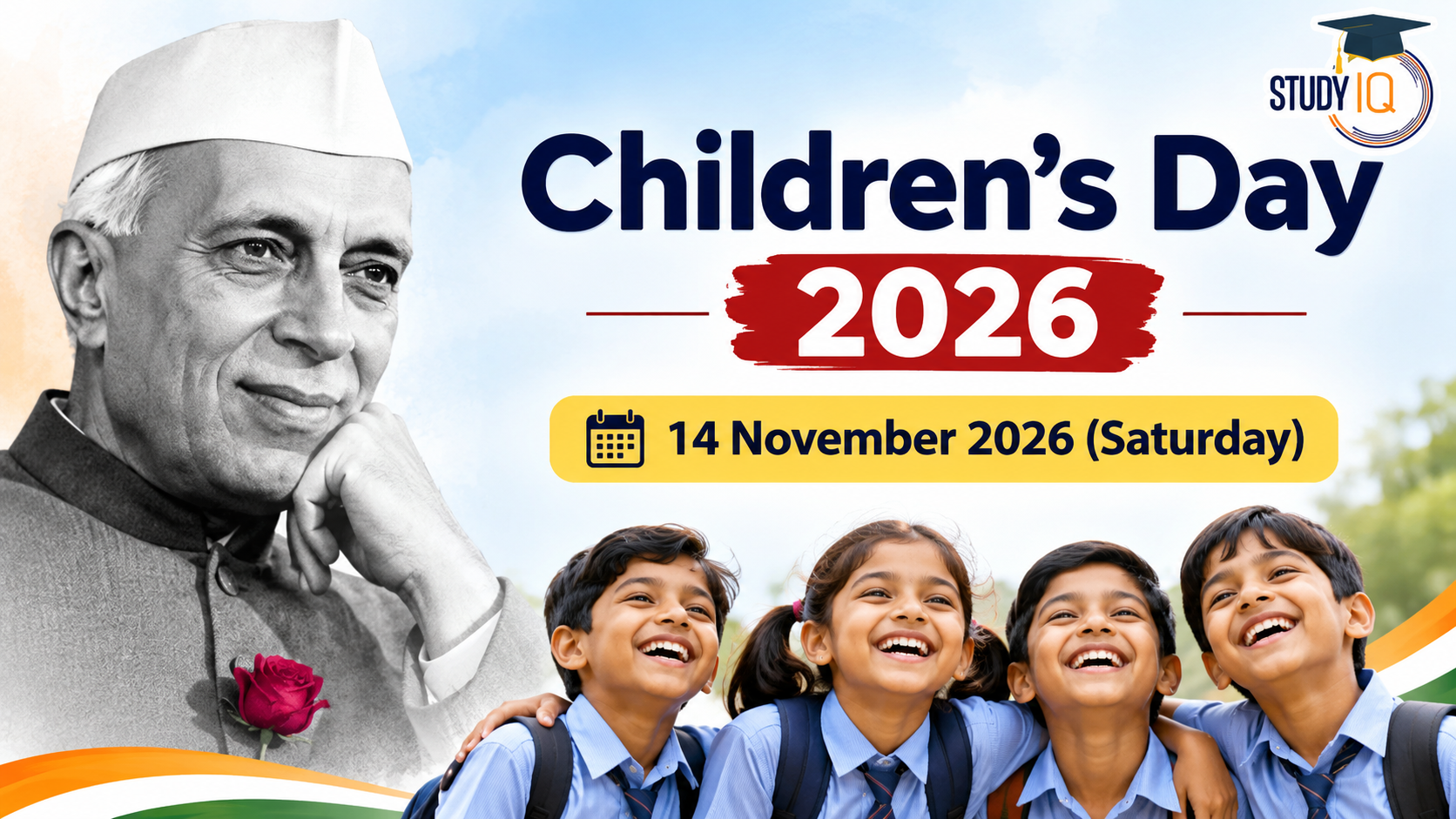
Childrens Day 2026 will be celebrated across India on 14 November 2026 (Saturday) to commemorate the 137th birth anniversary of Jawaharlal Nehru, India’s first Prime Minister. Popularly known as Chacha Nehru, he strongly believed that children were the foundation of a nation’s future and emphasised their education, healthcare and overall development.
Also known as Bal Diwas, the occasion highlights the importance of protecting children’s rights, ensuring quality education, improving nutritional outcomes and providing equal opportunities for every child.
Children’s Day is not merely a celebration in schools and educational institutions; it is also an opportunity to reflect on India’s commitment to child welfare, protection and inclusive development.
Read Also: UPSC Daily Current Affairs 2026
Childrens Day 2026: Overview
| Particulars | Details |
|---|---|
| Occasion | National Children’s Day |
| Also Known As | Bal Diwas |
| Date | 14 November 2026 |
| Day | Saturday |
| Birth Anniversary | 137th birth anniversary of Jawaharlal Nehru |
| First Prime Minister of India | Jawaharlal Nehru |
| Popular Name | Chacha Nehru |
| Nehru’s Date of Birth | 14 November 1889 |
| International Children’s Day | 20 November |
History of Children’s Day in India
The history of Children’s Day in India is closely associated with Jawaharlal Nehru, who was born on 14 November 1889 in Allahabad, present-day Prayagraj, Uttar Pradesh.
Nehru believed that children played a crucial role in nation-building and deserved proper education, care, protection and opportunities for development. His affection for children earned him the popular title Chacha Nehru.
Interestingly, Children’s Day was celebrated on 14 November even during Nehru’s lifetime. Historical records in the Nehru Archive indicate that the Indian Council for Child Welfare had requested the celebration of Children’s Day on his birthday.
A note dated 13 November 1957 and a speech delivered by Nehru on 14 November 1957 also provide evidence of the observance during his lifetime.
Therefore, the popular claim that Children’s Day was shifted to 14 November only after Nehru’s death in 1964 is not historically accurate.
Why is Children’s Day Celebrated on 14 November?
India celebrates Children’s Day on 14 November to commemorate Jawaharlal Nehru’s birth anniversary and recognise his contribution to children’s welfare and education.
The day highlights the importance of:
-
Providing universal access to quality education.
-
Ensuring adequate nutrition and healthcare.
-
Protecting children from exploitation, trafficking and abuse.
-
Promoting gender equality and equal opportunities.
-
Supporting children’s physical, emotional and intellectual development.
-
Encouraging creativity, participation and freedom of expression.
Significance of Children’s Day 2026
Children’s Day carries significant social and developmental importance because children represent the future human capital of the country.
1. Promoting Quality Education
Education is essential for reducing poverty, improving social mobility and developing human capabilities. Children’s Day reinforces the need for inclusive and accessible education for every child.
2. Improving Child Health and Nutrition
Malnutrition, anaemia, stunting and inadequate healthcare can affect children’s physical and cognitive development. The occasion highlights the importance of maternal and child healthcare, immunisation and nutritional interventions.
3. Protection of Child Rights
Children remain vulnerable to child labour, trafficking, abuse, exploitation and neglect. Children’s Day draws attention to the need for effective legal protection and institutional mechanisms.
4. Gender Equality
Equal opportunities for girls and boys in education, nutrition, healthcare and social participation are essential for building an inclusive society.
5. Encouraging Holistic Development
Children require opportunities beyond formal education, including sports, cultural activities, creativity, emotional development and social interaction.
National Children’s Day vs World Children’s Day
India’s National Children’s Day and the United Nations’ World Children’s Day are observed on different dates and have distinct historical associations.
| Parameters | National Children’s Day | World Children’s Day |
|---|---|---|
| Date | 14 November | 20 November |
| Observed In | India | Worldwide |
| Associated With | Jawaharlal Nehru | United Nations |
| Historical Association | Nehru’s birth anniversary | International child rights milestones |
| Main Objective | Children’s welfare and development | Promotion of children’s rights |
Why is World Children’s Day Celebrated on 20 November?
The United Nations observes World Children’s Day on 20 November every year.
In 1954, the United Nations General Assembly adopted Resolution 836 (IX), recommending the establishment of Universal Children’s Day to promote children’s welfare and international cooperation.
The date 20 November is particularly significant because two major international child rights milestones are associated with it:
-
1959 – Declaration of the Rights of the Child: Adopted by the United Nations General Assembly to recognise the fundamental rights of children.
-
1989 – Convention on the Rights of the Child (UNCRC): Adopted by the United Nations General Assembly on 20 November 1989.
The UNCRC entered into force on 2 September 1990 and established an internationally recognised framework for protecting children’s rights.
Convention on the Rights of the Child (UNCRC), 1989
The Convention on the Rights of the Child is an international human rights treaty that recognises the civil, political, economic, social, health and cultural rights of children.
It defines a child as every human being below the age of 18 years, unless the applicable law recognises an earlier age of majority.
The convention is based on four fundamental principles:
-
Non-discrimination: Every child is entitled to rights without discrimination.
-
Best Interests of the Child: Children’s best interests must be a primary consideration in decisions affecting them.
-
Right to Life, Survival and Development: Every child has the right to survival and holistic development.
-
Respect for the Views of the Child: Children have the right to express their views on matters affecting them.
Constitutional Provisions Related to Child Rights in India
The Indian Constitution provides several safeguards to protect children and promote their welfare.
| Article | Constitutional Provision |
|---|---|
| Article 14 | Equality before law and equal protection of laws |
| Article 15(3) | Special provisions for women and children |
| Article 21A | Free and compulsory education for children aged 6–14 years |
| Article 23 | Prohibition of human trafficking and forced labour |
| Article 24 | Prohibition of employment of children below 14 years in factories, mines and hazardous employment |
| Article 39(e) | Protection of children’s health and strength against abuse |
| Article 39(f) | Opportunities for healthy development and protection of childhood |
| Article 45 | Early childhood care and education for children below six years |
| Article 47 | Improvement of nutrition and public health |
These constitutional provisions establish the foundation for India’s child protection and development framework.
Major Government Schemes for Child Welfare in India
The Government of India has introduced several programmes to improve children’s education, nutrition, healthcare and protection.
1. Mission Vatsalya
Mission Vatsalya focuses on child protection and welfare, including institutional and non-institutional care, rehabilitation and support for vulnerable children.
2. Mission Saksham Anganwadi and POSHAN 2.0
The programme aims to improve nutritional outcomes among children, adolescent girls, pregnant women and lactating mothers through nutrition support and early childhood care.
3. PM POSHAN Scheme
The PM POSHAN Scheme provides nutritional support to eligible schoolchildren in government and government-aided schools, helping improve nutritional status and school participation.
4. Beti Bachao Beti Padhao
The initiative promotes the survival, protection and education of the girl child and seeks to address gender discrimination.
5. Right to Education Act, 2009
The Right of Children to Free and Compulsory Education Act provides free and compulsory elementary education to children aged 6–14 years.
6. POCSO Act, 2012
The Protection of Children from Sexual Offences Act provides a legal framework to protect children against sexual assault, sexual harassment and pornography.
How is Children’s Day Celebrated in India?
Children’s Day is celebrated across schools, colleges, educational institutions and communities through various activities.
Common celebrations include:
-
Cultural programmes, dance, music and theatrical performances.
-
Drawing, painting and creative writing competitions.
-
Sports activities and recreational games.
-
Educational visits to museums, science centres and historical sites.
-
Awareness campaigns on child rights, education and nutrition.
-
Community initiatives supporting underprivileged children.
Teachers and parents also organise special activities to encourage children’s creativity, confidence and participation.
Challenges Related to Child Welfare in India
Despite significant progress in education, healthcare and child protection, several challenges continue to affect children’s development.
-
Malnutrition: Undernutrition and anaemia continue to affect children’s health and development.
-
Child Labour: Economic vulnerability and poverty expose children to exploitative working conditions.
-
Child Trafficking: Vulnerable children remain at risk of trafficking and forced exploitation.
-
Educational Inequality: Socioeconomic differences, geographical barriers and the digital divide affect access to quality education.
-
Gender Discrimination: Girls in certain communities continue to face barriers to education, nutrition and equal opportunities.
-
Child Abuse: Physical, emotional and sexual abuse require stronger prevention, reporting and rehabilitation mechanisms.
Addressing these challenges requires coordinated efforts involving government institutions, families, educational institutions, civil society and communities.

 Climate Change Performance Index 2027: I...
 List of Military Exercises of India 2026...
 Lithium-Ion Battery Waste Export Ban 202...











 WhatsApp