Table of Contents
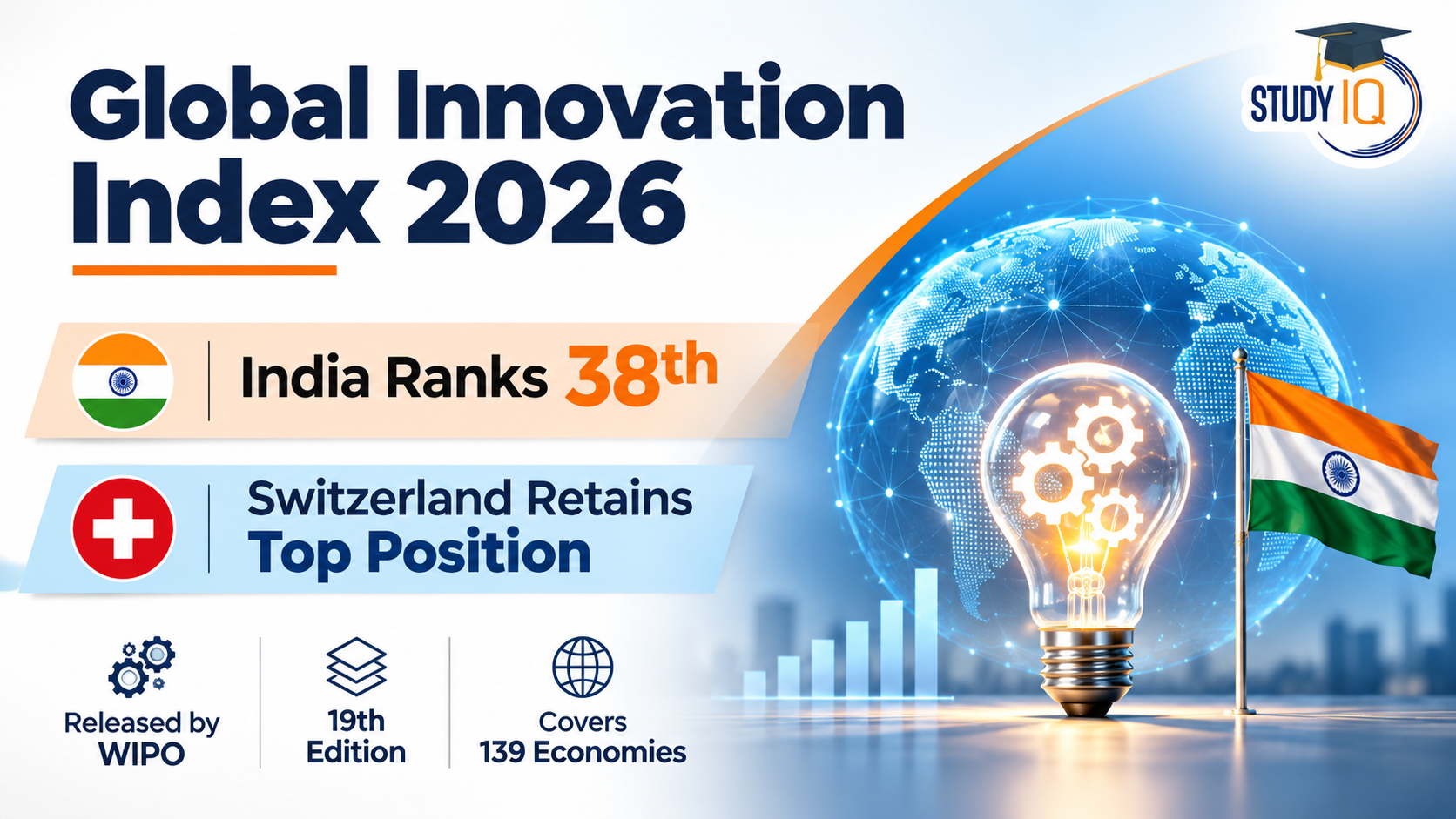
The Global Innovation Index 2026, released by the World Intellectual Property Organization (WIPO), ranks India 38th among 139 economies. India retains its first position among lower-middle-income economies and in the Central and Southern Asia region. Switzerland continues to lead the global rankings for the 16th consecutive year, followed by Sweden and the United States.
India’s performance reflects its growing capabilities in digital services, entrepreneurship, venture capital and knowledge-based industries. However, persistent gaps in research and development (R&D), institutional capacity and industry-academia collaboration highlight the need for a stronger innovation ecosystem.
Read Also: UPSC Daily Current Affairs 2026
Understanding the Global Innovation Index
The Global Innovation Index is an annual assessment of the innovation performance of economies worldwide. First published in 2007, it evaluates how effectively countries develop and utilise their innovation capabilities.
The 2026 edition is the 19th edition and covers 139 economies through 79 indicators, organised into 21 sub-pillars and seven major pillars.
The framework consists of two equally weighted sub-indices:
1. Innovation Input Sub-Index:
- Institutions
- Human Capital and Research
- Infrastructure
- Market Sophistication
- Business Sophistication
2. Innovation Output Sub-Index:
- Knowledge and Technology Outputs
- Creative Outputs
While the input sub-index measures the conditions supporting innovation, the output sub-index assesses the actual results generated through these capabilities.
Global Rankings: Leading Innovation Economies
Switzerland retained the top position, reflecting its strong research ecosystem, technological capabilities and institutional environment.
| Rank | Economy |
|---|---|
| 1 | Switzerland |
| 2 | Sweden |
| 3 | United States |
| 4 | Republic of Korea |
| 5 | Singapore |
| 6 | United Kingdom |
| 7 | Netherlands |
| 8 | Finland |
| 9 | Denmark |
| 10 | China |
China remains the only middle-income economy in the global top 30, demonstrating the growing innovation capabilities of emerging economies.
India’s Performance and Progress
India secured the 38th position in 2026, maintaining its 2025 ranking. Its long-term progress is significant, improving from 48th in 2020 to 38th in 2026.
| Indicator | India’s Rank |
|---|---|
| Overall Ranking | 38 |
| Lower Middle-Income Group | 1 |
| Central and Southern Asia | 1 |
| Innovation Input | 49 |
| Innovation Output | 25 |
| Knowledge and Technology Outputs | 15 |
The gap between India’s input and output rankings indicates its ability to generate relatively strong innovation outcomes despite limitations in supporting resources and institutional capabilities.
Major Areas of Strength
India demonstrates considerable strength across several innovation indicators:
- ICT Services Exports: 1st
- Domestic Market Size: 3rd
- Late-stage Venture Capital Deals: 4th
- Start-up and Scale-up Finance: 8th
- Unicorn Valuation: 10th
- Diverse Domestic Industry: 11th
- Cultural and Creative Services Exports: 12th
These achievements reflect India’s competitive IT services industry, expanding start-up ecosystem, digital infrastructure and growing entrepreneurial capabilities.
India and Vietnam have also remained innovation overperformers for 16 consecutive years (2011–2026), indicating innovation performance above what might be expected from their respective levels of economic development.
India’s Global Innovation Clusters
India has four innovation clusters among the world’s top 100:
| Rank | Innovation Cluster |
|---|---|
| 25 | Bengaluru |
| 27 | Delhi |
| 43 | Mumbai |
| 79 | Chennai |
These clusters demonstrate the concentration of scientific research, technological enterprises, inventors and venture capital activities in major Indian cities.
Key Challenges
Despite significant progress, India faces several structural constraints:
- Low R&D Investment: Insufficient research expenditure, particularly from the private sector, restricts the development of indigenous technologies.
- Industry-Academia Gap: Weak collaboration between universities, research institutions and industries limits the commercial application of scientific discoveries.
- Limited Deep-Tech Financing: Emerging sectors such as biotechnology, quantum computing, robotics and semiconductors require patient capital and long-term investment.
- Innovation Infrastructure: Unequal access to advanced laboratories, research facilities and technological infrastructure affects innovation across regions.
- Commercialisation of Research: Converting scientific discoveries into marketable products, patents and scalable technologies remains a major challenge.
Government Initiatives to Strengthen Innovation
Several initiatives aim to improve India’s innovation ecosystem:
- Startup India: Promotes entrepreneurship and supports start-ups.
- Atal Innovation Mission: Encourages innovation and entrepreneurial thinking.
- Anusandhan National Research Foundation: Strengthens research and development.
- IndiaAI Mission: Develops India’s artificial intelligence ecosystem.
- National Quantum Mission: Promotes quantum technology research.
- India Semiconductor Mission: Builds domestic semiconductor manufacturing capabilities.
- Digital India: Expands digital infrastructure and technology-enabled services.
Way Forward
India must transition from being primarily a technology services provider to a global hub of indigenous research, innovation and advanced manufacturing.
This requires higher public and private R&D expenditure, stronger university-industry partnerships, improved intellectual property protection and greater support for deep-tech enterprises. Investment in scientific education, skilled human capital and research infrastructure must also be prioritised.
Furthermore, innovation should become more inclusive by extending research facilities, digital access and entrepreneurial opportunities to smaller cities and underserved regions.

 UNESCO Memory of the World Register 2026...
 CBD COP-17 and Yerevan Pathway 2026: Key...
 Draft National Steel Policy 2047: Vision...














 WhatsApp