Table of Contents
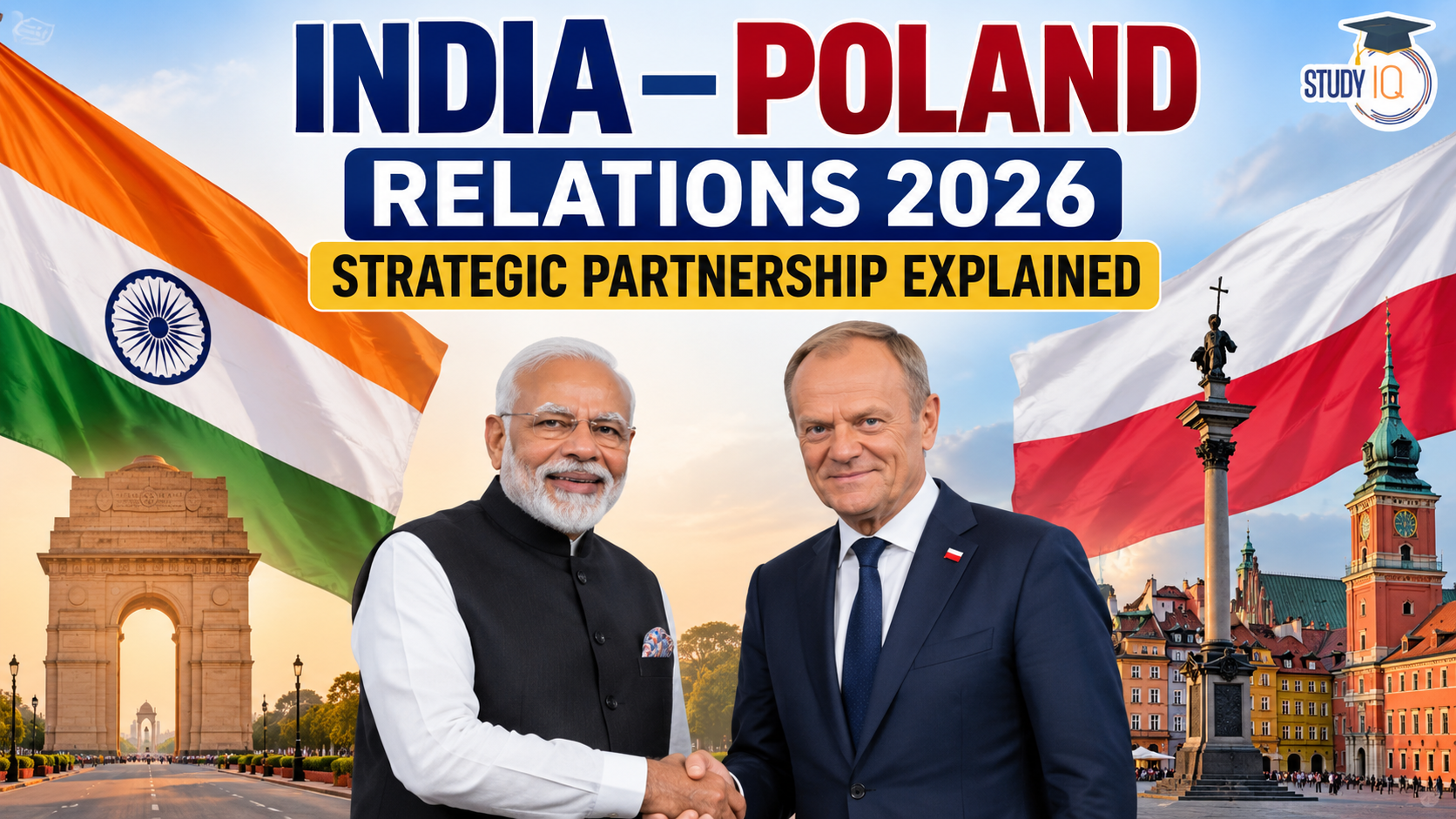
India–Poland relations have gained importance amid changing geopolitical dynamics and growing economic interdependence. The two countries elevated their bilateral relationship to a Strategic Partnership in August 2024, creating a framework for cooperation in trade, defence, technology, energy and education. In October 2026, Prime Minister Narendra Modi and Polish Prime Minister Donald Tusk engaged in discussions to strengthen bilateral ties and explore new opportunities for collaboration.
Read Also: UPSC Daily Current Affairs 2026
Historical Evolution of India–Poland Relations
India and Poland established diplomatic relations in 1954. Over the decades, their relationship has expanded through political dialogue, economic engagement, educational exchanges and cultural cooperation.
The elevation to a Strategic Partnership in 2024 marked a significant milestone. The Action Plan for 2024–2028 provides a roadmap for strengthening cooperation across multiple sectors. Poland’s strategic location in Central and Eastern Europe also makes it an important partner for India’s broader engagement with Europe.
Economic and Trade Relations
Economic cooperation is a major pillar of India–Poland relations. Bilateral trade has expanded considerably, creating opportunities for businesses in both countries.
Key areas of cooperation include:
- Manufacturing: Collaboration in engineering, automotive components and industrial production.
- Investment: Indian companies can explore opportunities in Poland, while Polish businesses can access India’s expanding domestic market.
- Agriculture and mining: Both countries can strengthen cooperation in agricultural technology, food processing and mineral-related industries.
- European market access: Poland’s European Union membership provides Indian companies with opportunities to connect with European supply chains.
Improving market access, reducing regulatory barriers and encouraging business partnerships can further strengthen economic relations.
Defence and Security Cooperation
Defence cooperation offers significant potential for the Strategic Partnership. Poland is modernising its armed forces, while India is seeking to strengthen domestic defence manufacturing under the Make in India initiative.
Potential areas include joint defence production, research and development, specialised military technologies and industrial partnerships. Cooperation could help India diversify its defence partnerships and strengthen technological capabilities.
However, differences in procurement systems, technology-transfer requirements and strategic priorities must be addressed to achieve meaningful results.
Clean Energy and Nuclear Cooperation
Energy security and the transition towards sustainable development provide additional opportunities for collaboration.
Poland is exploring nuclear power and small modular reactors (SMRs), while India continues to expand its energy infrastructure and renewable-energy capacity.
Cooperation could include nuclear technology, renewable energy, energy efficiency and clean-energy research. Such partnerships may support energy diversification and technological innovation. However, nuclear projects require substantial investment, stringent safety standards and regulatory coordination.
Space and Emerging Technologies
India and Poland can strengthen cooperation in space technology, artificial intelligence, cybersecurity and advanced manufacturing.
India’s expertise in satellite applications and cost-effective space missions complements Poland’s developing space industry. Potential applications include disaster management, agricultural monitoring, environmental protection and satellite-based Earth observation.
Joint research, university partnerships and collaboration between technology companies can promote innovation and create new commercial opportunities.
Challenges in India–Poland Relations
Despite growing opportunities, several challenges require attention.
- Geopolitical differences: India’s approach towards Russia differs from Poland’s security outlook, particularly regarding the Russia–Ukraine conflict.
- Trade barriers: Regulatory differences and administrative procedures can limit commercial expansion.
- Defence cooperation: Technology-sharing restrictions and procurement differences may delay joint projects.
- Implementation gaps: Political agreements must translate into measurable economic and strategic outcomes.
- Energy financing: Nuclear projects and advanced energy technologies require long-term investment and regulatory clarity.
Way Forward
India and Poland should prioritise practical implementation of their Strategic Partnership through measurable targets and regular institutional dialogue. Both countries should encourage joint ventures in defence manufacturing, expand trade and investment, strengthen cooperation in clean energy and promote research in space and digital technologies.
Greater university collaboration, student exchanges and business-to-business engagement can deepen people-to-people relations. At the same time, both countries should manage geopolitical differences through dialogue while respecting their respective national interests.
Conclusion
India–Poland relations reflect India’s growing engagement with Central and Eastern Europe. The Strategic Partnership provides opportunities to advance economic growth, technological innovation, defence cooperation and energy security. Converting diplomatic goodwill into concrete projects will be essential to building a resilient and mutually beneficial relationship.

 Supreme Court on Children's Right to Int...
 Daily Current Affairs PDF 2026: Download...
 Daily Mains Articles 2026 – Updated Da...












 WhatsApp