Table of Contents
Context
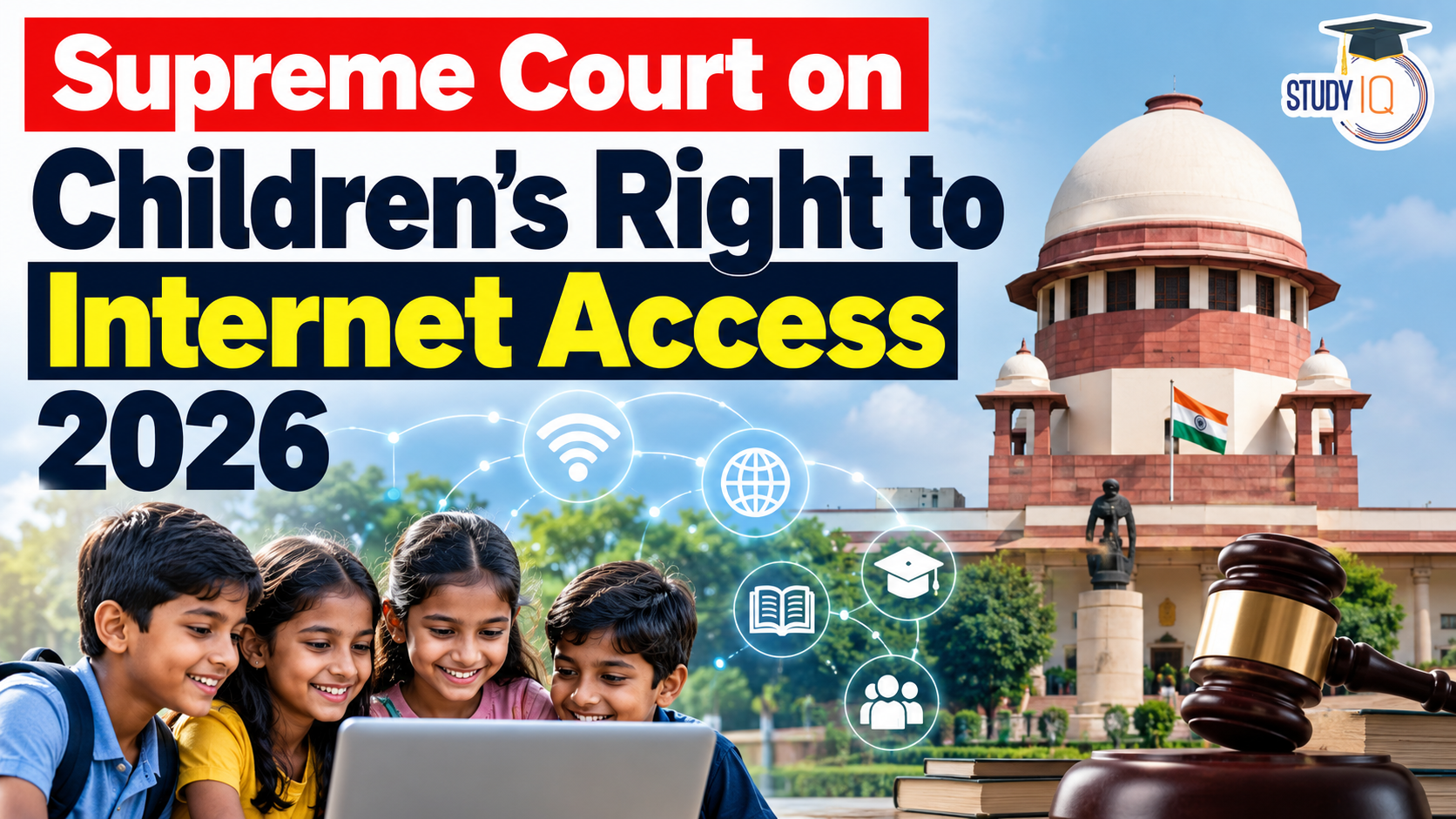
In its 15 October 2026 order in Just Rights for Children Alliance v. S. Harish, the Supreme Court expressly recognised the right to access and use the internet as a fundamental right under Article 21 read with Article 19(1)(a) of the Constitution.
What did the Supreme Court hold regarding internet access?
- Fundamental right: Internet access and use are protected under Article 21 (right to life and personal liberty) read with Article 19(1)(a) (freedom of speech and expression).
- Children’s digital rights: Children enjoy the right irrespective of age; their safety cannot be secured simply by excluding them from the internet.
- Access to education and information: Internet connectivity is particularly important for children in remote areas and persons with disabilities who rely on digital resources for learning, communication and participation.
- Rejection of blanket bans: Restrictions may push children towards less regulated platforms and discourage them from reporting online abuse for fear of punishment.
- Privacy protection: Age-verification systems that collect excessive personal information can create risks of surveillance and misuse of sensitive data.
- Targeted online safeguards: Measures should focus on harmful content, perpetrators and platform accountability rather than denying children access altogether. The Court also called for stronger mechanisms to detect and remove child sexual exploitation and abuse material (CSEAM).
What are the important judicial precedents on internet access and digital rights?
- Anuradha Bhasin v. Union of India (2020): The Supreme Court held that freedom of speech and expression under Article 19(1)(a) and the freedom to carry on trade or business under Article 19(1)(g) are protected when exercised through the internet. It ruled that indefinite internet suspensions are impermissible and that restrictions must satisfy constitutional requirements, including proportionality.
- Shreya Singhal v. Union of India (2015): The Court struck down Section 66A of the Information Technology Act, 2000, because its vague and overbroad restrictions violated freedom of speech and expression.
- K.S. Puttaswamy v. Union of India (2017): The Court recognised privacy as a fundamental right, establishing an important constitutional foundation for protecting personal information against disproportionate interference.
- Pragya Prasun v. Union of India (2025): The Court addressed exclusion arising from inaccessible digital KYC processes and recognised digital access as an intrinsic component of Article 21, emphasising inclusive digital systems for persons with disabilities and other marginalised groups.
What is the significance of recognising internet access as a fundamental right?
- Strengthens constitutional freedoms: Internet access enables citizens to exercise freedom of expression, receive information and participate in public debate, strengthening the practical enjoyment of Articles 19(1)(a) and 21.
- Promotes digital inclusion: It reinforces the need to address unequal access among rural communities, low-income households, women, persons with disabilities and other marginalised groups.
- Improves access to public services: Connectivity allows people to access welfare schemes, certificates, healthcare information and digital payments, making digital governance more accessible.
- Creates economic opportunities: Internet access supports online employment, digital entrepreneurship, skill development and market access. The Government e-Marketplace (GeM), for example, enables eligible businesses to participate in public procurement.
- Protects children’s development: Children can access educational resources, information and communication networks while benefiting from proportionate safeguards against exploitation and abuse.
- Advances accessibility and dignity: Accessible digital platforms and assistive technologies can improve the independence and participation of persons with disabilities.
- Strengthens judicial scrutiny: Constitutional protection provides a basis for challenging arbitrary restrictions on internet access, subject to applicable legal standards.
What are the major challenges in ensuring universal internet access in India?
1. Digital Divide and Unequal Access
- Infrastructure gap: Limited broadband and mobile connectivity in rural, remote and hilly regions.
- Affordability gap: High costs of devices, data and reliable internet restrict access for low-income households.
- Gender divide: Unequal access to devices and digital autonomy can disproportionately affect women and girls.
2. Digital Literacy and Accessibility
- Digital illiteracy: Limited skills to use online services, verify information and identify cyber fraud.
- Language barriers: Limited availability of quality digital content in Indian languages.
- Accessibility barriers: Many digital platforms remain difficult to use for persons with disabilities and elderly citizens.
3. Privacy and Cybersecurity Risks
- Data privacy: Excessive data collection and weak safeguards can compromise users’ privacy.
- Cybercrime: Online fraud, identity theft, cyberbullying and other forms of digital exploitation undermine safe access.
- Child safety: Protecting children from harmful content and exploitation without imposing blanket restrictions remains a key challenge.
4. Restrictions on Internet Access
- Internet shutdowns: Disproportionate restrictions can disrupt education, livelihoods, communication and access to public services.
- Overbroad regulation: Blanket bans or excessive content restrictions may undermine freedom of expression and access to information.
- Accountability deficit: Lack of transparency and effective review can make restrictions difficult to challenge.
5. Dependence on Digital-Only Services
- Exclusion from essential services: Digital-only delivery of education, welfare and public services can marginalise people without reliable connectivity or digital skills.
- Quality of access: Unstable connectivity, low speeds and frequent outages limit meaningful participation even where internet access technically exists.
Way Forward
1. Affordable Internet Access
- Infrastructure expansion: Accelerate BharatNet and last-mile connectivity to reduce the cost of network deployment in underserved regions.
- Affordable data and devices: Promote competitive data tariffs, low-cost devices and targeted subsidies for economically weaker households.
- Public access points: Expand public Wi-Fi through PM-WANI and strengthen community digital access centres.
- Service reliability: Improve internet speed, continuity and quality to ensure that affordable access is also meaningful.
2. Equitable Internet Access
- Bridge the rural–urban divide: Prioritise remote, rural, tribal and geographically isolated areas in digital infrastructure planning.
- Reduce the gender divide: Improve women’s access to devices, digital literacy and independent internet use.
- Ensure universal accessibility: Develop disability-friendly platforms and expand digital content in Indian languages through initiatives such as BHASHINI.
- Strengthen digital literacy: Expand digital education and awareness to help disadvantaged groups use online services safely and effectively.
- Protect constitutional freedoms: Prevent arbitrary internet shutdowns and ensure restrictions are lawful, necessary, proportionate and time-bound.
- Ensure inclusive service delivery: Maintain offline alternatives for essential public services so that lack of internet access does not result in exclusion.

 Daily Current Affairs PDF 2026: Download...
 Daily Mains Articles 2026 – Updated Da...
 Why Do Stampedes Occur in India? Crowd P...













 WhatsApp