Table of Contents
Context
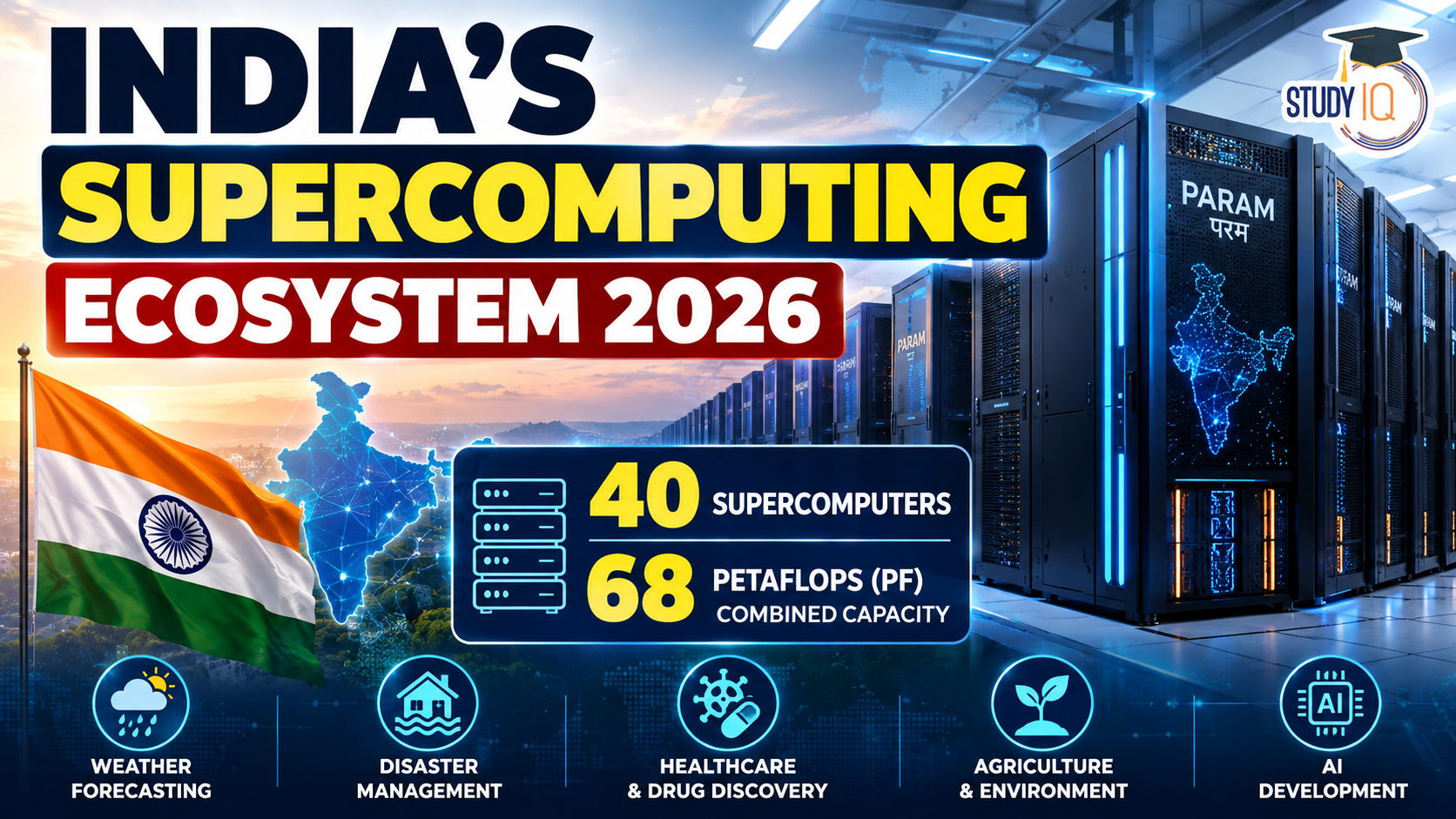
As of September 2026, India has 40 supercomputers with a combined capacity of 68 petaflops (PF).
Why is supercomputing strategically important for India?
- Solving complex problems: Supercomputers perform millions of calculations at the same time, allowing scientists to solve problems that ordinary computers cannot handle easily.
- Scientific research: They help researchers study areas such as climate, space, medicine, materials and engineering through large-scale simulations.
- AI development: Advanced AI systems need large amounts of computing power, making supercomputing an important part of India’s AI infrastructure.
- Public services: Supercomputing can turn large amounts of data into useful information such as weather forecasts, flood warnings and pollution predictions.
- Strategic autonomy: Developing domestic computing capacity reduces dependence on foreign systems for important scientific and strategic work.
How has the National Supercomputing Mission strengthened India’s capabilities?
- National infrastructure: NSM has built 40 supercomputers with a combined capacity of 68 PF, giving Indian researchers access to large-scale computing for science, AI, weather forecasting and disaster management.
- Build approach: The Mission follows a gradual approach from assembly to manufacturing and design support, helping India develop greater domestic capability in supercomputer production.
- Indian servers: C-DAC has designed Rudra servers, which are manufactured in India and used in PARAM Rudra systems, strengthening India’s ability to build and maintain HPC infrastructure.
- Indigenous technologies: India has developed capabilities in high-speed networking, system software and liquid cooling, reducing dependence on completely imported supercomputing systems.
- Wider research access: NSM has supported 16,000+ researchers across 400+ institutions, expanding access to advanced computing and strengthening India’s research and scientific capacity.
How is India using supercomputing to solve real-world problems?
- Weather forecasting: Supercomputers can process large weather datasets and improve predictions of rainfall, storms and extreme weather.
- Flood management: Computer models can predict how floods may spread, helping authorities prepare people and infrastructure in vulnerable areas.
- Forest-fire management: Supercomputing can model the likely spread of forest fires and support faster response.
- Healthcare: Large-scale computing helps in genomics, disease research and drug discovery by allowing scientists to study biological data more quickly.
- Agriculture and environment: Computing can support crop-yield prediction, climate modelling, pollution analysis and water-resource planning.
What are the major challenges facing India’s supercomputing ecosystem?
- Global capacity gap: India’s combined capacity of 68 PF is still far below the computing power of the world’s leading supercomputers.
- Uneven capacity: Of India’s 40 systems, 13 have more than 1 PF, while 15 have less than 500 TF, showing differences in computing capacity across systems.
- Dependence on foreign chips: India has made progress in designing and manufacturing servers, but advanced processors and accelerators remain an important area of foreign dependence.
- High energy use: More powerful computing systems require large amounts of electricity and efficient cooling, increasing operating costs.
- Skill gap: Building machines is not enough; India also needs more scientists, engineers and programmers who can use HPC effectively.
- Capacity–outcome gap: More computing power does not automatically create better results; India must convert computing capacity → research → innovation → useful products and public solutions.
Way Forward: How can India build a globally competitive supercomputing ecosystem?
- Build faster systems: Increase computing capacity while focusing on speed, reliability and energy efficiency.
- Develop critical technologies: Move gradually from Indian-made servers towards greater domestic capability in processors, accelerators, networking and cooling.
- Connect major technology missions: Create stronger links between NSM, IndiaAI, India Semiconductor Mission and the National Quantum Mission so that different technologies support each other.
- Expand access: Make advanced computing more accessible to universities, startups, MSMEs and industries, not only major research institutions.
- Build skilled manpower: Train students, researchers and engineers in HPC, AI, data science and advanced computing.
- Measure outcomes: Success should not be measured only by the number of supercomputers or PFLOPS, but also by research breakthroughs, patents, products, better public services and economic value.

 Daily Mains Articles 2026 – Updated Da...
 Daily Current Affairs PDF 2026: Download...
 National Household Travel Survey (NHTS) ...














 WhatsApp