Table of Contents
Nobel Prize in Chemistry 2026
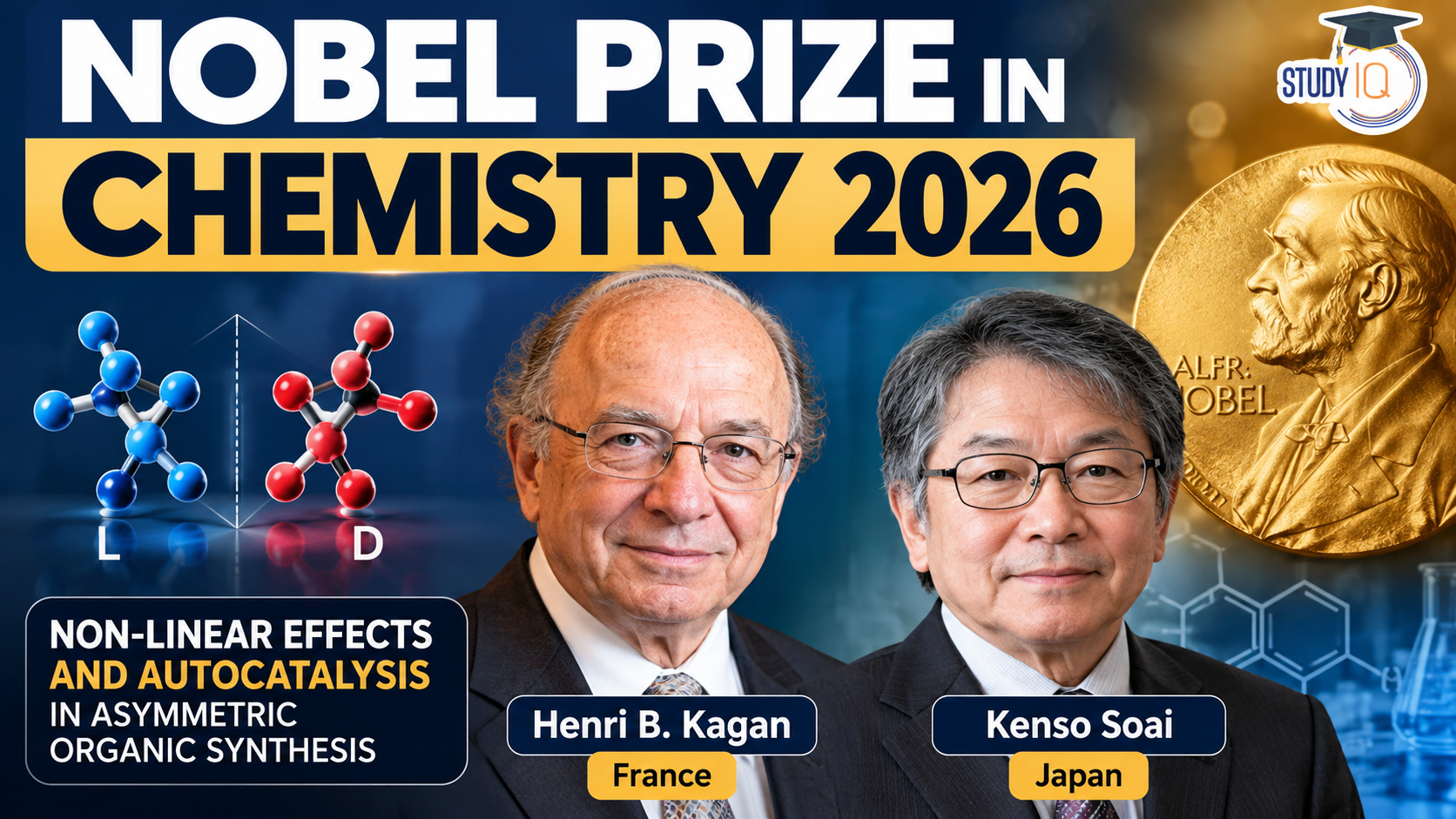
The Nobel Prize in Chemistry 2026 has been awarded to Henri B. Kagan of France and Kenso Soai of Japan for their discovery of “non-linear effects and autocatalysis in asymmetric organic synthesis.”
Their work addresses a fundamental question in chemistry: how can a small molecular asymmetry become amplified to produce predominantly one type of molecular handedness?
Key Facts
- Award: Nobel Prize in Chemistry 2026
- Laureates: Henri B. Kagan and Kenso Soai
- Countries: France and Japan
- Field: Organic chemistry
- Core concepts: Non-linear effects, autocatalysis and asymmetric synthesis
- Major significance: Understanding the emergence of homochirality
- Applications: Organic synthesis, pharmaceuticals and research into the chemical origins of life
Read Also: UPSC Daily Current Affairs 2026
What is Chirality?
Chirality is a property of a molecule whose mirror image cannot be superimposed on the original molecule.
A simple example is the left and right hand. They are mirror images of each other but cannot be perfectly superimposed.
The two mirror-image forms of a chiral molecule are called enantiomers.
Although enantiomers have the same chemical composition, their three-dimensional structures can result in different interactions with biological systems.
Why is Chirality Important?
Chirality is particularly important in:
- Biochemistry
- Pharmaceuticals
- Drug development
- Organic synthesis
- Molecular biology
A drug’s biological activity can depend strongly on its molecular orientation.
What is Asymmetric Organic Synthesis?
Asymmetric synthesis refers to chemical methods designed to preferentially produce one enantiomer rather than an equal mixture of two mirror-image forms.
In conventional synthesis:
Reactants → Mixture of two enantiomers
In asymmetric synthesis:
Reactants → Predominantly one desired enantiomer
This ability is extremely valuable in pharmaceutical chemistry.
What is Autocatalysis?
Autocatalysis occurs when a product of a chemical reaction helps accelerate the production of more of that same product.
The process can be simplified as:
Small initial imbalance
↓
One molecular form becomes slightly more abundant
↓
It promotes formation of more of itself
↓
The imbalance increases
↓
One molecular form becomes dominant
This creates a powerful self-amplifying chemical process.
What are Non-Linear Effects?
A non-linear effect occurs when a small difference in the starting conditions produces a disproportionately large difference in the final outcome.
In asymmetric chemistry, even a small initial excess of one enantiomer can potentially become much larger through chemical amplification.
Thus:
Small chiral imbalance → Chemical amplification → Large chiral imbalance
This concept is central to understanding how molecular asymmetry can emerge and become dominant.
What is Homochirality?
Homochirality refers to the predominance of one molecular handedness in a biological or chemical system.
Life on Earth displays striking examples of molecular homochirality:
- Proteins are primarily made from L-amino acids.
- Many biologically important sugars occur predominantly in the D-form.
This raises a major scientific question:
Why did life come to favour one molecular orientation over its mirror image?
The work recognised by the 2026 Chemistry Nobel provides important insights into how an initially small asymmetry can be amplified through chemical reactions.
Kagan’s Contribution
Henri B. Kagan made pioneering contributions to asymmetric chemistry and demonstrated important non-linear effects in asymmetric synthesis.
His work showed that the relationship between the composition of a chiral catalyst and the resulting product does not always have to be proportional.
This helped establish the importance of chemical amplification of chirality.
Soai’s Contribution
Kenso Soai became particularly well known for research into asymmetric autocatalysis.
The Soai reaction demonstrated a remarkable form of chemical self-amplification in which a chiral product can promote the formation of more product with the same molecular handedness.
This made the reaction an important model for studying:
- Chiral amplification
- Molecular asymmetry
- Autocatalysis
- The possible emergence of homochirality
Why is the Discovery Important?
1. Understanding the Origin of Molecular Asymmetry
The research helps explain how an initially very small molecular imbalance can become dominant.
2. Understanding the Chemistry of Life
Homochirality is a characteristic feature of biological systems. Chemical mechanisms capable of amplifying chirality are therefore relevant to studies of the origin of life.
3. Pharmaceutical Applications
Producing a particular enantiomer is often crucial in pharmaceutical chemistry because different enantiomers may interact differently with biological molecules.
4. Advances in Organic Chemistry
The research provides important principles for designing reactions that selectively produce molecules with a desired three-dimensional structure.
5. Chemical Self-Organisation
Autocatalysis demonstrates how chemical systems can generate self-amplifying behaviour without requiring an external mechanism to select the final molecular form.

 India Demonstrates First Free-Space Quan...
 India–EFTA Trade and Economic Partners...
 Daily Mains Articles 2026 – Updated Da...














 WhatsApp