Table of Contents
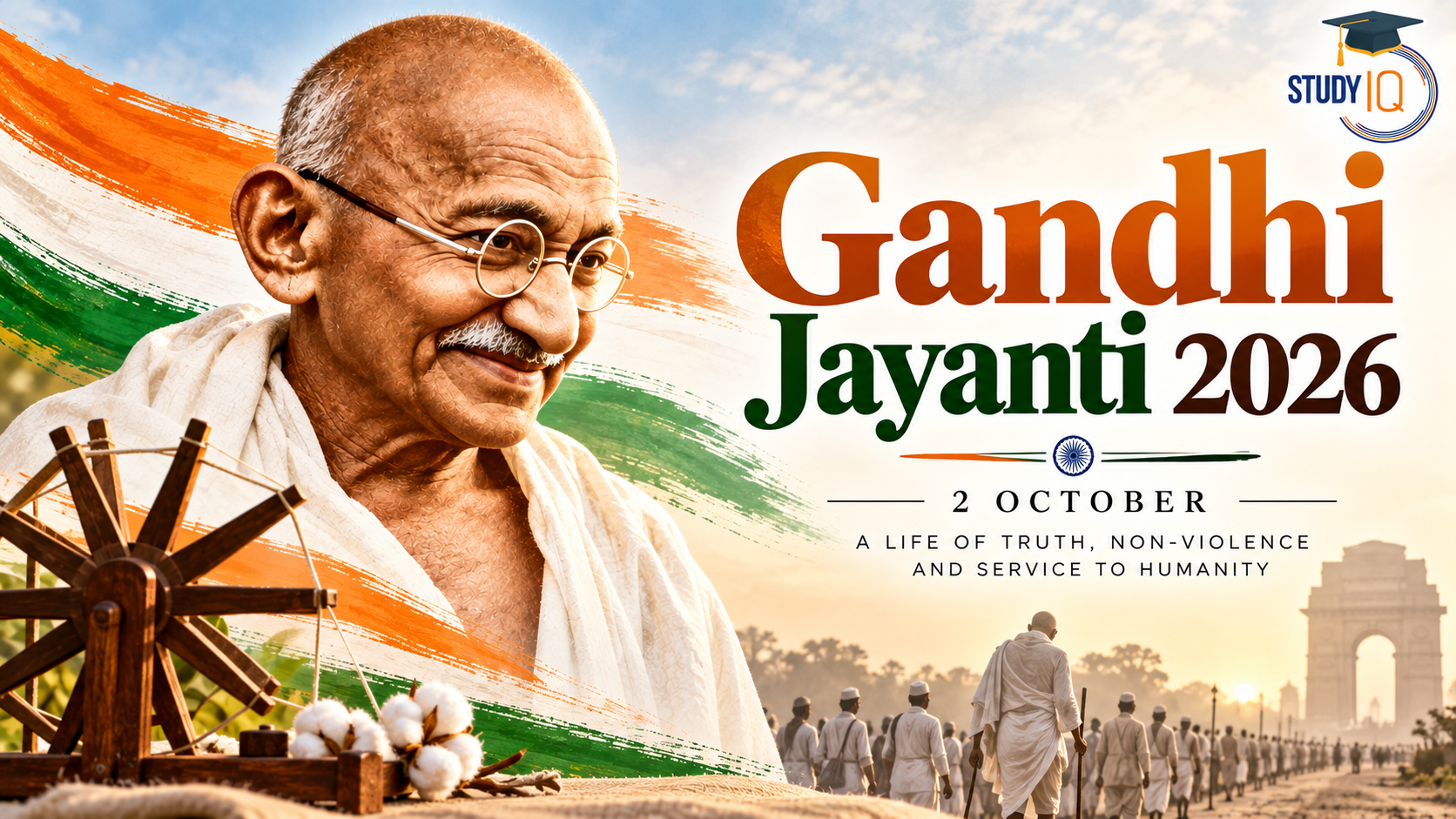
Gandhi Jayanti is observed every year on October 2 to commemorate the birth anniversary of Mahatma Gandhi, one of the most influential leaders of India’s freedom struggle. Gandhi was born on October 2, 1869, in Porbandar, Gujarat.
For UPSC aspirants, Gandhi Jayanti provides an opportunity to revise important aspects of Modern Indian History, Gandhian philosophy, nationalism, Satyagraha, Ahimsa and India’s freedom movement.
October 2 is also observed by the United Nations as the International Day of Non-Violence.
Why is Gandhi Jayanti celebrated?
Gandhi Jayanti commemorates the birth of Mohandas Karamchand Gandhi, popularly known as Mahatma Gandhi.
Gandhi played a major role in transforming India’s national movement into a mass movement by mobilising peasants, workers, women and other sections of society.
His political methods were strongly associated with:
- Ahimsa (Non-violence)
- Satyagraha
- Truth
- Civil disobedience
- Swadeshi
- Self-reliance
- Constructive work
- Sarvodaya
Gandhi’s Role in India’s Freedom Struggle
Gandhi returned to India from South Africa in 1915 and gradually emerged as a central figure in the Indian National Movement.
Major Gandhian Movements
| Year | Movement/Event | Significance |
|---|---|---|
| 1917 | Champaran Satyagraha | Gandhi’s first major Satyagraha in India; related to indigo cultivators |
| 1918 | Ahmedabad Mill Strike | Labour-related struggle |
| 1918 | Kheda Satyagraha | Peasant movement against revenue collection |
| 1919 | Rowlatt Satyagraha | Protest against the Rowlatt Act |
| 1920–22 | Non-Cooperation Movement | First nationwide mass movement under Gandhi |
| 1930 | Civil Disobedience Movement | Began with the Salt March |
| 1931 | Gandhi-Irwin Pact | Led to Gandhi’s participation in the Second Round Table Conference |
| 1942 | Quit India Movement | Called for an end to British rule in India |
Gandhian Philosophy
Gandhian thought was not limited to India’s freedom struggle. It represented a broader philosophy concerning ethics, politics, society, economics and individual conduct.
1. Ahimsa
Ahimsa, or non-violence, was central to Gandhi’s philosophy.
For Gandhi, non-violence was more than simply avoiding physical violence. It involved controlling hatred, hostility and harmful behaviour and promoting respect and compassion.
2. Satyagraha
The term Satyagraha literally refers to firmness in or adherence to truth.
Gandhi developed Satyagraha as a method of resistance based on:
- Truth
- Non-violence
- Moral courage
- Self-discipline
- Willingness to suffer rather than inflict suffering
Satyagraha became one of the defining features of Gandhian politics.
3. Swaraj
For Gandhi, Swaraj was not merely political independence from British rule.
It also involved self-rule, individual responsibility and social transformation. Gandhi connected political freedom with the ability of individuals and communities to exercise self-discipline.
4. Swadeshi
The Swadeshi principle encouraged the use of locally produced goods and greater economic self-reliance.
Gandhi associated the Charkha and Khadi with economic self-sufficiency, dignity of labour and resistance to colonial economic structures.
5. Sarvodaya
Sarvodaya broadly means the welfare or upliftment of all.
Gandhian thought emphasised that political and economic development should not benefit only a privileged section of society but should improve the condition of the most vulnerable.
6. Trusteeship
Gandhi proposed the idea of Trusteeship as an alternative approach to economic inequality.
Under this idea, those possessing wealth should regard themselves as trustees of their wealth and use it for the broader welfare of society.
Gandhi and Constructive Programme
Gandhi believed that political freedom had to be accompanied by social reconstruction.
His constructive programme included issues such as:
- Removal of untouchability
- Communal harmony
- Promotion of Khadi
- Village industries
- Women’s participation
- Basic education
- Sanitation
- Rural development
- Social equality
Thus, Gandhian politics combined resistance to colonial rule with constructive social work.
Gandhi Jayanti and International Day of Non-Violence
The United Nations General Assembly declared October 2 as the International Day of Non-Violence in 2007.
The date was chosen because it coincides with Gandhi’s birth anniversary. The observance recognises the continuing relevance of non-violence, dialogue and peaceful conflict resolution.
Gandhi’s Relevance in Contemporary India
Gandhian ideas continue to provide a framework for discussing several contemporary issues.
Non-violence can be connected with peaceful conflict resolution, while trusteeship provides a perspective on economic inequality. Gram Swaraj is relevant to decentralisation and local governance, and the constructive programme can be related to social inclusion and community participation.
His emphasis on truth, ethical conduct and responsibility also has relevance to the study of ethics in public administration.
Read Also: UPSC Daily Current Affairs 2026
 Right to Vote in India: Constitutional S...
 Daily Mains Articles 2026 – Updated Da...
 Daily Current Affairs PDF 2026: Download...









 WhatsApp