Table of Contents
UPI MDR Charges 2026: Why in News?
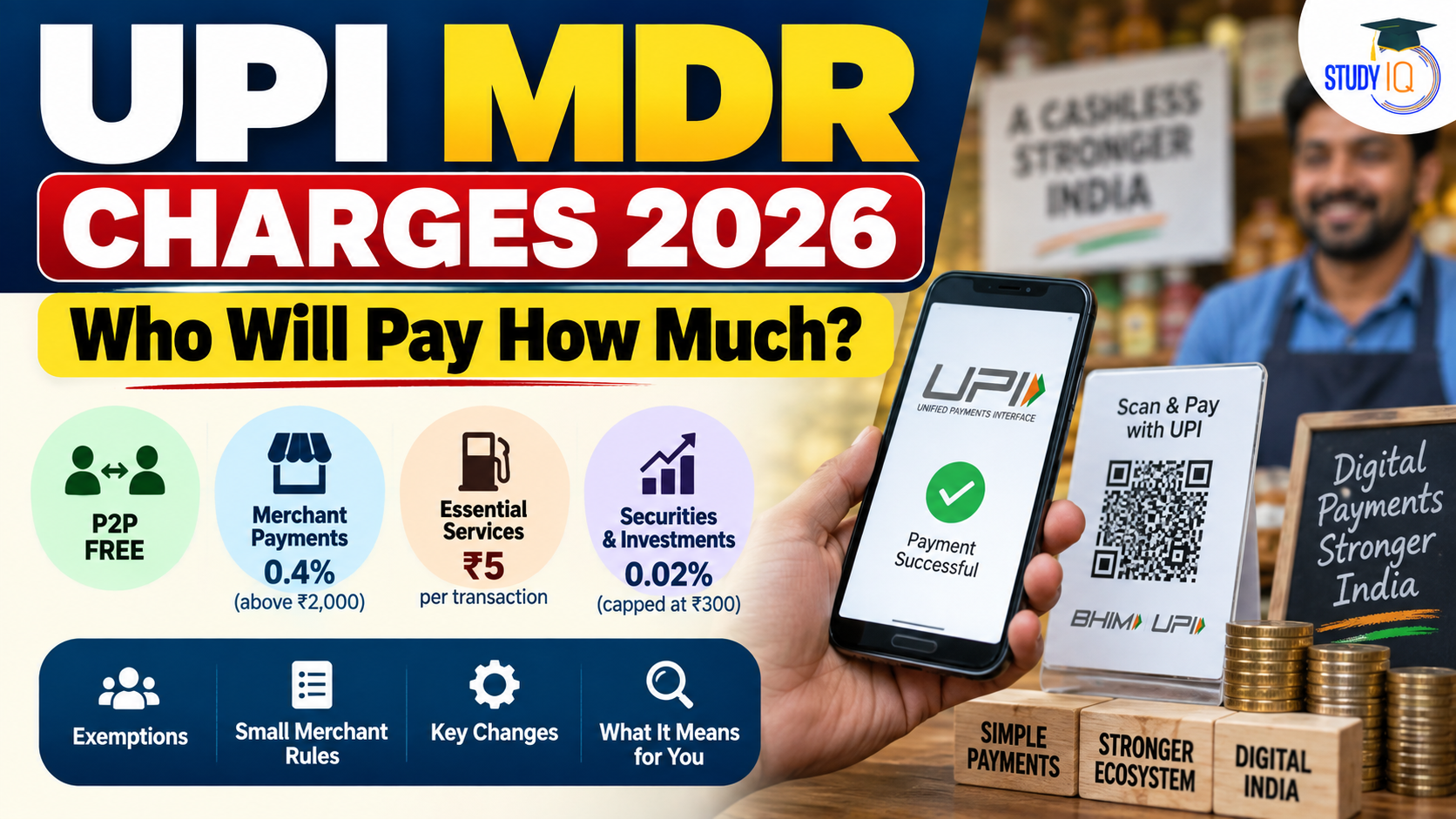
The Government has announced a new Merchant Discount Rate (MDR) framework for Unified Payments Interface (UPI) transactions. The new framework will come into effect from 15 October 2026.
Under the new system, person-to-person (P2P) UPI transactions will remain free, while certain higher-value payments made to merchants will attract MDR.
Read Also: UPSC Daily Current Affairs 2026
What is MDR?
Merchant Discount Rate (MDR) is a fee associated with processing a digital payment received by a merchant. It is charged within the merchant payment ecosystem and is not intended to be a direct charge on customers.
For UPI, the new framework introduces different MDR rates depending on the type and value of the transaction.
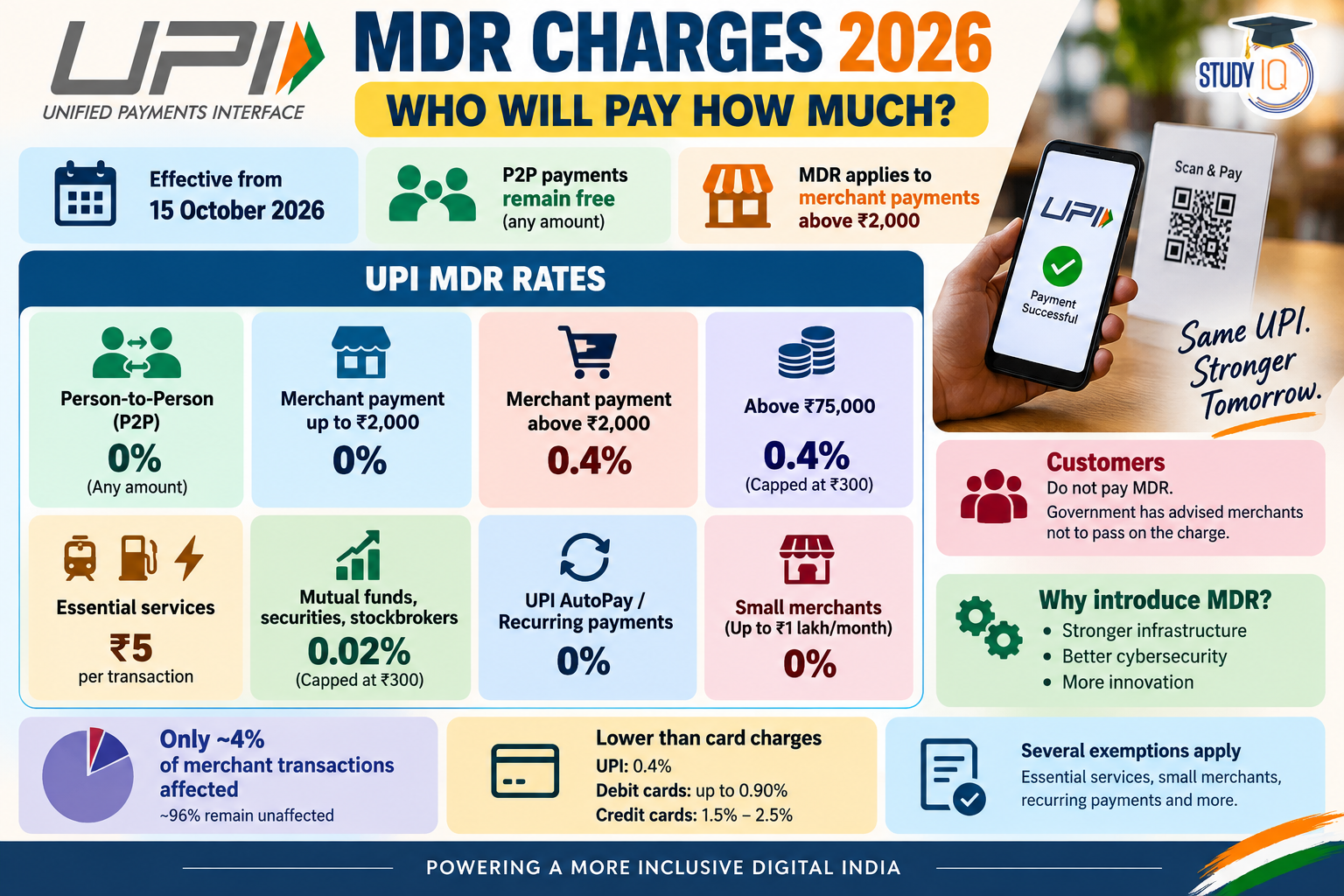
New UPI MDR Charges 2026
| Transaction Type | MDR |
|---|---|
| Person-to-person (P2P) payments | 0% |
| Merchant payments up to ₹2,000 | 0% |
| Merchant payments above ₹2,000 | 0.4% |
| Merchant payments above ₹75,000 | 0.4%, capped at ₹300 |
| Essential services | ₹5 per transaction |
| Mutual funds, securities, stockbrokers and dealers | 0.02%, capped at ₹300 |
| UPI AutoPay/recurring mandates | 0% |
| Eligible small merchants up to ₹1 lakh monthly UPI inflow | 0% |
Will Customers Have to Pay UPI Charges?
According to the government, customers will not directly pay the MDR.
Banks have been advised to ensure that merchants do not pass the MDR cost on to customers. UPI application providers have also been prohibited from imposing platform fees or hidden charges.
Therefore, ordinary consumers can continue using UPI without a direct transaction fee under the new framework.
Which UPI Transactions Will Attract 0.4% MDR?
The 0.4% MDR will apply primarily to person-to-merchant (P2M) transactions above ₹2,000.
For high-value merchant transactions exceeding ₹75,000, the MDR will remain 0.4% but will be capped at ₹300 per transaction.
For example, a ₹10,000 eligible merchant payment would attract MDR of ₹40 within the merchant ecosystem.
Exemptions Under the New UPI MDR Framework
Several categories will not be subject to the standard 0.4% rate.
Essential Services
Payments involving certain essential services will attract a flat ₹5 MDR per transaction, rather than 0.4%.
These include:
- Railways
- Telecommunications
- Insurance
- Fuel
- Electricity and other utility bills
- Piped gas
- Education
- Agricultural inputs
Capital Market Transactions
Transactions involving:
- Mutual funds
- Securities
- Stockbrokers
- Dealers
will attract an MDR of 0.02%, subject to a ₹300 per-transaction cap.
UPI AutoPay and Recurring Payments
Recurring transactions made through UPI Mandates/AutoPay, such as recurring investments, OTT subscriptions and monthly utility payments, will not attract MDR.
Special Protection for Small Merchants
The framework provides a zero-MDR category for eligible small merchants.
Small vendors, including street vendors, receiving up to ₹1 lakh per month through UPI QR codes into their personal bank accounts will remain exempt from MDR.
These merchants fall under the Person-to-Person-Merchant (P2PM) category.
They do not need to replace or re-register their existing QR codes because of the new framework.
What Happens If a Small Merchant Crosses ₹1 Lakh?
Banks and payment service providers will monitor transaction patterns and inward UPI payments.
If a merchant’s aggregate UPI inflows exceed ₹1 lakh per month for three consecutive months, the merchant can be moved from the P2PM category to the regular Person-to-Merchant (P2M) category.
The applicable MDR rules would then apply.
Why Has UPI MDR Been Introduced?
The National Payments Corporation of India (NPCI) has argued that the introduction of a limited MDR can support further investment in:
- UPI infrastructure
- Cybersecurity
- System resilience
- Innovation
- Customer service
UPI handles billions of transactions, creating significant requirements for maintaining and expanding payment infrastructure.
How Much of UPI Will Be Affected?
The government has stated that the new MDR framework will have a limited impact on merchant transactions.
According to government estimates, around 4% of merchant transactions will be affected, while approximately 96% will remain unaffected because they are either below the ₹2,000 threshold or covered by zero-MDR provisions for small merchants.
UPI MDR vs Debit and Credit Cards
The new UPI MDR rate is lower than typical merchant charges associated with many card-based payment systems.
- UPI: 0.4% for applicable transactions above ₹2,000
- Debit cards: MDR can be up to around 0.90%
- Credit cards: Merchant fees typically range from around 1.5% to 2.5%
This makes the new UPI MDR framework substantially different from conventional card-payment pricing.
Key Takeaways
- New UPI MDR framework comes into effect from 15 October 2026.
- P2P UPI payments remain free, regardless of transaction value.
- P2M transactions up to ₹2,000 remain free.
- Eligible P2M transactions above ₹2,000 attract 0.4% MDR.
- MDR on transactions above ₹75,000 is capped at ₹300.
- Several essential services have a flat ₹5 MDR.
- Capital-market transactions attract 0.02% MDR, capped at ₹300.
- Eligible small merchants receiving up to ₹1 lakh/month remain exempt.
- UPI AutoPay and recurring mandates remain outside MDR.
- Customers are not supposed to be directly charged MDR.

 Places in News: Mayun Island- Why Is Per...
 Place in News: Auli – Location, Geogra...
 Daily Mains Articles 2026 – Updated Da...














 WhatsApp