
Table of Contents
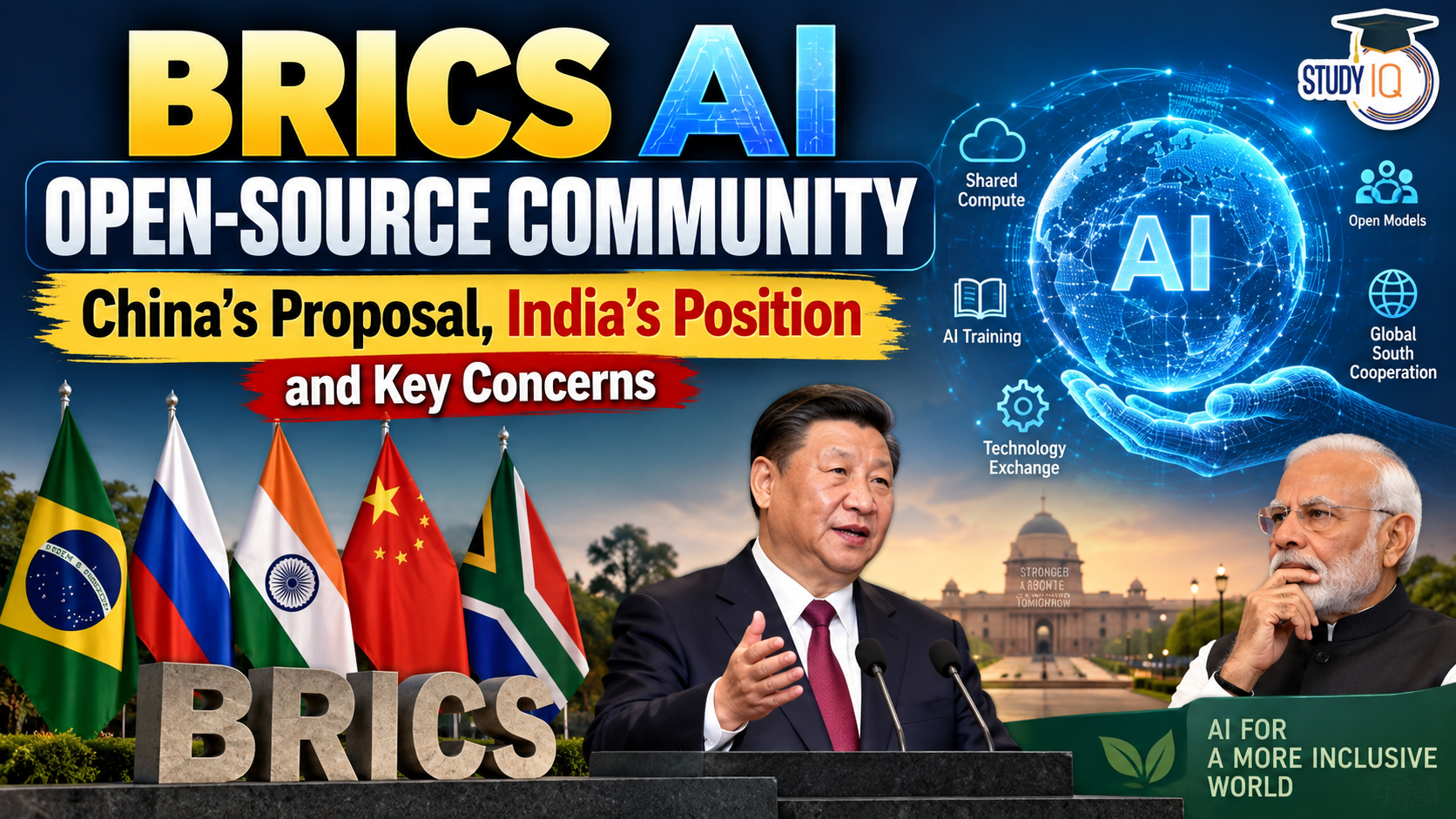
At the 2026 BRICS Summit in New Delhi, Chinese President Xi Jinping proposed establishing a “BRICS AI open-source community” to promote cooperation in artificial intelligence among member countries.
The proposal focuses on large language models (LLMs), AI training, technology exchange and digital cloud infrastructure. However, it is important to note that the proposal has not yet been formally adopted as a BRICS-wide programme.
Read Also: UPSC Daily Current Affairs 2026
What Is China’s BRICS AI Proposal?
China has proposed cooperation in:
- Large Language Models (LLMs) and AI development.
- AI training programmes and specialised seminars.
- Building an open AI ecosystem.
- A common BRICS digital ecosystem cloud platform.
- Digital skills and technology exchange.
- AI applications in intelligent manufacturing.
China’s initiative comes amid its growing promotion of open-weight AI models and greater AI access for developing countries.
What Has BRICS Actually Agreed?
The New Delhi Declaration does not specifically endorse the proposed BRICS open-source AI community or common cloud platform.
Instead, BRICS has broadly emphasised:
- Greater access to AI resources.
- Safe, secure and reliable AI.
- Inclusive and responsible AI development.
- Cooperation on global AI governance.
China’s assumption of the BRICS chairship in 2027 could provide an opportunity to further develop the proposal.
Why Is China Promoting Open-Source AI?
Chinese companies such as DeepSeek and Alibaba’s Qwen have helped expand the availability of open-weight AI models.
China’s approach can potentially:
- Lower barriers to AI adoption.
- Provide alternatives to proprietary AI systems.
- Expand China’s technological influence.
- Strengthen cooperation with Global South countries.
- Promote Chinese AI standards and technological ecosystems.
India’s Position
India has also advocated democratising access to AI resources, particularly for developing countries.
Through the IndiaAI Mission, India is building domestic capabilities in:
- AI compute infrastructure.
- Datasets.
- Foundation models.
- AI innovation.
- Domestic AI infrastructure and talent.
Therefore, BRICS cooperation on AI could complement India’s objective of making AI more accessible while strengthening its own technological capabilities.
Opportunities for India
A BRICS AI initiative could offer India several advantages:
- Access to AI infrastructure: Greater availability of computing resources and models.
- Global South cooperation: India could help shape an inclusive AI ecosystem for developing countries.
- Reduced dependence: Open models could provide alternatives to proprietary AI platforms.
- Technology collaboration: BRICS members could collaborate on AI research, training and applications.
- AI governance: India could use the platform to advocate transparent, inclusive and responsible AI governance.
Key Concerns for India
Despite these opportunities, India needs to carefully assess the strategic implications.
1. Data Sovereignty
India must ensure that sensitive Indian data is not transferred or stored in infrastructure outside its control.
2. Strategic Autonomy
Reducing dependence on Western technology should not result in new dependence on Chinese technology.
3. Cybersecurity
A common cloud platform could create significant cybersecurity and data-protection challenges.
4. Intellectual Property
Rules regarding ownership, licensing and commercial use of jointly developed AI models would need to be clearly established.
5. Technology Standards
India would need to ensure that BRICS AI standards remain interoperable with the broader global technology ecosystem.
Key Challenges Ahead
Several questions remain unanswered:
- Which AI models will be included?
- Who will control the common cloud platform?
- Where will the infrastructure be hosted?
- How will data be protected?
- What will be the licensing framework?
- Which BRICS members will participate?
- How will intellectual property be shared?
The answers will determine whether the proposal becomes a substantive multilateral initiative or remains primarily a Chinese technology-diplomacy proposal.
Conclusion
The BRICS AI Open-Source Community could potentially expand access to AI technologies and strengthen cooperation among developing economies. For India, however, participation must be guided by strategic autonomy, data sovereignty, cybersecurity and domestic AI capacity.
India’s ideal approach should be: open access to AI without strategic dependence on any single technology ecosystem.

 India’s Artificial Sun: New 82.6 GHz G...
 World Circular Economy Forum 2026: India...
 SAWEN and Kathmandu Declaration: Strengt...














 WhatsApp





