Table of Contents
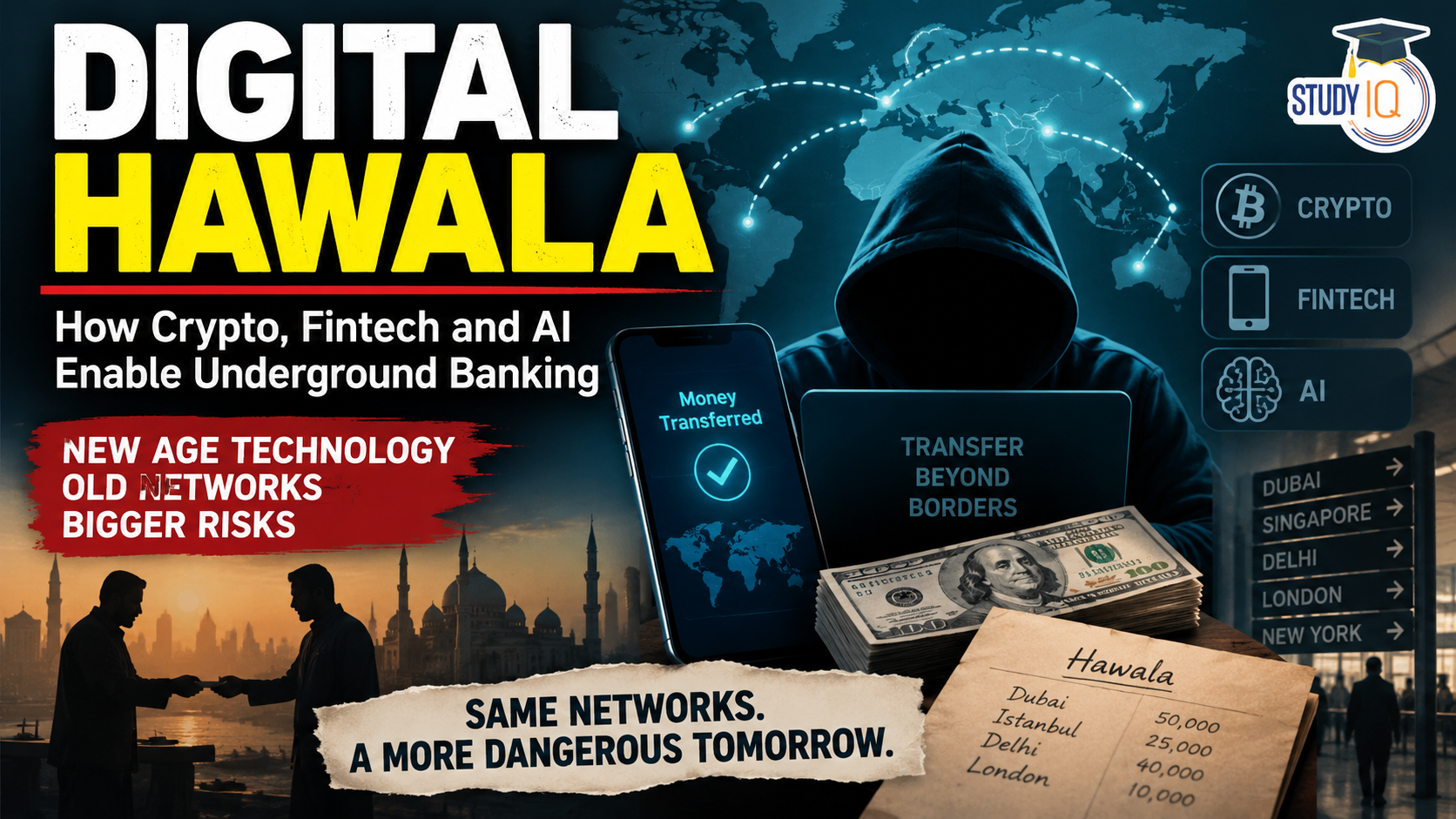
Digital hawala refers to the technology-driven evolution of traditional informal value-transfer networks. By combining fintech platforms, virtual assets, encrypted communication, digital payment systems and artificial intelligence (AI), underground financial networks are becoming faster, more sophisticated and difficult to trace.
The issue has gained attention following the Financial Action Task Force (FATF) report on professional money laundering, underground banking and hawala, which highlights the growing convergence of informal finance with modern technology.
Read Also: UPSC Daily Current Affairs 2026
What Is Hawala?
Hawala is an informal value-transfer mechanism through which money or value can move across borders without necessarily passing through conventional banking channels.
Traditional hawala generally relies on a network of trusted intermediaries, with transactions settled through cash, trade, netting arrangements or other forms of value exchange.
Hawala is not inherently illegal and can provide financial services where access to formal banking is limited. However, its informal nature can also be exploited for money laundering, tax evasion, organised crime and terrorist financing.
What Is Digital Hawala?
Digital hawala represents the technology-enabled transformation of these informal networks. Technology may be used for communication, customer interaction, record-keeping, transaction coordination and settlement.
FATF broadly identifies several forms of digitalisation, including:
- Digital coordination: Encrypted messaging and online platforms facilitate communication between participants.
- Digital customer interfaces: Fintech applications and mobile wallets may connect customers with informal transfer networks.
- Virtual-asset settlement: Crypto-assets, including stablecoins, may be incorporated into settlement arrangements.
- Formal digital infrastructure: Payment platforms and virtual IBANs can potentially facilitate movement of funds.
- AI-enabled operations: AI can increase automation and sophistication in financial operations.
- Integrated ecosystems: Messaging, social media, cloud services, VASPs and other digital platforms can become interconnected.
Thus, digital hawala does not necessarily replace traditional hawala; instead, technology can act as a catalyst that expands its speed, reach and resilience.
How Do Crypto, Fintech and AI Enable Underground Banking?
Cryptocurrency and Virtual Assets
Virtual assets can enable rapid and cross-border movement of value. Their global accessibility and technological complexity can create additional challenges for investigators attempting to establish the origin, ownership and destination of funds.
However, crypto-assets themselves are not illegal. The challenge lies in preventing their misuse while preserving legitimate innovation.
Fintech Platforms
Fintech has made financial transactions faster and more accessible. The same infrastructure can potentially be misused through mule accounts, fraudulent identities, layered transactions and cross-border payment networks.
This creates a regulatory challenge: authorities must prevent criminal misuse without undermining legitimate digital finance and financial inclusion.
Artificial Intelligence
AI can potentially make illicit financial operations more automated and sophisticated. It may assist criminal networks in analysing financial information, structuring transactions and managing complex networks.
Consequently, investigators increasingly need AI and data-analytics capabilities of their own to identify suspicious patterns.
Why Is Digital Hawala a Major AML/CFT Challenge?
Digitalisation can make underground financial networks:
- Faster and geographically wider
- More difficult to trace
- Less dependent on face-to-face relationships
- More resilient to enforcement disruption
- Capable of combining informal finance with formal digital infrastructure
The problem becomes particularly serious in terror financing, where relatively small transactions can be difficult to distinguish from legitimate financial activity.
India’s Perspective
Digital hawala is relevant to India’s efforts against money laundering, organised crime and terror financing.
Key institutions include:
- Financial Intelligence Unit–India (FIU-IND): Receives and analyses suspicious financial transaction information.
- Enforcement Directorate (ED): Investigates money laundering offences under the Prevention of Money Laundering Act, 2002.
- Reserve Bank of India (RBI): Regulates banks and payment systems and oversees AML/CFT compliance within its regulatory framework.
- Law-enforcement and intelligence agencies: Investigate organised crime, terrorism and associated financial networks.
India also needs stronger capabilities in blockchain analytics, cyber-financial investigations and digital forensics.
Way Forward
A comprehensive strategy should focus on five priorities:
- Strengthen financial intelligence through AI, big-data analytics and network analysis.
- Regulate virtual-asset ecosystems through effective AML/CFT compliance.
- Improve digital-forensics capabilities of investigative agencies.
- Enhance international cooperation through FATF, FIU-to-FIU coordination and mutual legal assistance.
- Promote financial inclusion so legitimate users are not pushed towards informal channels.
Importantly, excessive bank de-risking can unintentionally push legitimate financial activity into informal systems. Therefore, regulation should remain risk-based rather than blanket and punitive.
Conclusion
Digital hawala represents the convergence of traditional informal finance with fintech, crypto-assets and AI. It demonstrates how technological innovation can simultaneously create economic opportunities and new security vulnerabilities.
For India, the objective should not be to restrict technology itself but to build stronger AML/CFT institutions, digital investigative capabilities, VASP oversight, international intelligence-sharing mechanisms and inclusive formal financial channels.

 India-China Border Tensions 2026: LAC, I...
 Career247 Rebrands as Adda247 Skills to ...
 GRAP Stage I Explained: AQI Limits, Meas...













 WhatsApp