
Table of Contents
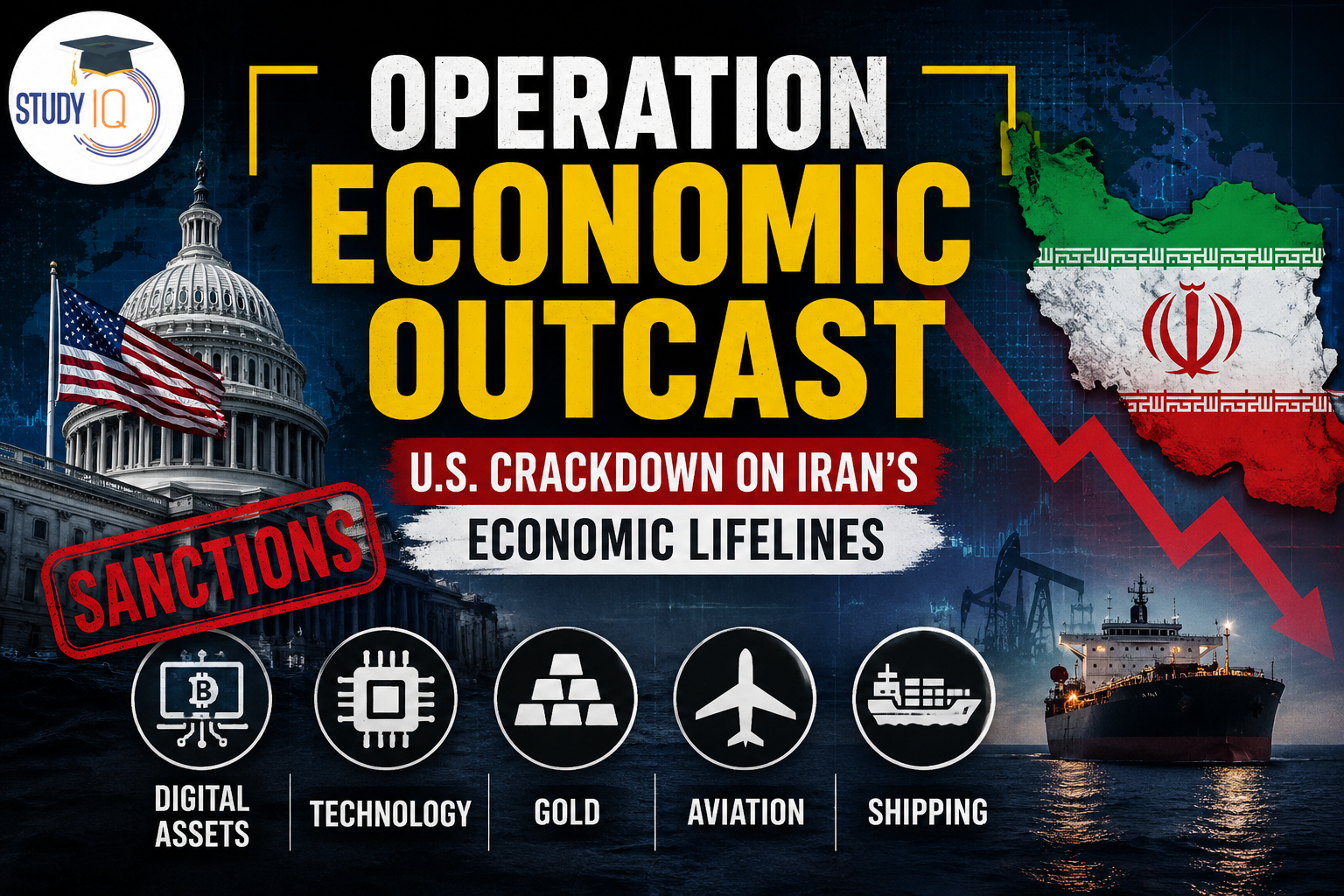
The United States has launched “Operation Economic Outcast”, a major economic pressure campaign aimed at cutting Iran off from global financial and trading networks. Announced by US Treasury Secretary Scott Bessent on August 24, 2026, the campaign seeks to target Iran’s revenue sources, particularly oil, while warning foreign companies and countries that facilitate Iranian trade of possible secondary sanctions.
The initiative comes amid heightened tensions between the United States and Iran and growing concerns over regional security, energy supplies and maritime trade.
Read Also: UPSC Daily Current Affairs 2026
What Is Operation Economic Outcast?
Operation Economic Outcast seeks to sever the economic lifelines supporting Iran’s economy. Unlike conventional sanctions focused primarily on Iranian entities, the campaign aims to disrupt the wider international ecosystem that enables Tehran to earn, transfer and access revenue.
Bessent described the campaign as “economic D-Day”, signalling a significant escalation in US economic pressure. Washington has also warned international businesses that transactions supporting Iranian economic networks could expose them to US penalties.
Five Key Sectors Targeted
US officials have identified five major sectors as important Iranian economic lifelines:
- Digital assets: To prevent alternative channels for transferring and storing funds.
- Technology: To restrict access to sensitive and dual-use technologies.
- Gold: To limit alternative mechanisms for preserving and transferring wealth.
- Aviation: To constrain aircraft-related services, equipment and transactions.
- Shipping: To disrupt vessels, maritime services and networks facilitating Iranian trade.
Iranian oil revenues remain a central target, as oil exports are a major source of foreign exchange for Tehran.
The US Treasury has also imposed fresh sanctions against 60 entities, vessels and individuals across jurisdictions including the UAE, Hong Kong, China, Singapore and Switzerland.
Secondary Sanctions and Global Economic Impact
The most significant feature of the campaign is its emphasis on secondary sanctions. These measures can penalise foreign companies and institutions that facilitate prohibited transactions involving Iran.
This creates a dilemma for international businesses: maintain commercial relations with Iran or protect access to the US financial system.
The consequences could extend beyond Iran. Restrictions on Iranian oil exports may affect global energy prices, while sanctions on shipping networks could increase freight, insurance and compliance costs.
The issue becomes particularly significant because of the Strait of Hormuz, a crucial energy chokepoint connecting the Persian Gulf with the Gulf of Oman. Prolonged disruption could generate higher oil prices and inflationary pressures across energy-importing economies.
Strategic Significance
The campaign reflects the growing importance of economic statecraft in international relations. Financial sanctions, export controls and restrictions on trade networks allow major powers to exert geopolitical pressure without relying exclusively on military instruments.
For Washington, the objective is not merely economic damage but also to create incentives for Tehran to return to negotiations and make concessions concerning its nuclear programme and regional activities.
However, sanctions have limitations. Iran has decades of experience operating under economic restrictions and can attempt to use alternative markets, intermediaries, informal financial channels and non-Western trading partners.
Thus, greater economic pressure does not necessarily guarantee political capitulation.
Implications for India
India faces a complex strategic situation because Iran is important for both energy security and regional connectivity.
Energy Security
Any reduction in Iranian oil supplies or disruption around the Strait of Hormuz could contribute to higher global crude prices. For India, this could increase the import bill, inflationary pressures and the current-account burden.
Chabahar Port
Iran is strategically important for India’s connectivity with Afghanistan and Central Asia. The Chabahar Port provides an alternative route that reduces India’s dependence on routes through Pakistan. Wider sanctions could complicate India’s efforts to maintain and expand this connectivity corridor.
Strategic Autonomy
The campaign also highlights the challenge of maintaining India’s strategic autonomy while deepening its relationship with the United States and retaining independent relations with Iran and other major powers.
India would need to balance sanctions compliance with its legitimate economic and strategic interests.
Challenges Before the US
Operation Economic Outcast faces several challenges:
- Sanctions evasion: Iran may use intermediary companies and alternative trading networks.
- Alternative partnerships: Tehran can strengthen economic ties with countries willing to trade with it.
- Global costs: Restrictions may increase energy and shipping prices.
- Political resistance: Economic pressure can sometimes strengthen nationalist resistance rather than encourage concessions.
- Financial fragmentation: Extensive secondary sanctions may encourage countries to develop alternative payment and settlement mechanisms.

UPSC IAS Live GS P2I Foundation 2027 Pratigya August Evening Batch 2 (Basic)
Conclusion
Operation Economic Outcast represents an escalation from conventional sanctions towards broader economic isolation of Iran. By targeting oil revenues and international networks across digital assets, technology, gold, aviation and shipping, Washington aims to increase the economic cost of Tehran’s policies.
Its success will ultimately depend on whether economic pressure produces meaningful diplomatic concessions without triggering wider instability in energy markets and global trade.
For India, the episode underlines the importance of energy diversification, strategic petroleum preparedness, maritime security, resilient connectivity and strategic autonomy in an increasingly fragmented geopolitical environment.
 Child Marriage in India: Causes, Impacts...
 World Development Report 2026: The Promi...
 US Suspension of PERM Filings by Major I...













 WhatsApp





