Table of Contents
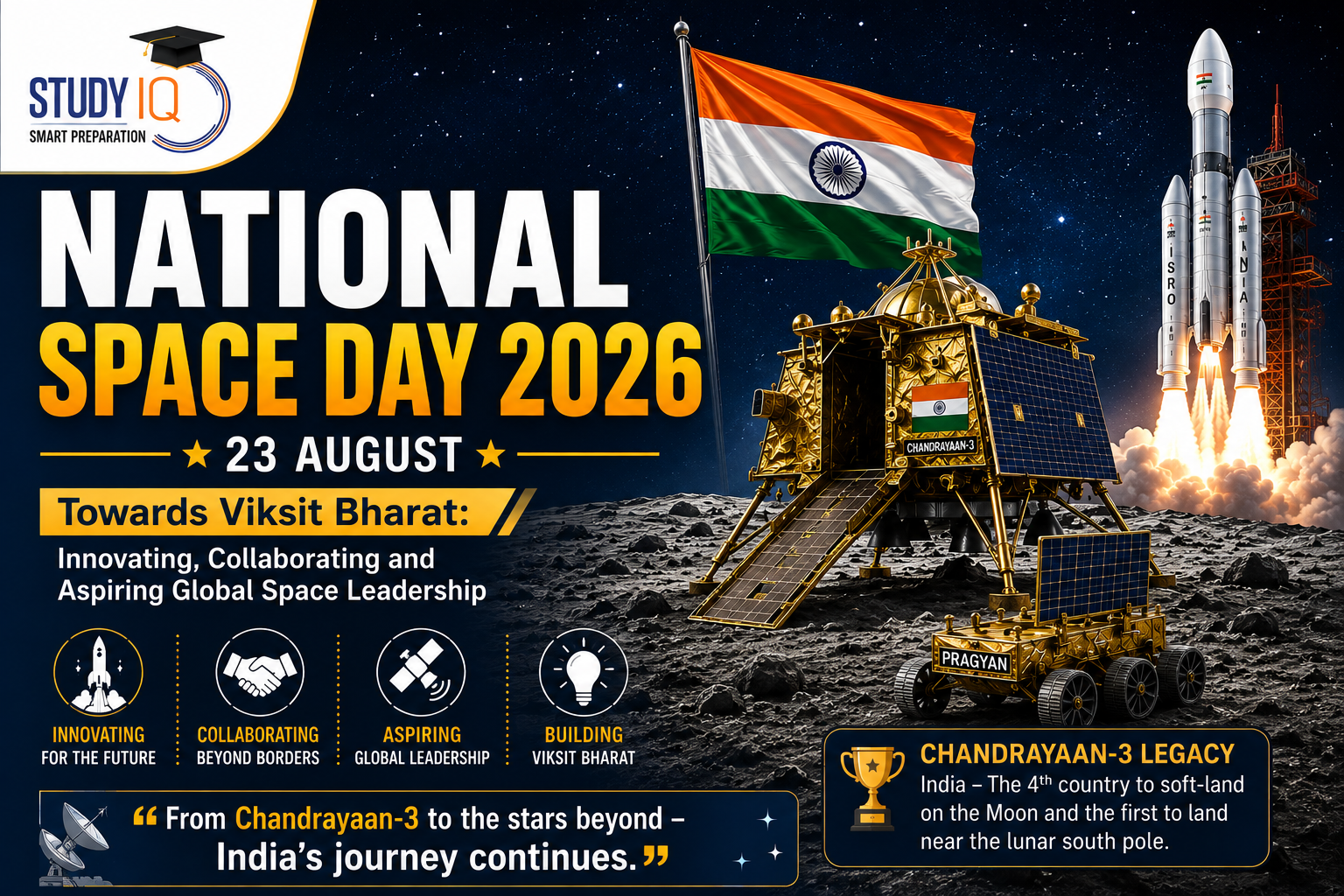
National Space Day, observed annually on 23 August, commemorates the historic soft landing of Chandrayaan-3 on the Moon in 2023. For UPSC Mains, the occasion is significant not merely as a celebration of a scientific achievement but as a lens to examine India’s technological self-reliance, strategic autonomy, space economy and global ambitions.
The 2026 theme, “Towards Viksit Bharat: Innovating, Collaborating and Aspiring Global Space Leadership”—captures India’s evolving role in the global space ecosystem.
Read Also: UPSC Daily Current Affairs 2026
Chandrayaan-3: A Technological Milestone
On 23 August 2023, ISRO successfully landed the Vikram lander of Chandrayaan-3 on the lunar surface, making India the fourth country to achieve a soft landing on the Moon. It also made India the first country to successfully land in the lunar south-polar region, an area of exceptional scientific interest because of the possibility of water ice and its unique geological conditions.
The mission comprised the Vikram lander and Pragyan rover, supported by a propulsion module. Pragyan conducted in-situ experiments, while the mission demonstrated critical capabilities in autonomous navigation, controlled descent and precision landing.
The landing site was named Shiv Shakti Point, while the Chandrayaan-2 impact site was named Tiranga Point.
Chandrayaan-3 was particularly important because it demonstrated India’s ability to learn from the partial failure of Chandrayaan-2 and successfully overcome complex technological challenges.
From Space Programme to Space Ecosystem
India’s space journey has evolved considerably since Aryabhata, the country’s first satellite. Missions such as Chandrayaan-1, Mangalyaan, Chandrayaan-2, Chandrayaan-3 and Aditya-L1 demonstrate the expansion of Indian capabilities from basic satellite applications to lunar, planetary and solar exploration.
The space sector today also extends beyond ISRO. Policy reforms have encouraged greater participation by private companies and startups, while institutions such as IN-SPACe seek to facilitate and regulate non-governmental space activities.
This transition can generate employment, attract investment, promote indigenous technologies and strengthen India’s position in the emerging global space economy.
Strategic and Developmental Significance
Space technology has implications far beyond scientific prestige.
- First, development: satellites support agriculture, weather forecasting, disaster management, telecommunications, navigation, fisheries and urban planning.
- Second, strategic autonomy: indigenous launch vehicles, satellite systems and navigation capabilities reduce dependence on foreign technological infrastructure.
- Third, economic potential: the growing private space sector can create new markets in satellite services, launch systems, Earth observation and downstream applications.
- Fourth, diplomacy: initiatives such as NISAR, developed jointly by NASA and ISRO, demonstrate how space cooperation can strengthen India’s technological and diplomatic partnerships.
Thus, India’s space programme simultaneously serves developmental, strategic, economic and diplomatic objectives.
The Road Ahead
Chandrayaan-3 should be viewed as a stepping stone rather than an endpoint. Chandrayaan-4, planned as a lunar sample-return mission, aims to take India from landing and in-situ exploration towards collecting and returning lunar material to Earth.
Similarly, Gaganyaan seeks to demonstrate India’s human-spaceflight capabilities. The proposed Bharatiya Antariksh Station reflects the longer-term ambition of sustaining human activity in space.
India is also pursuing deeper international cooperation in lunar exploration, including the LUPEX/Chandrayaan-5 framework with Japan.
These missions can strengthen domestic capabilities in robotics, propulsion, life-support systems, materials science, artificial intelligence and advanced manufacturing.
Challenges
Despite its achievements, India faces several challenges. These include the need for higher investment in space R&D, strengthening private-sector capabilities, developing indigenous critical technologies, ensuring space sustainability and addressing the growing problem of space debris.
India must also balance commercialisation with strategic and scientific priorities while ensuring that the benefits of space technology reach wider sections of society.
Way Forward
India needs a comprehensive whole-of-ecosystem approach involving government agencies, private enterprises, universities and international partners.
Key priorities should include:
- Increasing public and private investment in space R&D.
- Strengthening academia-industry collaboration.
- Promoting indigenous critical technologies.
- Expanding private participation in launch and satellite services.
- Developing capabilities in space situational awareness and debris management.
- Using Earth-observation data for climate action, agriculture and disaster resilience.
- Deepening international cooperation while preserving strategic autonomy.

 Daily Current Affairs PDF 2026: Download...
 Child Marriage in India: Causes, Impacts...
 World Development Report 2026: The Promi...














 WhatsApp