
Table of Contents
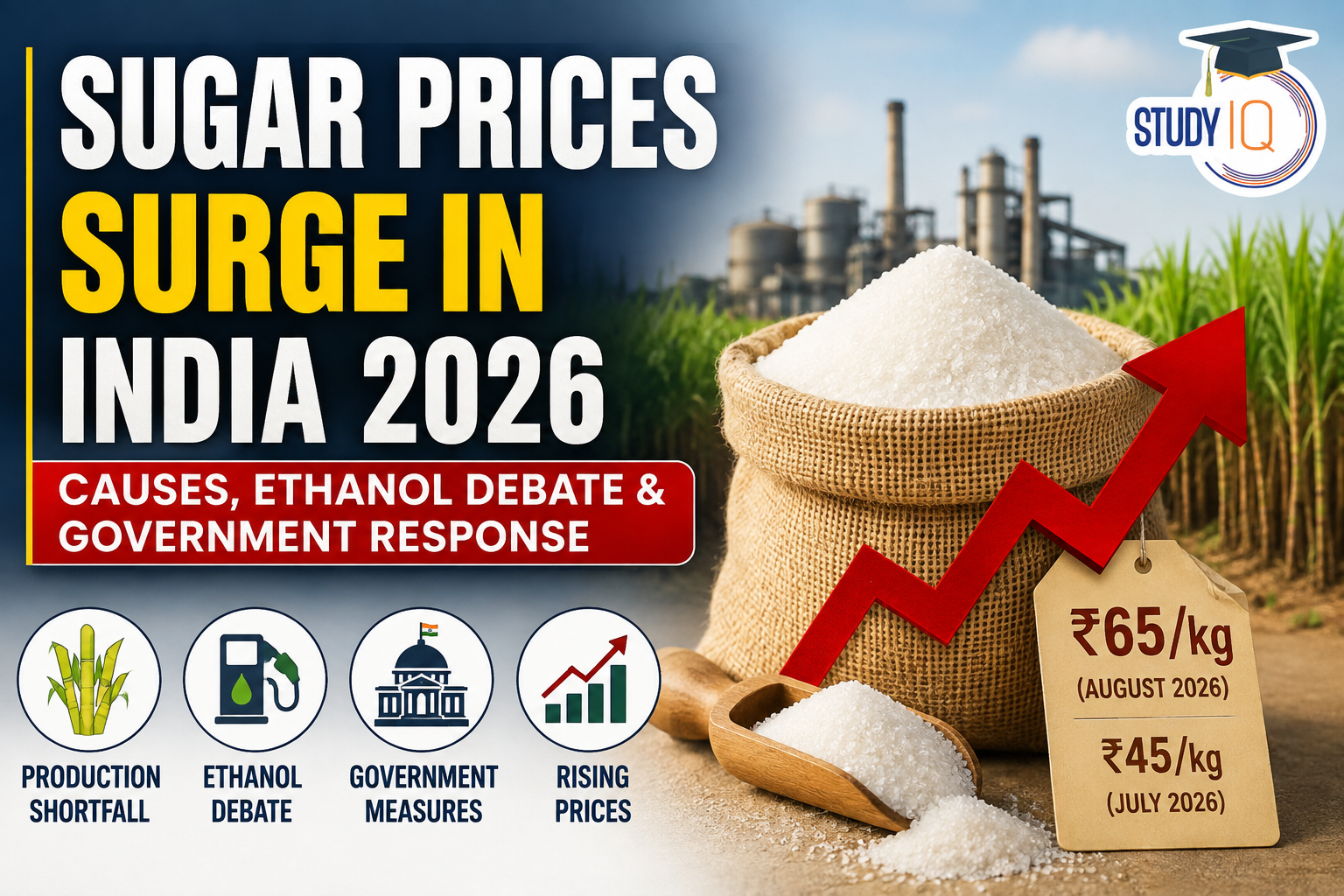
The sharp rise in sugar prices in India in 2026 highlights the complex interplay between agricultural production, climate variability, food security, market dynamics and energy policy. Retail sugar prices reportedly increased from around ₹45/kg in July to nearly ₹65/kg in August, raising concerns ahead of the festive season.
Reasons for the Sugar Price Surge
The primary cause is the shortfall in domestic sugar production. Initial estimates had projected gross sugar production at around 343.5 lakh tonnes, whereas subsequent estimates placed it near 309 lakh tonnes. This significant decline has tightened domestic supplies.
Climate-related factors played a major role. Excess rainfall and delayed monsoon withdrawal in Maharashtra, Karnataka and Gujarat during September–October 2025 caused waterlogging and reduced sunlight, affecting sugarcane growth and sucrose accumulation. In Uttar Pradesh, red rot disease and top shoot borer affected the widely cultivated Co-0238 variety, further reducing yields and sugar recovery.
Consequently, closing sugar stocks are projected to fall to around 41 lakh tonnes, among the lowest levels in recent years. Lower inventories have amplified the impact of seasonal demand expected during Dussehra and Diwali.
Other factors include speculative buying, stock accumulation by traders and mills, uncertainty regarding actual inventories and expectations of another weak sugarcane crop.
Is Ethanol Diversion Responsible?
The diversion of sugar towards ethanol has emerged as a major point of controversy. Around 30 lakh tonnes of sugar equivalent was diverted for ethanol production during the current season.
However, attributing the entire price surge to ethanol diversion would be misleading. Gross sugar production itself fell by around 34.5 lakh tonnes compared with the initial projection. Thus, the production shock was a major independent cause of the shortage.
Moreover, India’s ethanol supply is increasingly diversified. Of the approximately 810.67 crore litres supplied for blending between November 2025 and July 2026, only around 32% came from sugarcane-based feedstocks, while nearly 68% came from grain-based sources such as maize and rice.
Therefore, the present crisis is better understood as a production and inventory shock compounded by market expectations, rather than simply an ethanol-induced shortage.
Government Response
The government has undertaken several measures to stabilise prices:
- Export restrictions: Sugar exports have been prohibited until September 30, 2026 to preserve domestic availability.
- Duty-free imports: Up to 10 lakh tonnes of raw sugar have been permitted at zero duty until October 31.
- Stock limits: A 400-tonne limit has been imposed on sugar dealers to curb excessive stocking.
- Market monitoring: Mills have been asked to provide information on major bulk consumers and inventories.
- Stock verification: Authorities can verify physical stocks to detect hoarding and artificial scarcity.
These measures aim to bridge the supply gap until the next sugarcane crushing season begins.
Policy Challenges and Way Forward
India faces a delicate food-energy trade-off. Ethanol diversion helps reduce sugar surpluses, improves the financial position of sugar mills and contributes to energy security by reducing dependence on imported crude oil. However, excessive diversion during a production-deficit year can tighten sugar supplies.
Hence, India needs a dynamic and counter-cyclical sugar-ethanol policy. Ethanol diversion can be encouraged during surplus years but moderated during severe production shortages.
In addition, India should promote climate-resilient sugarcane varieties, disease-resistant cultivars, micro-irrigation and better water management. Modern forecasting using satellite imagery and weather data can improve production estimates. Real-time monitoring of inventories can also reduce speculative behaviour.
Conclusion
The 2026 sugar-price surge demonstrates that climate shocks can rapidly transform a structural surplus into a supply-constrained market. Ethanol diversion is a contributing factor but not the principal explanation for the present crisis. The way forward lies in balancing consumer affordability, farmer welfare, mill viability, food security and energy security through a flexible, climate-resilient and data-driven sugar policy.

 Panama Earthquake 2026: Location, Tecton...
 Project Seabird Phase IIA: India’s Nav...
 Daily Current Affairs PDF 2026: Download...














 WhatsApp





