Table of Contents
Food Security Act Amendment 2026: The Department of Food and Public Distribution (DFPD) has proposed amendments to the National Food Security Act (NFSA), 2013, through the draft National Food Security (Amendment) Bill, 2026.
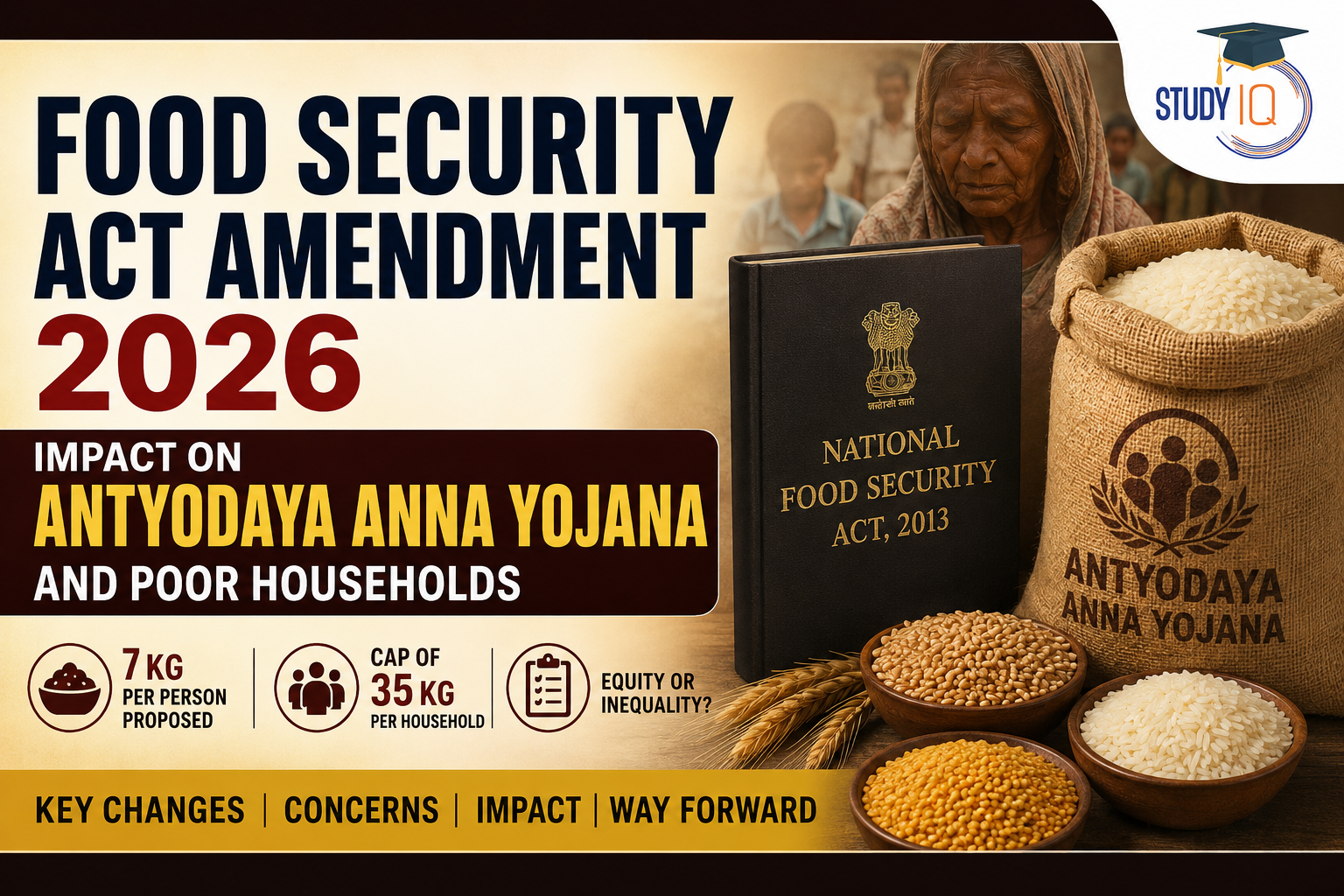
The proposal seeks to change the foodgrain entitlement of households covered under the Antyodaya Anna Yojana (AAY) from a fixed 35 kg per household per month to 7 kg per person per month, subject to a maximum of 35 kg per household. The government has stated that the objective is to remove inequities within the AAY category and make foodgrain allocation more rational.
The draft was released for public consultation, with comments invited until July 13, 2026. Therefore, it is important to note that this is a proposed amendment and not yet an enacted change.
What is the Antyodaya Anna Yojana?
The Antyodaya Anna Yojana (AAY) was launched in December 2000 to provide food security to the poorest of the poor.
Under the existing NFSA framework:
- AAY households: 35 kg foodgrains per household per month.
- Priority Households (PHH): 5 kg foodgrains per person per month.
- NFSA provides for coverage of up to 75% of the rural population and 50% of the urban population.
The AAY category is therefore intended to provide stronger protection to the most vulnerable sections of society.
What Does the Food Security Act Amendment 2026 Propose?
The major change is from a household-based entitlement to a per-person entitlement.
| Household Size | Existing AAY Entitlement | Proposed Entitlement |
|---|---|---|
| 1 member | 35 kg | 7 kg |
| 2 members | 35 kg | 14 kg |
| 3 members | 35 kg | 21 kg |
| 4 members | 35 kg | 28 kg |
| 5 members | 35 kg | 35 kg |
| 6+ members | 35 kg | 35 kg* |
*The proposed system retains a maximum ceiling of 35 kg per household.
Thus, a five-member AAY household would receive the same 35 kg as under the current system, while smaller households would receive a lower absolute quantity.
Why Has the Government Proposed the Change?
The government argues that the existing system creates intra-category inequities.
At present, a two-member AAY household and a five-member AAY household both receive 35 kg per month. Consequently, the per-capita entitlement is much higher for the smaller household.
For example:
- Two-member family: 35 ÷ 2 = 17.5 kg/person
- Five-member family: 35 ÷ 5 = 7 kg/person
The government therefore wants to link entitlement more closely to household size and nutritional requirements.
Impact on Poor Households
The proposal has generated an important debate because AAY beneficiaries are among India’s most vulnerable households.
Small households could receive less
A one-member AAY household would receive 7 kg instead of 35 kg, while a two-member household would receive 14 kg instead of 35 kg.
This could particularly affect vulnerable groups such as:
- elderly persons living alone,
- widows,
- persons with disabilities,
- households without an earning member,
- other highly vulnerable small households.
Critics argue that household size alone may not accurately reflect a family’s economic vulnerability or food requirement.
Larger households benefit relatively
For households with five members, the proposed calculation reaches the existing 35 kg ceiling. Thus, they would continue receiving 35 kg.
However, households with more than five members would still be restricted to 35 kg, despite the 7 kg per-person formula.
This means the proposal addresses one disparity but retains a separate issue created by the household ceiling.
Equality vs Equity: The Core Debate
The amendment raises an important public policy question:
Should food security be based primarily on household size or vulnerability?
The government emphasises rational and equitable allocation by linking foodgrain entitlement with the number of household members.
However, critics argue that the purpose of AAY is to protect the poorest of the poor, and some of the most vulnerable beneficiaries may be small households.
Therefore, equal per-person treatment may not always produce equitable outcomes.
Key Concerns
The proposed amendment also raises broader issues:
- Protection of vulnerable individuals: Small households may face a substantial reduction in foodgrain entitlement.
- Nutrition security: Food security involves more than cereals; access to pulses, proteins and micronutrients is also important.
- Identification of beneficiaries: Outdated beneficiary lists can create exclusion errors.
- PDS accessibility: Digitisation and biometric authentication should not become barriers for vulnerable beneficiaries.
- 35 kg ceiling: Large families remain restricted by the household-level cap.
Way Forward
A balanced approach should combine efficiency with social protection. Highly vulnerable small households could receive additional safeguards, while AAY beneficiary lists should be regularly updated.
The reform should also move beyond cereal distribution towards nutrition security, strengthen grievance redressal and reduce exclusion errors in the Public Distribution System.
UPSC Relevance
Prelims
- NFSA: 2013
- AAY launched: 2000
- Existing AAY entitlement: 35 kg/household/month
- Proposed AAY entitlement: 7 kg/person/month
- Proposed maximum: 35 kg/household/month
- PHH entitlement: 5 kg/person/month
- NFSA coverage: 75% rural and 50% urban population
Mains GS-II
- Food security
- Welfare schemes
- Social justice
- Vulnerable sections
- Public Distribution System
- Rights-based approach
Mains GS-III
- Food subsidy
- Agriculture and foodgrain management
- PDS reforms
- Nutrition security
- Fiscal sustainability
Conclusion
The Food Security Act Amendment 2026 seeks to shift AAY from a fixed 35 kg household entitlement to 7 kg per person, capped at 35 kg per household. While the proposal aims to make allocation more rational and reduce disparities between households of different sizes, it raises concerns about the protection available to highly vulnerable small households.
The larger policy challenge is to strike a balance between fiscal efficiency, administrative rationalisation and the right to food. For India’s poorest households, food-security reforms must ultimately ensure not merely equal distribution, but equitable access to adequate and nutritious food.
Read Also: UPSC Daily Current Affairs 2026
 East Sea (Sea of Japan): Location, Count...
 WMO State of Global Water Resources 2025...
 FCRA Amendment Bill 2026: Key Provisions...














 WhatsApp