Table of Contents
Context
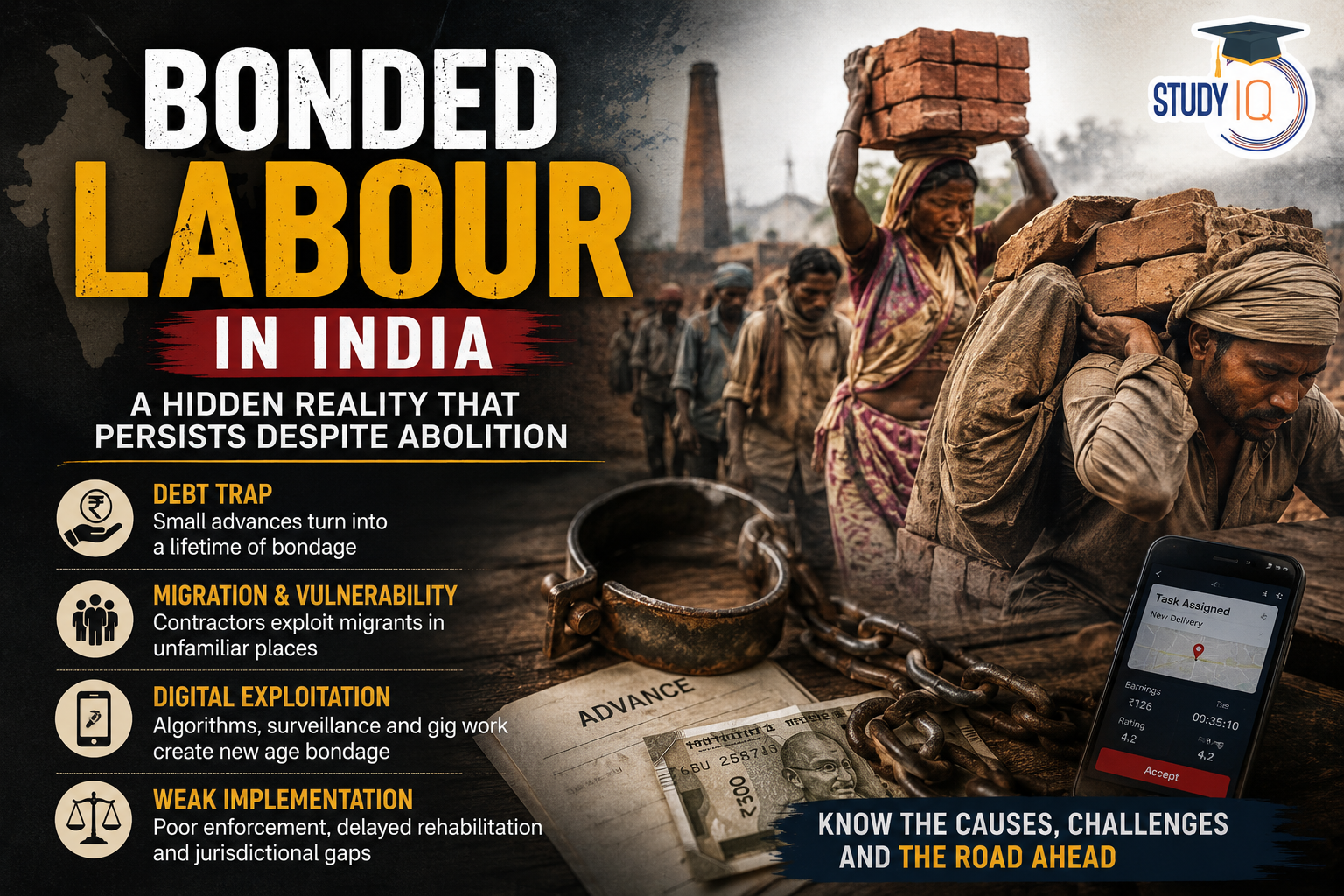
The rescue of 12 bonded labourers from a factory in Muzaffarnagar, Uttar Pradesh has reignited concerns over the persistence of bonded labour despite its abolition under the Bonded Labour System (Abolition) Act, 1976.
Why does India’s informal economy reproduce conditions favourable for bonded labour?
- Financial exclusion: Limited access to institutional credit forces poor households to rely on informal advances during crises or seasonal unemployment. This creates the initial debt relationship that pulls workers into informal labour markets.
- Debt collateralisation: In the absence of written contracts, the advance becomes collateral for labour rather than a simple loan. Employers can unilaterally determine wages, repayment, interest and working conditions, converting temporary debt into long-term labour bondage.
- g., Brick kiln workers in Punjab and Haryana frequently find their outstanding debt inflated at the end of the season, extending bondage into the next production cycle.
- Labour intermediation: Migrant workers depend on labour contractors (thekedars) for employment, housing, transport and basic necessities. This concentration of control restricts their mobility and bargaining power, making escape from bonded work difficult.
- g., Odisha-Andhra Pradesh brick kiln migrants have reported contractors retaining Aadhaar cards to prevent workers from leaving.
- Exit barriers: Caste hierarchies and dominant employer networks restrict access to alternative jobs, land leases and local support systems. Workers leaving bonded labour therefore face social ostracism and livelihood loss, reinforcing dependence.
- g., NHRC documented Dalit families in Tamil Nadu being denied irrigation water and local employment after leaving bonded agricultural work.
- Rehabilitation failure: Delayed Release Certificates, weak District Vigilance Committees and poor coordination between source and destination states delay rehabilitation assistance. Without immediate livelihood support, many rescued workers return to debt bondage for survival.
- g., A 2021 survey in Bihar’s Gaya district found several rescued labourers re-entering bonded work due to delayed rehabilitation.
How has interstate migration transformed the nature of bonded labour?
- Contractor intermediation: Interstate migration has shifted bonded labour from direct employer–worker relationships to contractor-mediated recruitment. Labour contractors recruit workers, provide advances, arrange transport and allocate them to multiple employers, distancing the debt relationship from the workplace and diffusing the principal employer’s legal liability.
- g., Jharkhand workers recruited for Punjab’s paddy transplantation often receive advances from village-level contractors who later subcontract them to farmers.
- Structural anonymity: Migrants work in unfamiliar linguistic, social and administrative environments where they lack local identity and support networks. This structural anonymity weakens bargaining power and makes dependence on contractors a more effective mechanism of control than traditional village-based social ties.
- g., Contractors recruiting tribal workers from Chhattisgarh for Kerala plantations exploit workers’ unfamiliarity with the local language and administrative systems.
- Entitlement deficit: Crossing state borders disconnects migrant workers from locally anchored welfare, healthcare and grievance mechanisms. This loss of portable entitlements makes contractors the primary providers of housing, food and credit, deepening workers’ dependence.
- g., Odisha-Andhra Pradesh brick kiln migrants have reported contractors withholding Aadhaar cards to restrict access to welfare and prevent workers from leaving.
- Enclave exploitation: Bonded labour now extends beyond wages to employer-controlled hostels, labour colonies and remote worksites. These isolated enclaves restrict workers’ movement and limit contact with labour inspectors, trade unions and civil society.
- g., Under the Sumangali scheme, spinning mills in Tamil Nadu confined many young women workers to factory hostels with severely restricted movement.
- Jurisdictional fragmentation: Interstate migration divides responsibility between source and destination states, weakening rescue, rehabilitation and prosecution. Weak implementation of the Inter-State Migrant Workmen Act, 1979, the Occupational Safety, Health and Working Conditions Code, 2020, and poor coordination among District Vigilance Committees allow many cases to fall through administrative gaps.
- g., Rescue and rehabilitation of migrant bonded labourers from Bihar working in Tamil Nadu have often been delayed due to weak inter-state coordination and verification.
How has digitalisation changed the forms of labour exploitation?
- Algorithmic control: Digital platforms manage work through ratings, acceptance rates and automated task allocation rather than direct managerial supervision. This shifts disciplinary power from a visible employer to an opaque algorithm, making decisions on pay, work allocation and deactivation difficult to question or contest.
- g., Food delivery riders on Swiggy and Zomato have reported sudden ID deactivation through automated fraud-detection systems without any human explanation.
- Digital surveillance: GPS tracking, behavioural analytics and performance scoring enable continuous monitoring of workers beyond the traditional workplace. Algorithmic surveillance shapes worker behaviour through incentives and penalties, extending employer control without direct supervision.
- g., Ola and Uber drivers have reported acceptance-rate algorithms penalising ride rejections, effectively keeping them under continuous performance monitoring.
- Employment misclassification: Digital platforms classify workers as “partners” or “independent contractors” instead of employees. This contractual arrangement excludes them from statutory protections such as minimum wages, provident fund and industrial dispute mechanisms despite exercising significant control over their work.
- g., The Code on Social Security, 2020 introduced a separate category for gig workers, recognising that platform workers largely fall outside conventional employer–employee relationships.
- Risk transfer: Digital platforms pay only for completed tasks, transferring business risks such as idle time, fuel costs, vehicle maintenance and demand fluctuations onto workers. This increases work intensity while reducing income security without providing the autonomy associated with self-employment.
- g., A 2021 Fairwork India study found delivery workers often earned below state minimum wages after accounting for unpaid waiting time between deliveries.
- Workforce fragmentation: Platform workers are dispersed across cities without a common workplace, limiting interaction and collective organisation. App-based grievance systems individualise disputes, weakening collective bargaining and unionisation.
- g., Driver unions in Delhi and Bengaluru have struggled to organise platform workers, who largely coordinate through informal WhatsApp groups instead of shared workplaces.
Read Also: UPSC Daily Current Affairs 2026
 India–Poland Relations 2026: Strategic...
 Supreme Court on Children's Right to Int...
 Daily Current Affairs PDF 2026: Download...














 WhatsApp