Table of Contents
Context
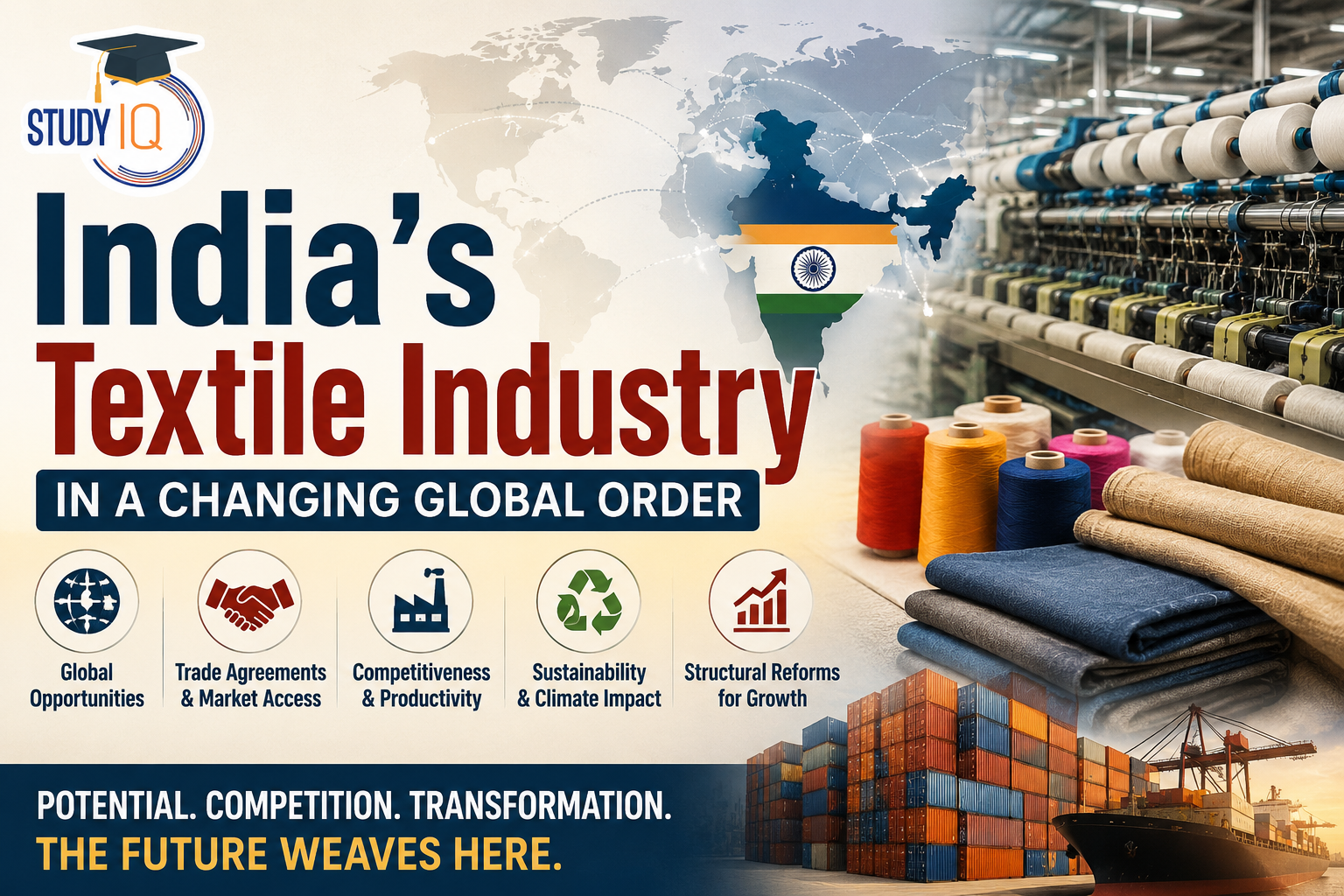
According to a 360 ONE Capital research report, India’s textile industry is entering a new growth phase, driven by China+1 sourcing, supply-chain diversification, and expanding trade agreements. However, translating this opportunity into sustained export growth will require structural transformation in competitiveness, productivity, and manufacturing scale.
Why have Bangladesh and Vietnam outperformed India in apparel exports despite having smaller textile ecosystems?
- Labour Cost and Productivity Advantage: Competitive wages, flexible labour regulations, and higher shop-floor productivity reduce unit labour costs, making apparel manufacturing more globally competitive than in India.
- g., Bangladesh’s minimum wage is roughly one-third of India’s organized sector wage, while Vietnam has consistently recorded higher manufacturing labour productivity growth.
- Preferential Trade Access: Duty-free access and high-quality FTAs reduce tariff costs, improving export competitiveness in major consumer markets.
- g., Bangladesh’s EBA access to the EU and Vietnam’s EVFTA provide a tariff advantage over Indian apparel exports.
- MMF-Oriented Production: Vietnam and Bangladesh aligned production with rising global demand for man-made fibre (MMF) garments, while India’s cotton-centric ecosystem, reinforced by past policy biases, slowed MMF expansion.
- g., MMF accounts for over 70% of global apparel trade but constitutes a relatively smaller share of India’s apparel exports.
- Lead-Time Optimization: Efficient logistics, faster customs, and streamlined export procedures enable quicker delivery, a decisive advantage in fast-fashion supply chains.
- g., Vietnam’s shorter port-to-shipment turnaround helps meet the 4–6-week replenishment cycles of buyers such as Zara and H&M.
- FDI-Led Integrated Manufacturing Scale: Export-oriented FDI has created large, integrated garment clusters capable of delivering high-volume orders with consistent quality and lower unit costs, unlike India’s fragmented MSME-dominated industry.
How has fast fashion altered the competitive dynamics of the global textile industry?
- Compression of Product Cycles: Fast fashion reduced design-to-shelf timelines from seasonal collections to weeks, making speed and agile production more important than traditional scale or raw material availability.
- g., Zara introduces new designs to stores in under three weeks, compared to the traditional six-month seasonal cycle.
- Shift towards Time-Sensitive Sourcing: Global buyers increasingly combine cost with lead time and supply-chain reliability, favouring suppliers that can rapidly replenish orders within their sourcing geography.
- g., Zara relies on near-shore suppliers such as Spain, Portugal and Morocco for rapid replenishment, while brands source larger-volume collections from Vietnam and Bangladesh.
- Rise of Regional Production Networks: Fast fashion strengthened regional value chains, where efficient cross-border sourcing of inputs and seamless logistics matter more than complete domestic integration.
- g., Vietnam imports most fabrics from Southern China but achieves rapid exports through efficient logistics and customs connectivity.
- Sustainability as a Competitive Imperative: Rapid product turnover has increased textile waste, carbon emissions, and regulatory scrutiny, making environmental compliance a key determinant of market access.
- g., The EU’s sustainability regulations and growing textile waste in countries such as Ghana are reshaping sourcing decisions.
- Reconfiguration of Global Value Chains: Fast fashion shifted governance towards buyer-driven value chains while rewarding reliable, compliant manufacturers with long-term sourcing relationships.
- g., Large Bangladeshi and Vietnamese suppliers secure repeat contracts by consistently meeting quality, compliance, and delivery standards despite thin margins.
How is climate change likely to reshape the future demand for the textile industry?
- Shift towards Sustainable Fibre Mix: Climate stress on cotton production is increasing demand for recycled, regenerated, and other sustainable fibres that reduce dependence on climate-sensitive raw materials.
- Preference for Climate-Resilient Sourcing: Rising climate disruptions are increasing buyer preference for suppliers located in regions with lower exposure to floods, heatwaves, and other climate risks, ensuring more reliable deliveries.
- g., Recurrent flooding in Bangladesh has encouraged global brands to diversify sourcing across multiple production locations to reduce climate-related supply-chain risks.
- Sustainability as a Market Access Requirement: Climate-related regulations are making sustainable production a prerequisite for accessing premium export markets, shifting demand towards compliant manufacturers.
- g., The EU’s Ecodesign for Sustainable Products Regulation (ESPR) and Digital Product Passport requirements are reshaping sourcing decisions in the textile sector.
- Rise of Circular Fashion: Growing climate awareness is increasing demand for durable, repairable, reusable, and recyclable apparel, reducing reliance on linear fast-fashion consumption.
- g., Resale, rental, and repair-based apparel markets are expanding rapidly across Europe and North America.
- Demand for Water-Efficient Processing: Growing water scarcity is increasing buyer preference for manufacturers adopting water-efficient dyeing, recycling, and closed-loop processing technologies.
- g., Water shortages in textile clusters such as Tiruppur have disrupted production, accelerating the adoption of zero-liquid-discharge and water-recycling technologies.
What structural transformation is required for India to regain its historical leadership in the global textile industry?
- Build an MMF-Led and Future-Ready Textile Ecosystem: India should eliminate inverted duty structures, ensure affordable access to synthetic raw materials, and expand man-made, recycled, and technical textile capacity to align with global demand.
- Transition from Fragmented Production to Scalable Manufacturing Networks: India should complement MSME flexibility with consortium-led sourcing, integrated clusters, and common infrastructure to achieve economies of scale without sacrificing production agility.
- g., India can emulate Vietnam’s cluster-based manufacturing model, where integrated production networks enable large export orders while specialized firms remain part of the same value chain.
- Strengthen Labour Market Ecosystems: Beyond labour-code implementation, India should improve migrant worker housing, portable social security, skill development, and workforce retention to support large-scale formal apparel manufacturing.
- g., Seasonal labour shortages in hubs such as Tiruppur highlight the need for labour-market reforms beyond regulatory simplification.
- Convert Trade Access into Export Competitiveness: Recent FTAs must be complemented by improvements in quality standards, ESG compliance, and supply-chain readiness so Indian firms can fully utilize preferential market access.
- g., The India–UK FTA and the concluded India–EU FTA negotiations create new opportunities that require industry-wide upgrading to capture export gains.
- Reduce Non-Tariff Barriers through Logistics Modernization: India should reduce inland logistics costs, improve multimodal connectivity, and shorten export turnaround times to match global fast-fashion supply chains.
Read Also: UPSC Daily Current Affairs 2026
 India–Poland Relations 2026: Strategic...
 Supreme Court on Children's Right to Int...
 Daily Current Affairs PDF 2026: Download...














 WhatsApp