Table of Contents
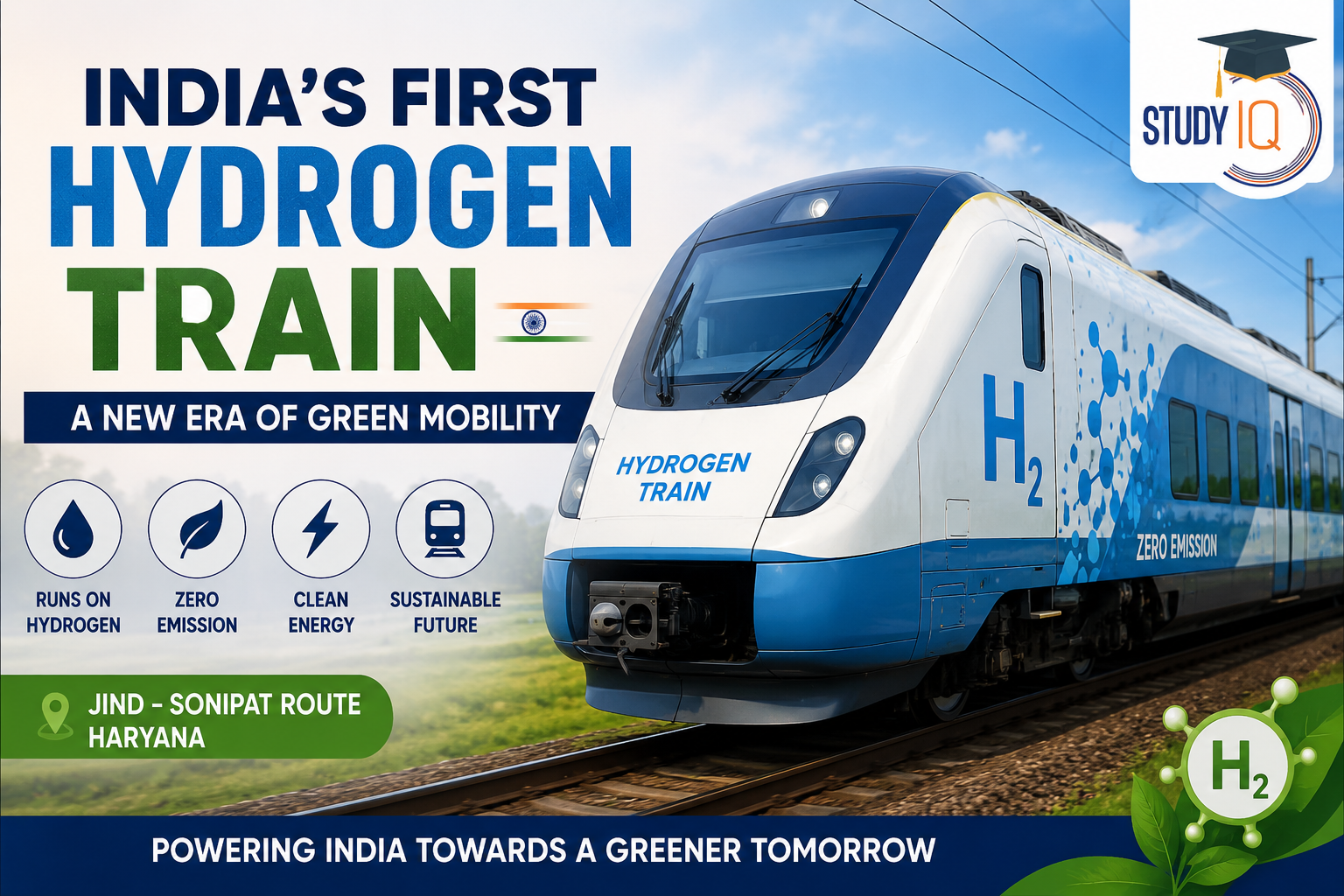
India has taken a significant step towards green transportation with the launch of its first hydrogen-powered train on the Jind–Sonipat route in Haryana. Flagged off by the Prime Minister, this landmark initiative places India among the select nations exploring hydrogen-based railway technology for sustainable and low-emission public transport.
Hydrogen-powered trains are expected to play a crucial role in reducing dependence on diesel locomotives while supporting India’s commitment to achieving Net Zero emissions by 2070.
What is a Hydrogen Train?
A Hydrogen Train is a railway system powered by hydrogen fuel cells instead of conventional diesel engines. The fuel cells convert hydrogen into electricity onboard, which powers electric motors to drive the train.
Unlike diesel locomotives, hydrogen trains emit only water vapour, making them one of the cleanest forms of rail transport.
India’s First Hydrogen Train: Key Highlights
| Particular | Details |
|---|---|
| Project | India’s First Hydrogen-Powered Train |
| Route | Jind–Sonipat, Haryana |
| Maximum Speed | 75 km/h |
| Power Output | 2,400 kW |
| Hydrogen Storage | Around 440 kg |
| Fuel Cell Supplier | Ballard Power Systems (Canada) |
| Technology | Hydrogen Fuel Cell + LiFePO₄ Battery |
| Emission | Water Vapour Only |
Key Features of India’s Hydrogen Train
1. High Power Output
The train delivers 2,400 kW of power, making it one of the most powerful hydrogen trainsets globally.
2. Hydrogen Storage Capacity
It carries approximately 440 kg of compressed hydrogen stored in high-pressure tanks.
3. Eco-Friendly Transportation
The train produces zero carbon emissions at the point of use, releasing only water vapour.
4. Hybrid Energy System
The train combines:
- Hydrogen Fuel Cells
- Lithium Iron Phosphate (LiFePO₄) Batteries
This hybrid arrangement improves efficiency and operational reliability.
5. Retrofitted Design
Instead of manufacturing an entirely new train, Indian Railways has retrofitted an existing Diesel Electric Multiple Unit (DEMU) by replacing diesel engines with hydrogen-electric propulsion.
How Does a Hydrogen Train Work?
The hydrogen-powered train operates through an integrated fuel-cell and battery system.
Step 1: Hydrogen Storage
Compressed hydrogen is stored in specially designed high-pressure tanks mounted on the train.
Step 2: Fuel Cell Reaction
Hydrogen enters the fuel cell and reacts with oxygen from the atmosphere.
Step 3: Electricity Generation
The electrochemical reaction produces electricity without combustion.
Step 4: Power Supply
The electricity powers the electric traction motors that move the train.
Step 5: Battery Support
The LiFePO₄ battery:
- Supplies extra power during acceleration.
- Stores excess electricity generated during low-demand periods.
- Improves overall energy efficiency.
Step 6: Zero Emission
The only by-product of the reaction is water vapour, making hydrogen trains environmentally friendly.
Working Mechanism Flowchart
Hydrogen Tank → Fuel Cell → Electricity Generation → Battery Management System → Electric Motor → Train Movement
World’s First Hydrogen Train
The Coradia iLint, developed by Alstom, became the world’s first commercial hydrogen-powered passenger train.
Key Facts
| Feature | Details |
|---|---|
| Train | Coradia iLint |
| Company | Alstom |
| Country | Germany |
| Commercial Launch | 2018 |
| Fuel | Hydrogen Fuel Cell |
The successful deployment of Coradia iLint inspired several countries, including India, to adopt hydrogen-based rail transport.
Advantages of Hydrogen Trains
Zero Tailpipe Emissions
Hydrogen trains emit only water vapour, significantly reducing greenhouse gas emissions.
Reduced Air Pollution
They eliminate particulate matter and nitrogen oxide emissions associated with diesel locomotives.
Lower Noise Levels
Electric propulsion systems are quieter than diesel engines.
Energy Security
Hydrogen can be produced domestically using renewable energy, reducing dependence on imported fossil fuels.
Suitable for Non-Electrified Routes
Hydrogen trains offer an alternative to expensive railway electrification in remote regions.
Challenges of Hydrogen Trains
High Initial Cost
Hydrogen fuel cell technology remains more expensive than conventional diesel systems.
Hydrogen Production
Most hydrogen is currently produced from natural gas, which generates carbon emissions unless green hydrogen is used.
Storage Infrastructure
Hydrogen requires specialized high-pressure storage tanks and dedicated refuelling stations.
Safety Measures
Hydrogen is highly flammable, necessitating advanced storage and monitoring systems.
Limited Infrastructure
India needs significant investment in hydrogen production, transportation, and refuelling infrastructure.
Hydrogen Trains vs Diesel Trains
| Parameter | Hydrogen Train | Diesel Train |
|---|---|---|
| Fuel | Hydrogen | Diesel |
| Emissions | Water Vapour | CO₂, NOx, PM |
| Noise | Low | High |
| Maintenance | Moderate | Higher |
| Environmental Impact | Very Low | High |
| Fuel Source | Renewable Possible | Fossil Fuel |
Significance for India
The launch of India’s first hydrogen-powered train aligns with several national priorities:
- Promotes green mobility and clean transportation.
- Supports the National Green Hydrogen Mission.
- Helps reduce dependence on imported fossil fuels.
- Advances India’s goal of achieving Net Zero emissions by 2070.
- Encourages indigenous innovation in clean energy technologies.
- Demonstrates Indian Railways’ commitment to sustainable modernization.
UPSC Prelims Facts
- Route: Jind–Sonipat (Haryana)
- Maximum Speed: 75 km/h
- Power: 2,400 kW
- Hydrogen Storage: 440 kg
- Technology: Hydrogen Fuel Cell + LiFePO₄ Battery
- Fuel Cell Supplier: Ballard Power Systems (Canada)
- World’s First Commercial Hydrogen Train: Coradia iLint (Germany, 2018)
- Emission: Water Vapour
 World Food Day 2026: Strengthening Nutri...
 International Day for the Eradication of...
 India’s Ramsar Sites Reach 103: Sukhna...














 WhatsApp