
Table of Contents
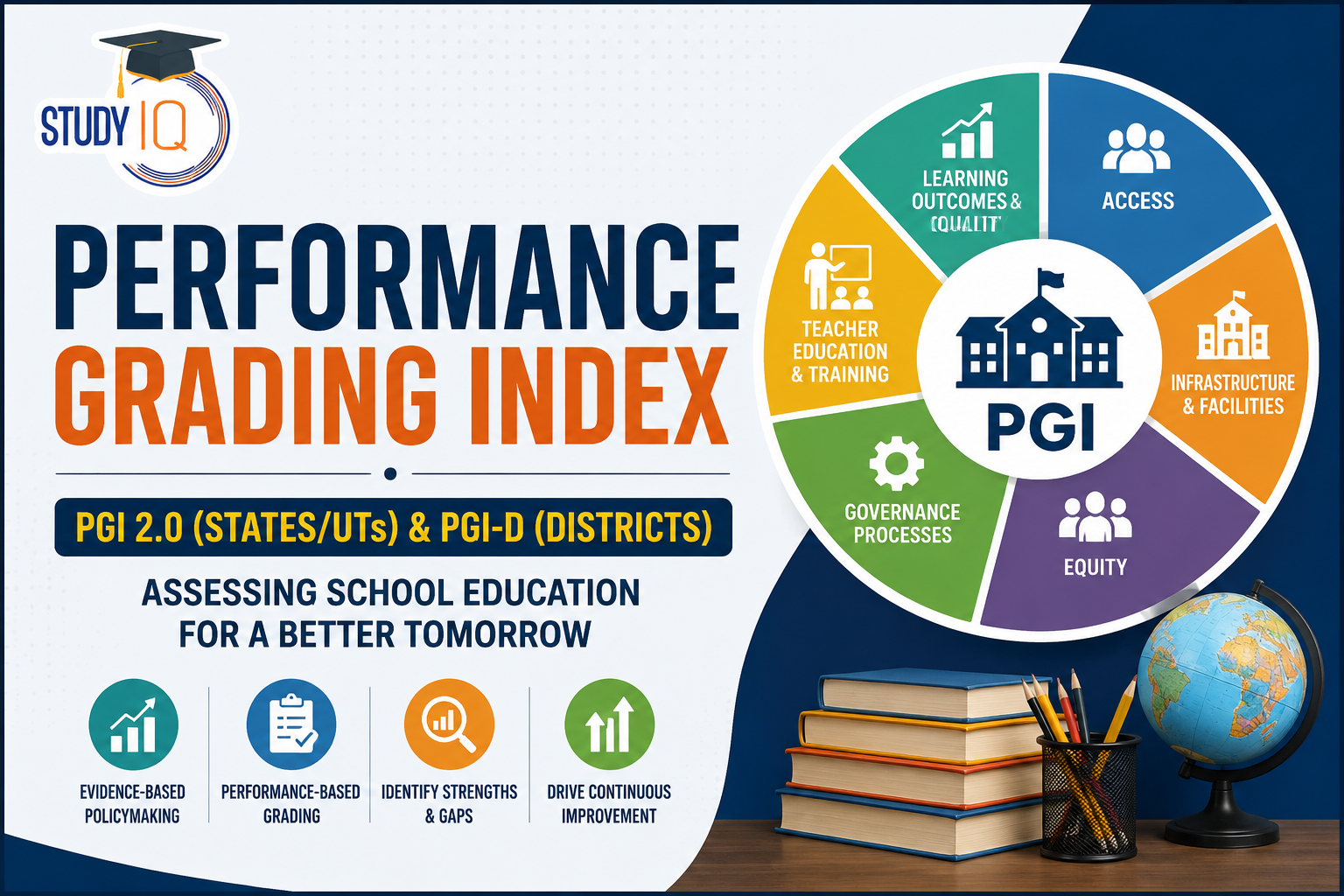
The Ministry of Education has released the Performance Grading Index (PGI) 2.0 for States and Union Territories (2025–26) along with the Performance Grading Index for Districts (PGI-D). The framework serves as an important tool for evaluating the performance of school education systems across India through data-driven indicators.
PGI has become an important topic for UPSC, State PCS, and other competitive examinations as it reflects India’s efforts to improve the quality, accessibility, and governance of school education through evidence-based policymaking.
What is the Performance Grading Index (PGI)?
The Performance Grading Index (PGI) is an assessment framework developed by the Department of School Education & Literacy (DoSEL) under the Ministry of Education.
It measures the performance of States, Union Territories, and districts on various aspects of school education using a standardized set of indicators. Rather than ranking governments solely on enrollment or examination results, PGI evaluates the overall effectiveness of the education system.
Objectives of PGI
The major objectives of the Performance Grading Index are:
- Assess the quality of school education across States, UTs, and districts.
- Promote evidence-based policy formulation.
- Encourage healthy competition among States and districts.
- Identify strengths and gaps in educational outcomes.
- Improve governance, accountability, and transparency.
- Support targeted interventions for better educational performance.
Performance Grading Index (PGI) 2.0 for States and Union Territories
PGI 2.0 evaluates the performance of States and Union Territories using a comprehensive framework based on measurable indicators.
Key Features
| Particular | Details |
|---|---|
| Implementing Agency | Department of School Education & Literacy (DoSEL), Ministry of Education |
| Assessment Scale | 1,000 Points |
| Number of Indicators | 70 |
| Coverage | All States and Union Territories |
| Categories | Outcomes; Governance & Management |
Six Domains of PGI 2.0
The 70 indicators are grouped under six major domains.
1. Learning Outcomes & Quality
This domain measures:
- Student learning achievements
- Foundational literacy and numeracy
- Assessment quality
- Academic performance
2. Access
Evaluates:
- Enrollment
- School availability
- Retention rates
- Transition rates
3. Infrastructure & Facilities
Includes indicators related to:
- School buildings
- Classrooms
- Toilets
- Drinking water
- Electricity
- ICT infrastructure
4. Equity
Measures educational inclusion for:
- Girls
- Scheduled Castes (SCs)
- Scheduled Tribes (STs)
- Children with Special Needs (CWSN)
- Other disadvantaged groups
5. Governance Processes
Assesses:
- School administration
- Financial management
- Monitoring mechanisms
- Data reporting
- Implementation of education schemes
6. Teacher Education & Training
Focuses on:
- Teacher vacancies
- Professional development
- Capacity building
- In-service training
- Teacher quality
Data Sources Used in PGI 2.0
The assessment relies on multiple verified government databases, including:
- UDISE+
- PARAKH Rashtriya Sarvekshan
- PM POSHAN
- PRABANDH Portal
- Vidyanjali Portal
These databases ensure standardized, reliable, and comparable educational data across India.
Performance Grading Index for Districts (PGI-D)
The Performance Grading Index for Districts (PGI-D) extends the assessment framework to the district level, helping identify local disparities and improving district-level planning.
Key Features
| Particular | Details |
|---|---|
| Assessment Scale | 600 Points |
| Number of Indicators | 70 |
| Coverage | Districts across India |
Major Parameters under PGI-D
District performance is assessed on:
- Learning outcomes
- School infrastructure
- Digital learning
- School safety
- Governance
- Teacher availability
- Educational access
- Equity
- Classroom resources
Data Sources for PGI-D
The district index uses data from:
- UDISE+
- PARAKH Rashtriya Sarvekshan
- PRABANDH Portal
Importance of PGI
The Performance Grading Index plays a significant role in improving India’s school education ecosystem.
Promotes Data-Driven Governance
Governments can identify weak-performing sectors and allocate resources efficiently.
Encourages Healthy Competition
States and districts strive to improve educational performance through better policies and implementation.
Improves Accountability
The framework creates measurable benchmarks for educational governance.
Supports Policy Reforms
PGI helps policymakers design targeted interventions based on objective data.
Strengthens Cooperative Federalism
States learn from best-performing regions and adopt successful educational practices.
Challenges in PGI Implementation
Despite its usefulness, PGI faces certain challenges:
- Dependence on accurate and timely data reporting.
- Variations in administrative capacity among States.
- Infrastructure gaps in remote and aspirational districts.
- Teacher shortages affecting educational outcomes.
- Socio-economic disparities influencing educational performance.
Way Forward
To maximize the effectiveness of PGI, governments should:
- Strengthen real-time educational data systems.
- Improve teacher recruitment and training.
- Invest in digital infrastructure.
- Focus on learning outcomes rather than only enrollment.
- Increase community participation in school governance.
- Regularly monitor district-level progress and share best practices.
Latest UPSC Updates
| Resource | Link |
|---|---|
| UPSC Prelims Result 2026 | Check Here |
| UPSC Exam Calendar 2027 | View Calendar |
| UPSC Question Paper 2026 | Download PDF |
| UPSC Prelims Answer Key 2026 | Check Answer Key |
| UPSC Cut Off 2026 | View Cut Off |
| UPSC Syllabus 2026 | Read Syllabus |
| Daily Current Affairs 2026 | Read Updates |
| StudyIQ UPSC IAS Foundation 2027 (English) | Join Course |
| StudyIQ UPSC IAS Foundation 2027 (Hindi) | Join Course |
| StudyIQ UPSC IAS Foundation 2027 (Bilingual) | Join Course |
 Circular Economy in India: Benefits, Cha...
 EPFO Wage Ceiling Hike 2026: Social Secu...
 Daily Mains Articles 2026 – Updated Da...














 WhatsApp





