Table of Contents
Context
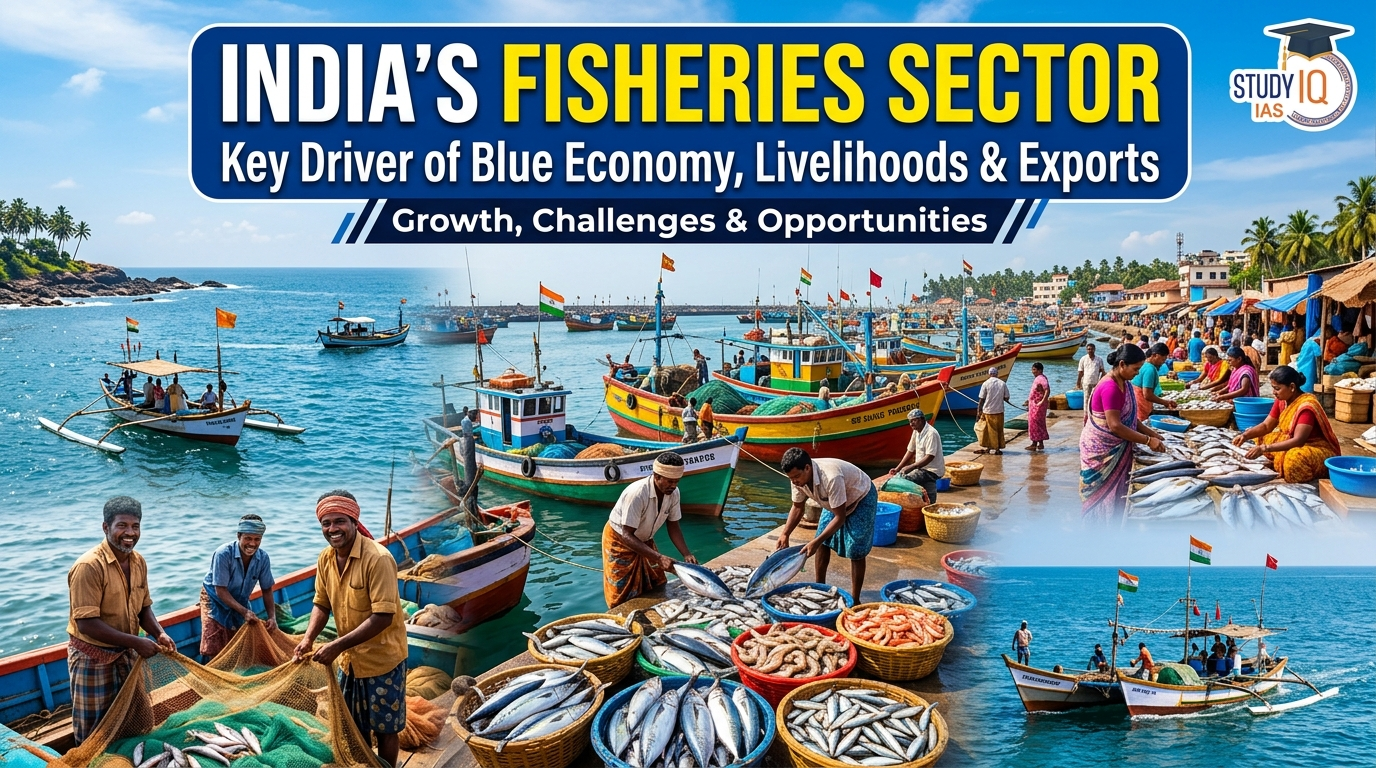
The Government’s recent assessment, based on the Central Marine Fisheries Research Institute (CMFRI), reports that 91.1% of India’s assessed marine fish stocks are sustainable.
Why is India’s Fisheries Sector Important?
- Ensuring Food and Nutritional Security: Fisheries provide an affordable source of high-quality protein, essential fatty acids, vitamins, and micronutrients, strengthening dietary security and reducing malnutrition, particularly in coastal and rural communities.
- Supporting Livelihoods and Inclusive Rural Development: The sector sustains livelihoods across capture fisheries, aquaculture, processing, transportation, and marketing while creating employment opportunities for women, small fishers, and allied workers.
- g. Fisheries support the livelihoods of nearly 3 crore people, including members of Fish Farmer Producer Organizations (FFPOs).
- Contributing to Agricultural Growth: As the fastest-growing allied agricultural sector, fisheries diversify rural incomes and strengthen India’s agricultural economy.
- g. The sector contributes about 7.43% of Agricultural Gross Value Added, the highest among allied agricultural sectors.
- Strengthening Export Competitiveness: India is among the world’s leading exporters of shrimp and marine products, generating foreign exchange earnings and integrating domestic producers into global seafood value chains.
- g. Marine product exports earned approximately ₹62,408 crore during Financial Year 2024–25.
- Supporting Maritime Presence and Resource Stewardship: Fishing communities maintain a continuous economic presence across India’s coastal waters and Exclusive Economic Zone, contributing to marine resource utilisation and strengthening surveillance against Illegal, Unreported and Unregulated (IUU) fishing alongside maritime enforcement agencies.
What are the Key Challenges for India’s Fisheries Sector
- Weak Scientific Assessment of Marine Fish Stocks: India mainly relies on landing (catch) data instead of direct scientific assessments of fish stocks, which may not reflect the true condition of marine resources.
- g. The claim that 91.1% of assessed marine fish stocks are sustainable is questioned because higher catches may result from more fishing effort (more boats, longer fishing hours, and better gear), even as Catch Per Unit Effort (CPUE)declines, indicating shrinking fish populations.
- Technological Intensification and Ecosystem Degradation: Advances in mechanised fishing, sonar, synthetic nets, and high-powered engines have significantly increased fishing capacity, while bottom trawling, mangrove loss, pollution, and reduced river nutrient flows have degraded breeding and nursery habitats.
- g. India operates over 64,000 mechanised fishing vessels, and bottom trawling has caused extensive degradation of benthic ecosystems that support commercially important species.
- Institutional Fragmentation and Weak Fisheries Governance: Fragmented institutional responsibilities, weak scientific monitoring, inadequate enforcement of fishing regulations, and limited participation of fishing communities undermine sustainable fisheries management.
- g. Restrictions on mechanised fishing within 5 nautical miles remain weakly enforced due to limited surveillance and monitoring capacity.
- Livelihood Trap and Resource Conflicts: Declining fish stocks reduce fisher incomes, but limited alternative livelihoods compel fishing communities to intensify fishing effort, reinforcing overexploitation and creating a self-perpetuating cycle of resource depletion.
- g. Competition over shrinking resources has intensified conflicts between mechanised and artisanal fishers and pushed trawlers into neighbouring waters such as the Palk Bay, leading to recurring India-Sri Lanka fishing disputes.
- Limited Standalone Role of Deep-Sea Fishing: While deep-sea fishing can improve utilisation of India’s Exclusive Economic Zone (EEZ) and strengthen its presence against Illegal, Unreported and Unregulated (IUU) fishing, it cannot substitute for restoring degraded coastal ecosystems where the majority of fish production and livelihoods are concentrated.
- g.FAO assessments indicate that deep-sea fisheries offer only limited additional production compared to the gains achievable through sustainable management of coastal fisheries.
- Emerging Long-Term Pressures: Climate change, ocean warming, marine heatwaves, and rising demand for fish protein are expected to further increase pressure on already stressed marine ecosystems.
- g. The FAO’s State of World Fisheries and Aquaculture reports that nearly 90% of global marine fish stocks are fully exploited, overfished, or depleted.
What Should be the Way Forward for Sustainable Development of India’s Fisheries Sector?
- Adopt an Ecosystem Approach to Fisheries Management: Integrate landing (catch) data with Catch Per Unit Effort (CPUE), ecosystem-based fish stock assessments, benthic habitat surveys, and real-time monitoring to enable evidence-based fisheries management.
- g. Strengthen scientific assessments through the Central Marine Fisheries Research Institute (CMFRI) by combining ecological surveys with landing statistics for accurate stock estimation.
- Restore Coastal and Marine Ecosystems: Conserve mangroves, estuaries, coral reefs, and benthic habitats while reducing marine pollution and maintaining environmental river flows to rebuild fish breeding grounds and coastal productivity.
- g. Strengthen habitat restoration through the Integrated Coastal Zone Management (ICZM) programme.
- Strengthen Participatory Fisheries Governance: Expand vessel registration, Vessel Monitoring Systems (VMS), digital licensing, and surveillance while ensuring community participation, transparency, and shared ownership of fisheries data to improve compliance and trust.
- g. Community-led fisheries management, supported by Vessel Monitoring Systems (VMS), can protect traditional fishing rights while improving enforcement.
- Support Fisheries-Based Livelihood Diversification: Gradually rationalise excessive mechanised fishing capacity while providing transition finance, vessel buyback schemes, skill development, and livelihood opportunities that build on existing marine skills rather than requiring entirely new occupations.
- g. Promote sustainable long-lining, mariculture, open-sea cage culture, fish processing, and value-added fisheries enterprises through fisher participation and targeted financial support.
- Promote Sustainable Deep-Sea Fishing: Deep-sea fishing should support, not replace, the restoration of coastal fisheries by focusing on sustainable fishing of species like tuna in India’s Exclusive Economic Zone (EEZ) while improving cooperation to prevent Illegal, Unreported and Unregulated (IUU) fishing and cross-border conflicts.
Latest UPSC Updates
| Resource | Link |
|---|---|
| UPSC Prelims Result 2026 | Check Here |
| UPSC Exam Calendar 2027 | View Calendar |
| UPSC Question Paper 2026 | Download PDF |
| UPSC Prelims Answer Key 2026 | Check Answer Key |
| UPSC Cut Off 2026 | View Cut Off |
| UPSC Syllabus 2026 | Read Syllabus |
| Daily Current Affairs 2026 | Read Updates |
| StudyIQ UPSC IAS Foundation 2027 (English) | Join Course |
| StudyIQ UPSC IAS Foundation 2027 (Hindi) | Join Course |
| StudyIQ UPSC IAS Foundation 2027 (Bilingual) | Join Course |
 Financial Stability in India: RBI’s 5 ...
 Inter-Parliamentary Union (IPU): 153rd A...
 GST 2.0 and Decriminalisation of Tax Off...












 WhatsApp