Table of Contents
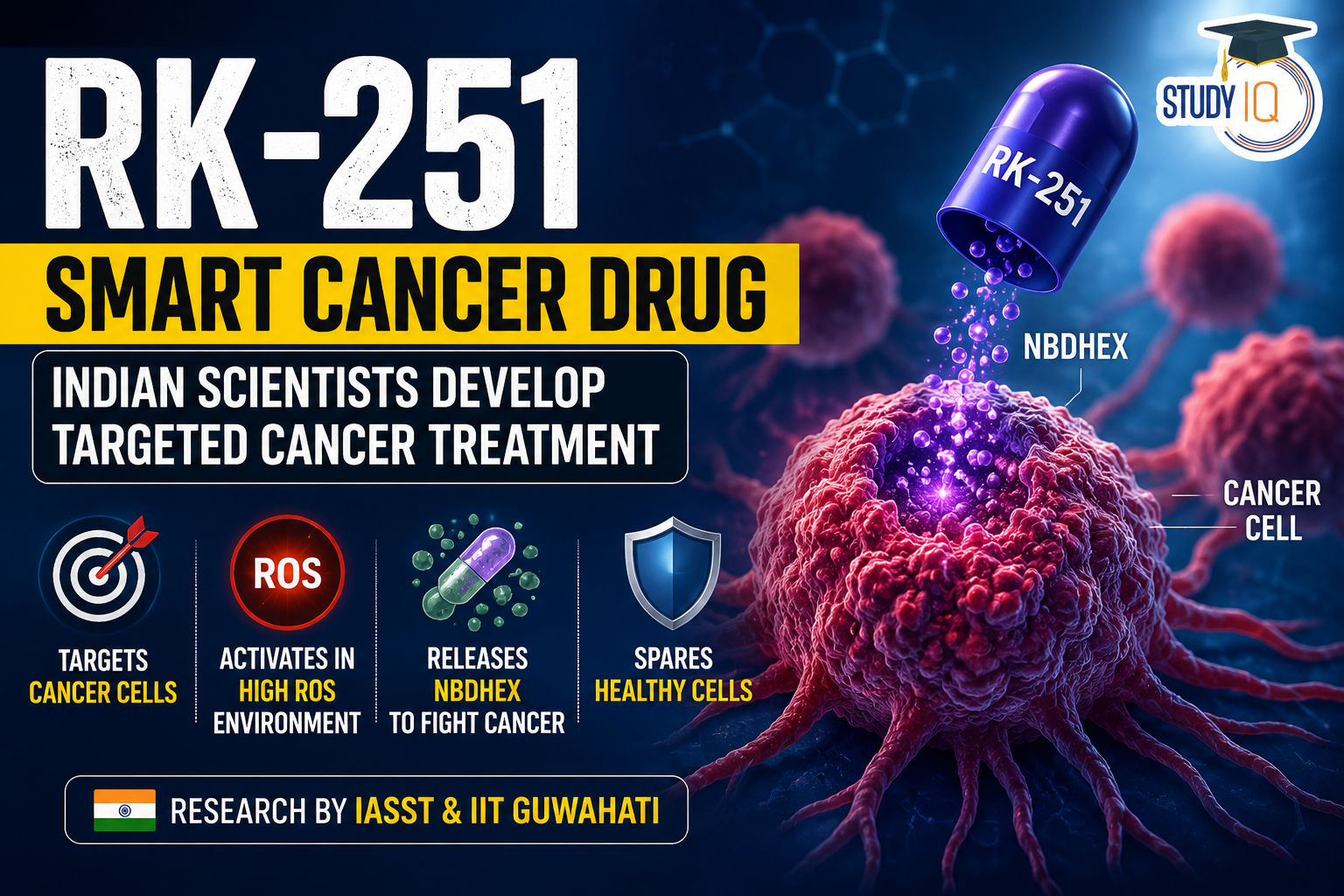
Indian scientists have developed RK-251, a promising smart cancer drug designed to target tumour cells while potentially reducing damage to healthy cells. The research marks an important development in targeted cancer therapy and drug discovery.
The research was led by Dr. Asis Bala of the Institute of Advanced Study in Science and Technology (IASST) and Dr. K.P. Bhabak of IIT Guwahati. IASST is an autonomous institute under the Department of Science and Technology (DST).
Unlike conventional chemotherapy, which can affect both cancerous and healthy cells, RK-251 is designed to become activated primarily in the biochemical environment associated with cancer cells.
Read Also: UPSC Daily Current Affairs 2026
How Does RK-251 Work?
The key feature of RK-251 is its ability to respond to Reactive Oxygen Species (ROS).
Cancer cells often have higher levels of ROS than normal cells. Researchers have exploited this difference to design a ROS-responsive drug candidate.
The mechanism can be understood as:
High ROS in tumour cell → RK-251 activation → NBDHEX release → Anticancer action
Once RK-251 encounters an ROS-rich environment, it becomes activated and releases NBDHEX, an anticancer compound. NBDHEX targets proteins and cellular pathways involved in cancer-cell survival and treatment resistance.
This approach aims to concentrate the anticancer activity within tumour cells rather than exposing healthy tissues to the active drug to the same extent.
RK-251 and Triple-Negative Breast Cancer
The drug candidate has shown promising activity against triple-negative breast cancer (TNBC) cells in preclinical experiments.
TNBC is an aggressive form of breast cancer that lacks three commonly targeted receptors: estrogen receptor, progesterone receptor and HER2. This can make treatment more challenging.
The activity of RK-251 against TNBC cells therefore provides an important basis for further research. However, the results are currently limited to preclinical studies and should not be interpreted as evidence that RK-251 can treat cancer patients.

Link- UPSC IAS Live GS P2I Foundation 2027 Pratigya August Batch (Basic)
Zebrafish Studies and Fluorescence
Researchers also evaluated RK-251 using zebrafish embryos (Danio rerio).
The behavioural assessment did not show obvious signs of toxicity in the experiments. The drug also demonstrated the expected fluorescence response in the presence of ROS.
This fluorescence is significant because it provides an indication that the drug is being activated in an ROS-rich environment. Thus, RK-251 combines a ROS-responsive activation mechanism with a detectable fluorescence response, providing researchers with a useful tool for studying its behaviour.
Potential Advantages
The approach behind RK-251 could offer several potential advantages over conventional chemotherapy.
First, it seeks to exploit a biological difference between tumour and healthy cells. Second, activation within an ROS-rich environment could potentially improve tumour selectivity. Third, reduced activation in normal tissues may eventually help minimise unwanted damage.
However, these are potential benefits, not established clinical outcomes. Further research is needed to determine whether the proposed selectivity translates into meaningful safety advantages in living organisms and humans.
Current Status of RK-251
RK-251 is currently at the preclinical stage. It is therefore not an approved cancer medicine and should not be described as a cancer cure.
Before any potential human application, researchers will need to conduct extensive studies to establish its safety, toxicity, pharmacological properties, appropriate dosage and therapeutic effectiveness.
If these studies produce favourable results, the candidate would still need to undergo regulated human clinical trials before any possible approval.
Significance
The development of RK-251 highlights India’s growing capabilities in medicinal chemistry, cancer biology and targeted drug development.
The collaboration between IASST and IIT Guwahati demonstrates the importance of interdisciplinary research in developing next-generation therapies. More broadly, the research reflects a shift from non-selective cancer treatment towards precision medicine and tumour-specific drug activation.
The findings have been published in the Journal of Medicinal Chemistry, a publication of the American Chemical Society.
 GST 2.0 and Decriminalisation of Tax Off...
 Tuvalu and Rising Sea Levels: Climate Ch...
 US Treasury Yields at 25-Year High: Impa...













 WhatsApp