Table of Contents
Context
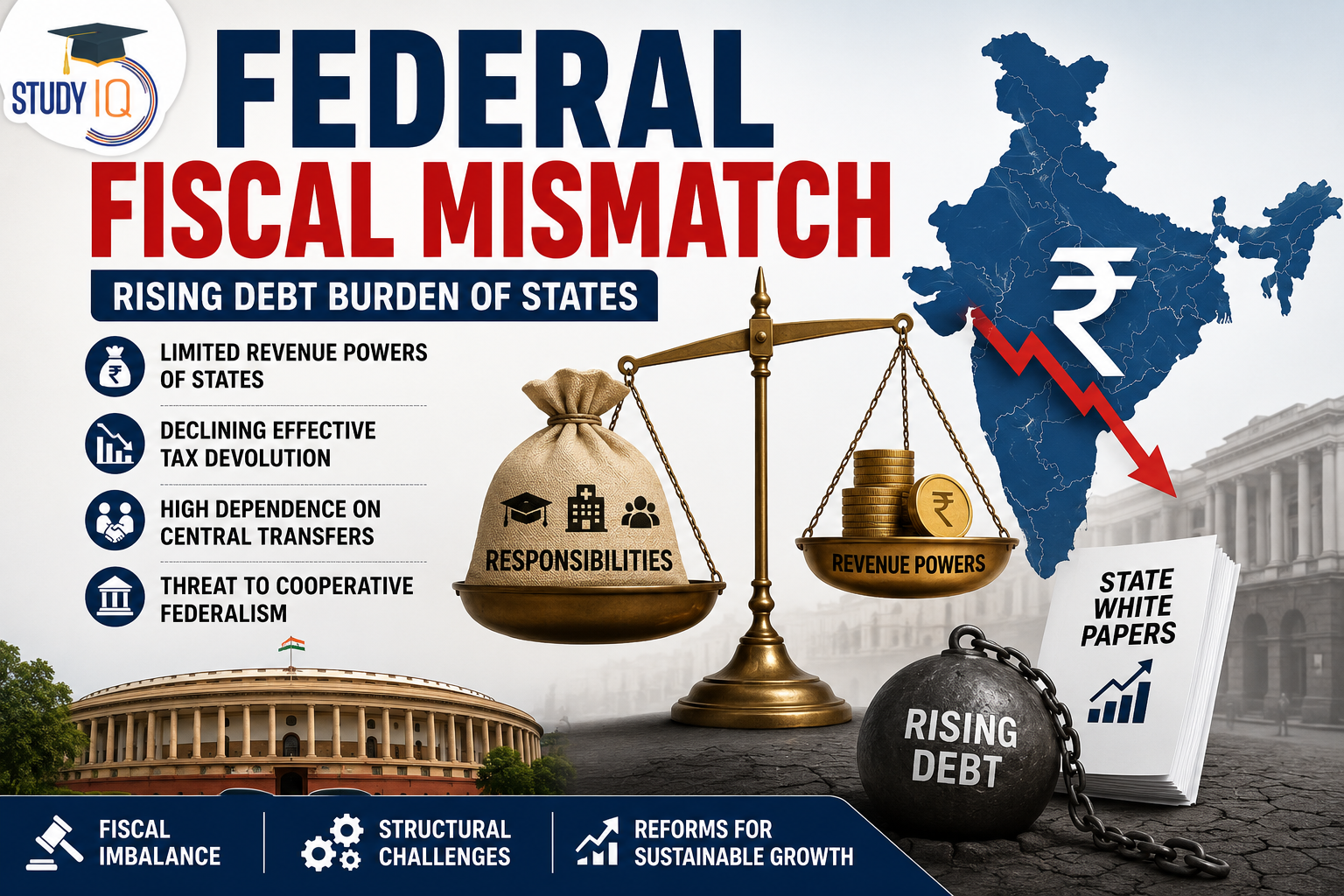
The fiscal health of Indian States has come under focus after Kerala and Tamil Nadu released White Papers highlighting rising public debt. The reports have reignited the debate on whether increasing State debt reflects fiscal mismanagement or a structural mismatch between States’ development responsibilities and their limited revenue-raising powers.
How Does Growing Fiscal Imbalance Undermine Cooperative Federalism?
- Centralisation of Taxation Powers: The introduction of GST shifted major indirect taxation powers from States to a common framework, reducing their independent revenue-raising capacity.
- g., States surrendered taxes such as octroi, entry tax, and several local levies after the introduction of GST.
- Declining Effective Tax Devolution: The growing reliance on cesses and surcharges, which are excluded from the divisible pool, has reduced the effective share of Union taxes transferred to States.
- g., Although the 16th Finance Commission retained 41% vertical tax devolution, the increasing use of non-shareable cesses has lowered the actual revenues received by States.
- High Dependence on Central Transfers: Limited own-source revenues make many States heavily dependent on grants and transfers from the Union Government.
- g., Central transfers account for over 44% of aggregate State revenues and around 72% in Bihar.
- Erosion of Fiscal Autonomy: The growing number of Centrally Sponsored Schemes (CSS) has constrained States’ flexibility in setting expenditure priorities.
- g., Expansion of CSS in sectors such as health and education has increased States’ financial obligations without corresponding policy autonomy.
- Institutional Imbalances in Fiscal Federalism: Perceived asymmetries in fiscal institutions have raised concerns over the balance of power between the Centre and the States.
- g., States have expressed concerns over the criteria used by the Finance Commission and decision-making within the GST Council, particularly regarding tax effort and population control.
What are the Challenges Faced by Indian States?
- Demographic-Driven Fiscal Pressures: States face varying expenditure needs depending on their stage of demographic transition, placing sustained pressure on their fiscal resources.
- g., Younger States such as Bihar require greater investment in education, skilling, and job creation, whereas ageing States like Kerala and Tamil Nadu face rising expenditure on pensions, healthcare, and elderly care.
- Fiscal Pressure on Social Sector Spending: States face limited flexibility to raise fiscal space without affecting essential welfare services.
- g., Cuts in expenditure on health and education could weaken long-standing gains in human development indicators.
- Underutilisation of Own Revenue Sources: States have not fully utilised available taxation and non-tax revenue instruments, limiting their fiscal capacity despite rising private wealth.
- g., Weak property tax administration and limited land monetisation have constrained revenues, leaving urban local bodies with inadequate resources to finance infrastructure and public services.
- High Debt Servicing Burden: Rising interest obligations consume a growing share of State finances, reducing fiscal space for developmental expenditure and pushing debt levels beyond prudent limits.
- g., As highlighted in recent RBI State Finances Reports, many States increasingly rely on fresh borrowings through State Development Loans (SDLs) to service existing debt, creating a persistent debt cycle.
- High Cost of Borrowing: Reliance on market-based borrowing increases financing costs for infrastructure and development projects.
- g., Unlike Chinese local governments, which often access lower-cost domestic financing, Indian states borrow at relatively higher interest rates through SDLs.
- State-Level Fiscal Mismanagement: Populist spending, untargeted subsidies, and rising administrative expenditure have weakened the fiscal health of several States.
- g., The recurring financial distress of State power distribution companies (DISCOMs) has compelled governments to undertake repeated bailout measures, such as the UDAY Scheme, increasing public debt.
Way Forward
- Reform Fiscal Devolution for Balanced Federalism: Revise the Finance Commission‘s devolution formula to balance fiscal equity across States while rewarding sound fiscal management and demographic performance.
- g., Continue redistributive support for fiscally weaker States such as Bihar, while providing performance-based grants to States like Kerala and Tamil Nadu for achievements in tax effort, population stabilisation, and fiscal discipline.
- Expand Access to Long-Term Development Finance: Create mechanisms to channel domestic savings into productive investments by State governments.
- g., Facilitate greater investment in State Development Loans (SDLs) and other State-backed infrastructure bonds.
- Reduce Borrowing Costs for States: Lower the interest burden on State borrowings through coordinated fiscal support and improved credit mechanisms.
- g.,A Union-backed credit enhancement framework could reduce the interest premium on SDLs, increasing fiscal space for development.
- Prioritise Capital Expenditure: Gradually shift public spending towards infrastructure and productive asset creation to strengthen long-term growth.
- g., Increase investment in transport networks, industrial corridors, research institutions, and technology parks.
- Strengthen Fiscal Discipline at the State Level: Institutionalise fiscal safeguards to prioritise productive capital expenditure over unsustainable revenue spending and populist measures.
- g., Establish independent State Fiscal Councils to assess the long-term fiscal sustainability and debt implications of major welfare schemes before their implementation.
Latest UPSC Updates
| Resource | Link |
|---|---|
| UPSC Prelims Result 2026 | Check Here |
| UPSC Exam Calendar 2027 | View Calendar |
| UPSC Question Paper 2026 | Download PDF |
| UPSC Prelims Answer Key 2026 | Check Answer Key |
| UPSC Cut Off 2026 | View Cut Off |
| UPSC Syllabus 2026 | Read Syllabus |
| Daily Current Affairs 2026 | Read Updates |
| StudyIQ UPSC IAS Foundation 2027 (English) | Join Course |
| StudyIQ UPSC IAS Foundation 2027 (Hindi) | Join Course |
| StudyIQ UPSC IAS Foundation 2027 (Bilingual) | Join Course |
 Gandhi Jayanti 2026: History, Significan...
 Right to Vote in India: Constitutional S...
 Daily Mains Articles 2026 – Updated Da...












 WhatsApp