Table of Contents
Context
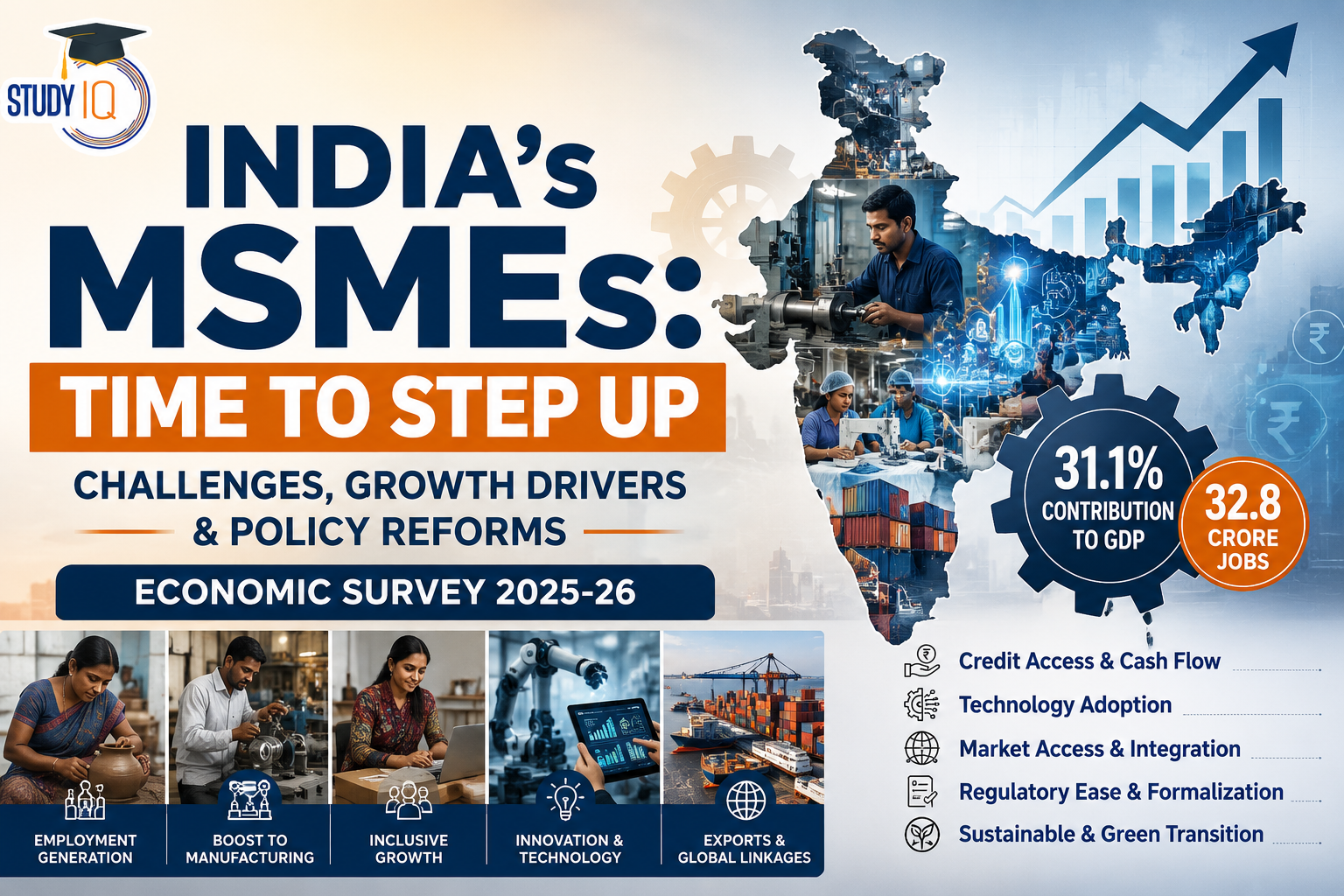
The Economic Survey 2025-26 has highlighted India’s MSME sector as a critical economic cornerstone contributing 31.1% to GDP and employing 32.8 crore people, while flagging their failure to transition from micro to mid-sized firms as a major structural constraint for the nation’s next growth phase.
In What Ways Do MSMEs Fuel India’s Economic Engine?
- Macroeconomic Value & Trade: The sector contributes 1% to India’s GDP, 35.4% to manufacturing output, and 48.58% to total exports. They act as critical suppliers of intermediate goods (e.g., Pune auto components, Noida electronics) to both domestic heavy industries and Global Value Chains (GVCs).
- Demographic Absorption: As the second-largest employer after agriculture, MSMEs support over 8 crore livelihoods. Labor-intensive clusters like Tirupur (textiles) and Kanpur (leather) convert India’s surplus rural and semi-urban labor into manufacturing productivity.
- Grassroots Inclusion & Equity: The sector democratizes capital. Women own approximately 40% of registered units, and operations naturally disperse across Tier-2 and Tier-3 cities (e.g., Uttar Pradesh hosts over 86 lakh units). This slows rural-to-urban migration and fosters equitable regional growth.
- High-Tech Innovation: Moving beyond low-skill manufacturing, specialized small businesses now supply precision components to sectors like defense and aerospace, evidenced by MSMEs manufacturing critical sub-assemblies for ISRO’s Chandrayaan-3.
What Structural Bottlenecks Constrain MSME Growth?
- The “Dwarfishness” Trap: Over 99% of registered MSMEs remain perpetually micro. Firms intentionally suppress their scale to avoid regulatory compliance and retain small-business benefits, creating a “missing middle” of mid-sized companies that drive true productivity.
- Severe Credit and Liquidity Deficits: There is an estimated ₹30 lakh crore credit gap. Commercial banks rely on rigid, collateral-backed underwriting, which disadvantages unincorporated micro-firms that possess minimal fixed assets.
- Delayed Payments & Cash-Flow Crises: Despite the 45-day legal mandate under the MSME Development Act, delayed payments from large corporates and public sector enterprises routinely drain MSME working capital. Weak enforcement leaves small suppliers highly vulnerable to bankruptcy.
- Asymmetric Technology Adoption: While retail digital payments are ubiquitous (90% adoption), integration of operational technology is minimal. Only 18% of MSMEs use digital lending, and their overall productivity stands at a mere 18% of large enterprises.
- Vulnerability to Price Shocks: Lacking bulk bargaining power, small units absorb the full force of raw material price spikes, which frequently wipe out their razor-thin operating margins.
How Can Policy Catalyze and Scale the Ecosystem?
- Cash-Flow Based Algorithmic Lending: Move away from collateral dependency. By integrating the Udyam portal, GSTN, and Account Aggregators (AA), banks can dynamically underwrite working capital loans based on real-time invoice matching and digital ledger health.
- Deepening Liquidity Markets: Pool verified trade receivables from platforms like TReDS into sovereign-backed Asset-Backed Securities (ABS). Trading these in secondary markets will seamlessly channel institutional capital into MSME liquidity.
- Democratizing Technology Access: Establish “Plug-and-Play” Digital Common Facilities in Tier-II and Tier-III hubs. Providing shared access to advanced infrastructure—like 3D printing, precision CNC testing, and AI tools—on a pay-per-use model removes high capital barriers.
- Grassroots Formalization & Green Incentives: Deploy a decentralized network of “Corporate Mitras” (trained local commerce graduates) to handle compliance and intellectual property filings for micro-units. Additionally, link Zero Defect Zero Effect (ZED) sustainability certifications to automatic interest subventions to encourage green transitions.
- Frictionless Global Integration: Create specialized E-Commerce Export Fulfillment Hubs near multimodal logistics parks. Co-locating customs clearance, quality testing, and integrated warehousing will drastically reduce transit timelines and compliance friction for export-ready MSMEs.
Latest UPSC Updates
| Resource | Link |
|---|---|
| UPSC Prelims Result 2026 | Check Here |
| UPSC Exam Calendar 2027 | View Calendar |
| UPSC Question Paper 2026 | Download PDF |
| UPSC Prelims Answer Key 2026 | Check Answer Key |
| UPSC Cut Off 2026 | View Cut Off |
| UPSC Syllabus 2026 | Read Syllabus |
| Daily Current Affairs 2026 | Read Updates |
| StudyIQ UPSC IAS Foundation 2027 (English) | Join Course |
| StudyIQ UPSC IAS Foundation 2027 (Hindi) | Join Course |
| StudyIQ UPSC IAS Foundation 2027 (Bilingual) | Join Course |
 UN Charter Enemy State Clauses: Articles...
 World Tourism Day 2026: Theme, India Tou...
 Anti-Goonda Bill 2026 Explained: Why Pre...













 WhatsApp