
Table of Contents
Climate Change as a Cost-of-Living Crisis in India: Context
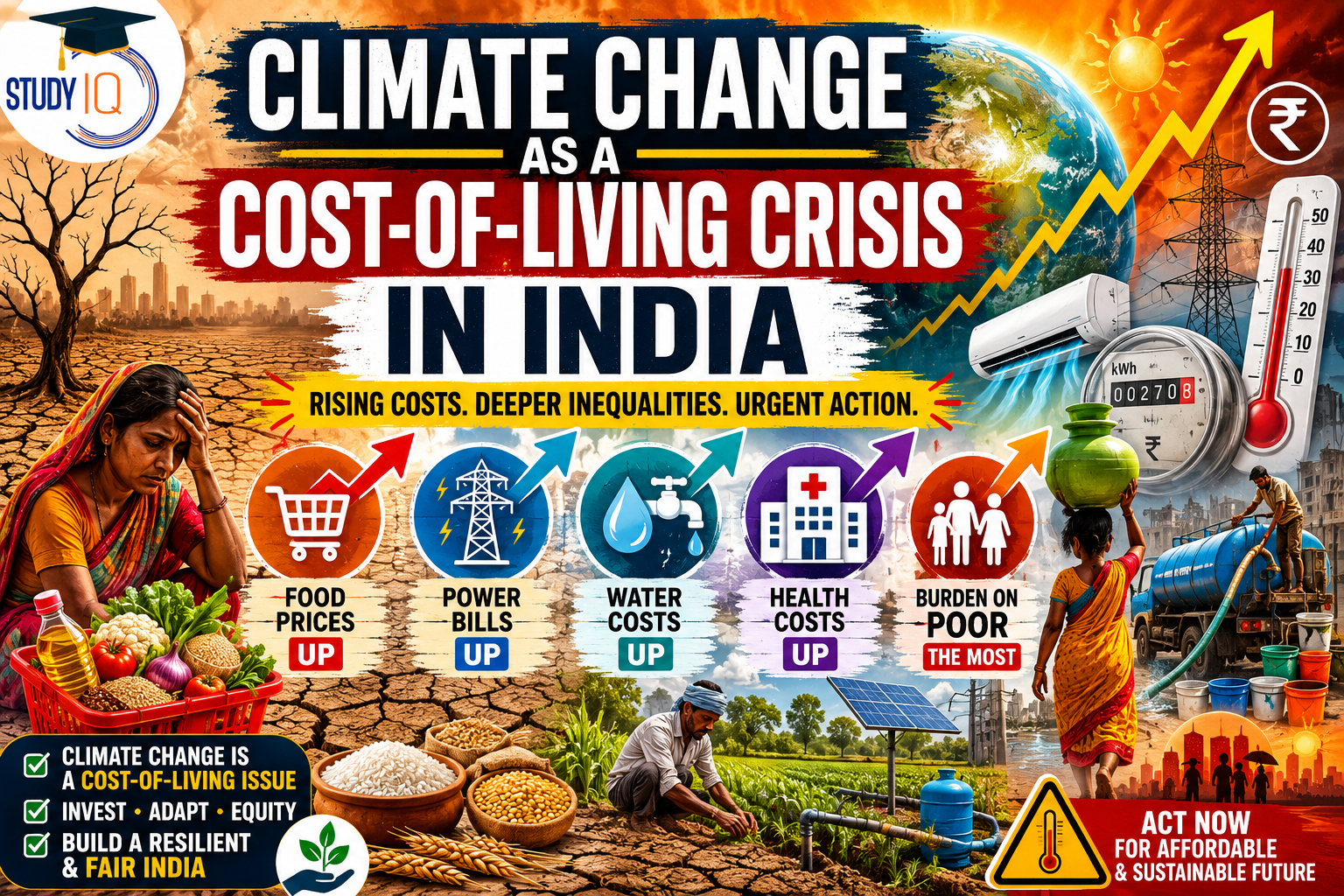
Climate change is usually seen as a distant 2070 net-zero problem. In reality, it is already raising everyday costs of food, power, water and health, hitting India’s poorest the hardest.
How Is Climate Change Driving Up the Cost of Living in India?
- Squeezing Food Budgets: Heatwaves and weak monsoons damage crop yields and push up food prices, which still carry the heaviest weight in India’s CPI basket.
- g., In 2023, a 6% monsoon rainfall deficit cut sown area for pulses and oilseeds, pushing retail prices of rice, wheat and pulses up by 6-15% year-on-year.
- Inflating Power Bills: Extreme heat raises cooling demand, straining the grid and forcing utilities to rely on costlier coal and imported fuel, costs that get passed on as higher tariffs.
- g., During the May 2026 heatwave, India’s power demand repeatedly touched a record 270.8 GW, driven largely by fans and ACs.
- Creating a Hidden Water Tax: Erratic rainfall and groundwater depletion are drying up wells, forcing rural households to spend more time fetching water and urban poor to pay private tanker vendors.
- g., Cities without reliable municipal supply have developed a parallel “tanker economy” that burdens informal settlements the most.
- Raising Out-of-Pocket Health Spending: Heat stress, poor air quality and climate-sensitive diseases increase medical costs and wage loss from missed work.
- g., Rural women bear a disproportionate burden, walking longer distances for water and caring for sick family members, losing wages each time.
- Acting as a Regressive Tax: The burden falls unevenly, since marginalised castes and tribes are less likely to access irrigation and other adaptive technologies.
- g., Those with more land and capital can absorb climate shocks, while the poor resort to debt, distress migration, or cutting food and education spending.
Why Does This Matter for India’s Growth and Equity Goals?
- Macroeconomic Drag: Climate stress is not a one-off shock but a structural drain on growth and living standards.
- g., The World Bank’s 2018 report on South Asia’s Hotspots projects climate change could shave 2.8% off India’s GDP and depress living standards for nearly half the population by 2050, with Chhattisgarh, Madhya Pradesh, Rajasthan, Uttar Pradesh and Maharashtra among the worst-hit hotspots.
- Compounding Agrarian Distress: The states identified as climate hotspots overlap with regions already facing low farm incomes, high indebtedness and farmer suicides.
- Eroding Vulnerable Households’ Resilience: Despite decades of rising median incomes, a large share of Indians remain highly exposed to even small economic shocks, which climate change turns into recurring, structural pressure.
What Is the Way Forward?
- Treat Climate Change as a Cost-of-Living Issue: Move beyond firefighting responses like export bans and ad hoc flood relief toward structural policy recognition of climate-driven inflation.
- Invest in Climate-Resilient Agriculture: Scale up low-input, climate-adaptive farming models to cut yield volatility and stabilise food prices.
- g., Andhra Pradesh Community Natural Farming (APCNF) is being used as a scalable model for climate-resilient agriculture.
- Strengthen Urban Heat Planning: Mandate Heat Action Plans with cooling shelters, early warning systems and urban greening in heat-vulnerable cities.
- Expand Universal Basic Services: Guarantee affordable water, power and healthcare access so climate shocks do not force poor households into debt or distress migration.
- Redistribute Climate Risk Equitably: Target adaptation support, irrigation access and credit toward marginalised castes, tribes and small farmers who currently adopt coping technologies the least.
Latest UPSC Updates
| Resource | Link |
|---|---|
| UPSC Prelims Result 2026 | Check Here |
| UPSC Exam Calendar 2027 | View Calendar |
| UPSC Question Paper 2026 | Download PDF |
| UPSC Prelims Answer Key 2026 | Check Answer Key |
| UPSC Cut Off 2026 | View Cut Off |
| UPSC Syllabus 2026 | Read Syllabus |
| Daily Current Affairs 2026 | Read Updates |
| StudyIQ UPSC IAS Foundation 2027 (English) | Join Course |
| StudyIQ UPSC IAS Foundation 2027 (Hindi) | Join Course |
| StudyIQ UPSC IAS Foundation 2027 (Bilingual) | Join Course |
 Anti-Goonda Bill 2026 Explained: Why Pre...
 Cool Leaders Award 2026: Winners, Global...
 Black Carbon and Himalayan Glacier Melt:...














 WhatsApp





