Table of Contents
Context
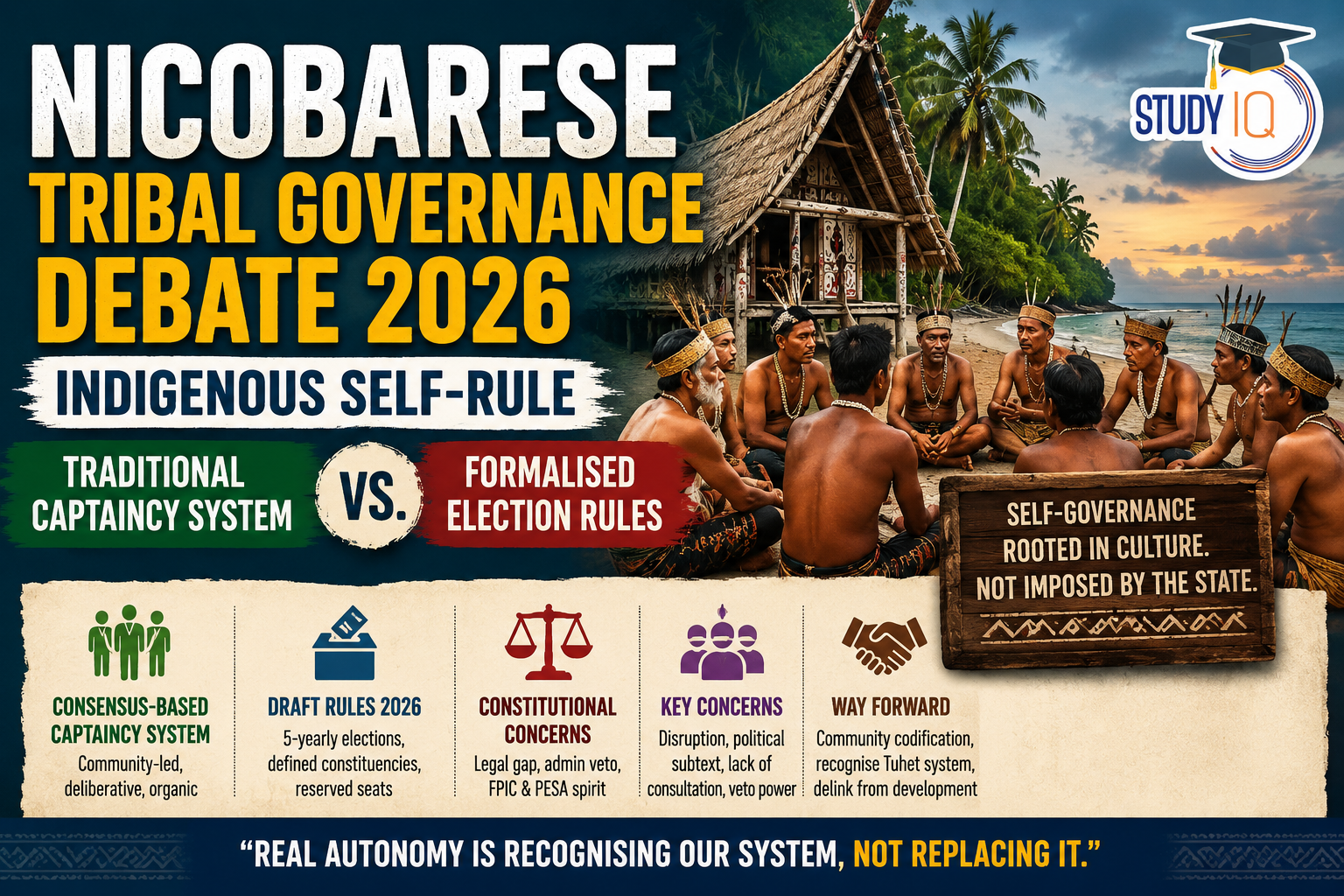
The A&NI administration notified draft election rules for Nicobarese Tribal Councils in May 2026. This has triggered a sharp debate on state interference in indigenous self-governance.
What Is the Existing Governance Structure of the Nicobarese?
- Consensus-Based Captaincy System: Each village is led by three Captains: First, Second, and Third.
- They are chosen through community meetings, not on a fixed schedule.
- Deliberative System: The system is deliberative, not just representative. All major decisions go back to the community for consultation.
- Seven Island Tribal Councils represent ~30,000 Nicobarese across Car Nicobar, Nancowry, Kamorta, Teressa, Little Nicobar, Great Nicobar, and other islands.
- Tuhet System as Social Foundation: Large joint families called Tuhets form the social base of Nicobarese life. The Captaincy structure grew organically as a bridge between this social system and the government.
What Do the Draft Rules (2026) Propose?
- Formalised 5-yearly elections for Village Councils and Island Tribal Councils, with defined constituencies, electoral rolls, and reserved seats for women.
- New representative hierarchy: Villagers elect 5–9 Captains per village and directly vote for the Chief Captain of each Island Tribal Council.
- First Captains of each village then vote among themselves for the Vice-Chief Captain of the Island Tribal Council.
- Notified under the A&NI (Tribal Councils) Regulation, 2009, which already gives the Deputy Commissioner an absolute veto over any council decision deemed an “annoyance” to public order.
Why Is Formalisation a Concern for Tribal Communities?
- Disruption of Living Governance: Tribal leaders argue the draft converts an organic, community-driven system into a bureaucratic process. It is disconnected from how communities actually live and decide.
- Political Subtext: Many tribal leaders suspect the rules are being pushed now to weaken opposition to the ₹91,000 crore GNI development project.
- Lack of Prior Consultation: The draft was notified without adequate community consultation. Most Nicobarese have not had access to the legal context of the 2009 Regulation under which these rules will operate.
- Non-Recognition of the Tuhet System: The draft completely ignores the Tuhet joint-family structure
- Retained Administrative Veto: The Deputy Commissioner retains unchecked power to override any council decision.
What Are the Constitutional and Legal Concerns?
- Union Territory Legal Gap: A&NI is technically outside the Fifth Schedule framework, which applies only to Scheduled Areas in states, not Union Territories.
- The Nicobarese thus lack the constitutional protection against state interference that tribal communities in mainland India enjoy.
- The 2009 Regulation’s built-in administrative veto further weakens the claim of genuine self-governance. Autonomy is structurally limited from the outset.
- FPIC Violation: Introducing a formal electoral structure without Free, Prior, and Informed Consent (FPIC) violates international indigenous rights norms and the spirit of the Forest Rights Act, 2006.
- g., In the 2013 Niyamgiri judgment, the Supreme Court held that tribal councils have the final say over decisions affecting their land and governance.
- PESA Spirit: PESA (1996) does not directly apply to Union Territories. But its core principle that tribal self-governance must not be replaced by state-designed structures remains relevant by constitutional intent.
Latest UPSC Updates
| Resource | Link |
|---|---|
| UPSC Prelims Result 2026 | Check Here |
| UPSC Exam Calendar 2027 | View Calendar |
| UPSC Question Paper 2026 | Download PDF |
| UPSC Prelims Answer Key 2026 | Check Answer Key |
| UPSC Cut Off 2026 | View Cut Off |
| UPSC Syllabus 2026 | Read Syllabus |
| Daily Current Affairs 2026 | Read Updates |
| StudyIQ UPSC IAS Foundation 2027 (English) | Join Course |
| StudyIQ UPSC IAS Foundation 2027 (Hindi) | Join Course |
| StudyIQ UPSC IAS Foundation 2027 (Bilingual) | Join Course |
What Is the Way Forward?
- Community-Led Codification: Instead of imposing external electoral rules, the administration should help tribal councils document and codify their own existing governance practices.
- g., New Zealand’s Maori governance model formally recognises customary decision-making within the national legal framework without displacing it.
- Recognise the Tuhet System Legally: The final rules must formally acknowledge the Tuhet joint-family system as the social foundation of Nicobarese governance.
- Delink Governance Reform from Development Clearance: Tribal council reform must be pursued independently of the GNI infrastructure project. It must not become a tool to manufacture consent for development.
 Special Summary Revision (SSR) 2026–27...
 Global Hunger Index 2026: India Ranks 10...
 France Protests 2026: Cost of Living, Sc...














 WhatsApp