
Table of Contents
Context
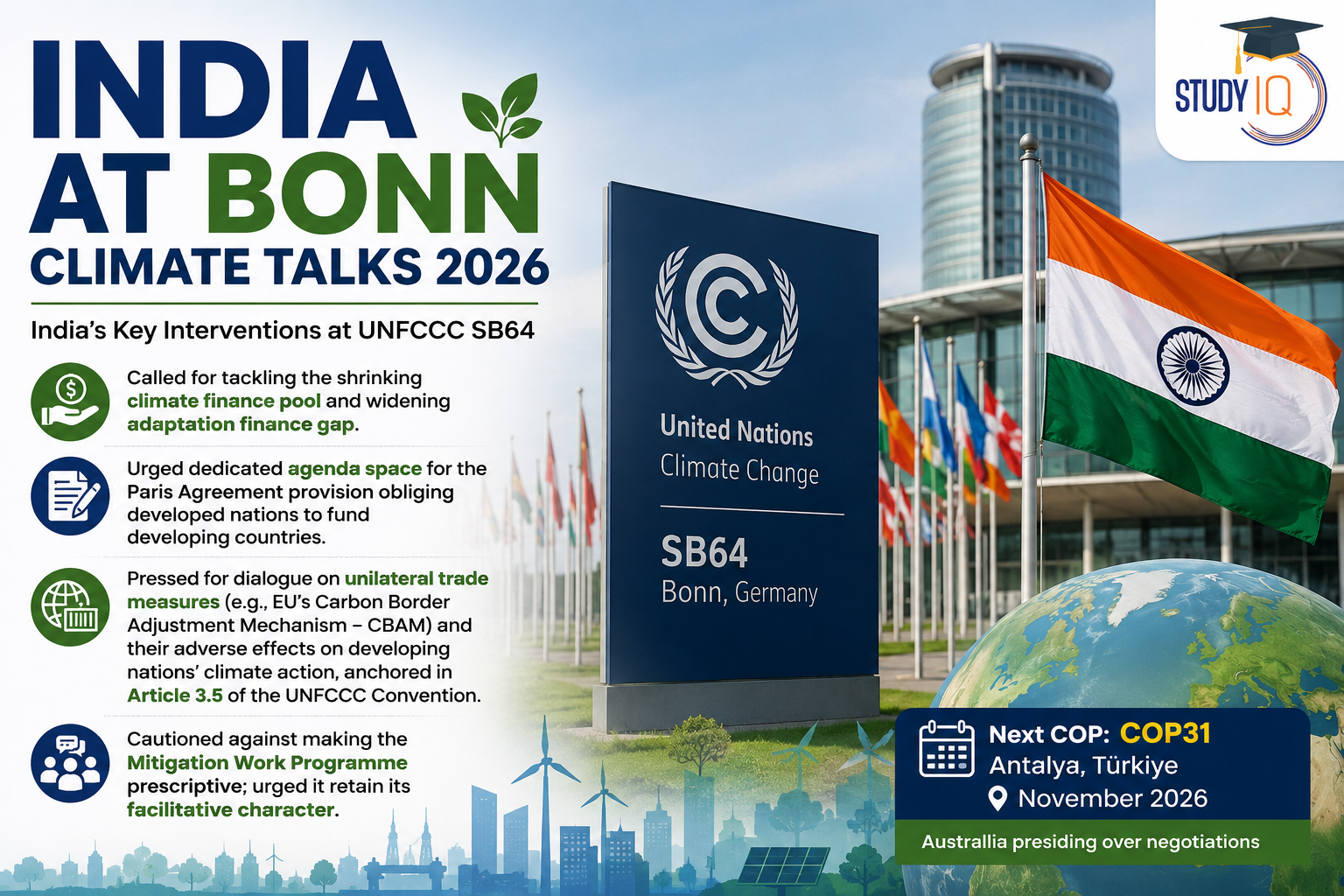
India made key interventions at the 64th session of the UNFCCC Subsidiary Bodies (SB64) underway in Bonn, Germany
Read Also: UPSC Daily Current Affairs 2026
About UNFCCC Subsidiary Bodies
- The UNFCCC operates through two permanent Subsidiary Bodies that meet twice a year to advance technical and procedural work between COPs:
- SBI (Subsidiary Body for Implementation): Oversees implementation of UNFCCC commitments and reviews national communications.
- SBSTA (Subsidiary Body for Scientific and Technological Advice): Bridges scientific findings and policy, advising the COP on technical matters.
- Their mid-year Bonn session (SB64) prepares draft decisions for adoption at the annual COP; outcomes here become negotiable text ahead of COP31.
- Next COP: COP31 to be hosted in Antalya, Türkiye (November 2026); Australia presiding over negotiations.
India’s Key Positions
- Called for tackling the shrinking climate finance pool and widening adaptation finance gap.
- Urged dedicated agenda space for the Paris Agreement provision obliging developed nations to fund developing countries.
- Pressed for dialogue on unilateral trade measures (e.g., EU’s Carbon Border Adjustment Mechanism — CBAM) and their adverse effects on developing nations’ climate action, anchored in Article 3.5 of the UNFCCC Convention.
- Cautioned against making the Mitigation Work Programme prescriptive; urged it retain its facilitative character.
| Mitigation Work Programme (MWP) or Sharm el-Sheikh Mitigation Ambition and Implementation Work Programme |
| ● Established at COP26, launched at COP27.
● Aims to urgently scale up global GHG emission reductions to help close the gap between current trajectories and the 1.5°C Paris Agreement goal. ● Operates as a facilitative, non-prescriptive platform and shares solutions, best practices, and investment opportunities without imposing new obligations on nations. ● Mandates at least two global dialogues and investment-focused events annually, covering sectors like circular economy, energy, waste, and transport. |
|
Read More Notes |
|
| Environment Notes | Art and Culture Notes |
| Science and Tech | History Notes |
| Geography Notes | Indian Polity Notes |
| General Knowledge | International Relation |
|
Explore StudyIQ Courses |
|
 UPSC Recruitment 2026: 212 Vacancies Thr...
 Nyedar Namlo, Arunachal Pradesh: Sacred ...
 Daily Mains Articles 2026 – Updated Da...


 WhatsApp





