
Table of Contents
Context
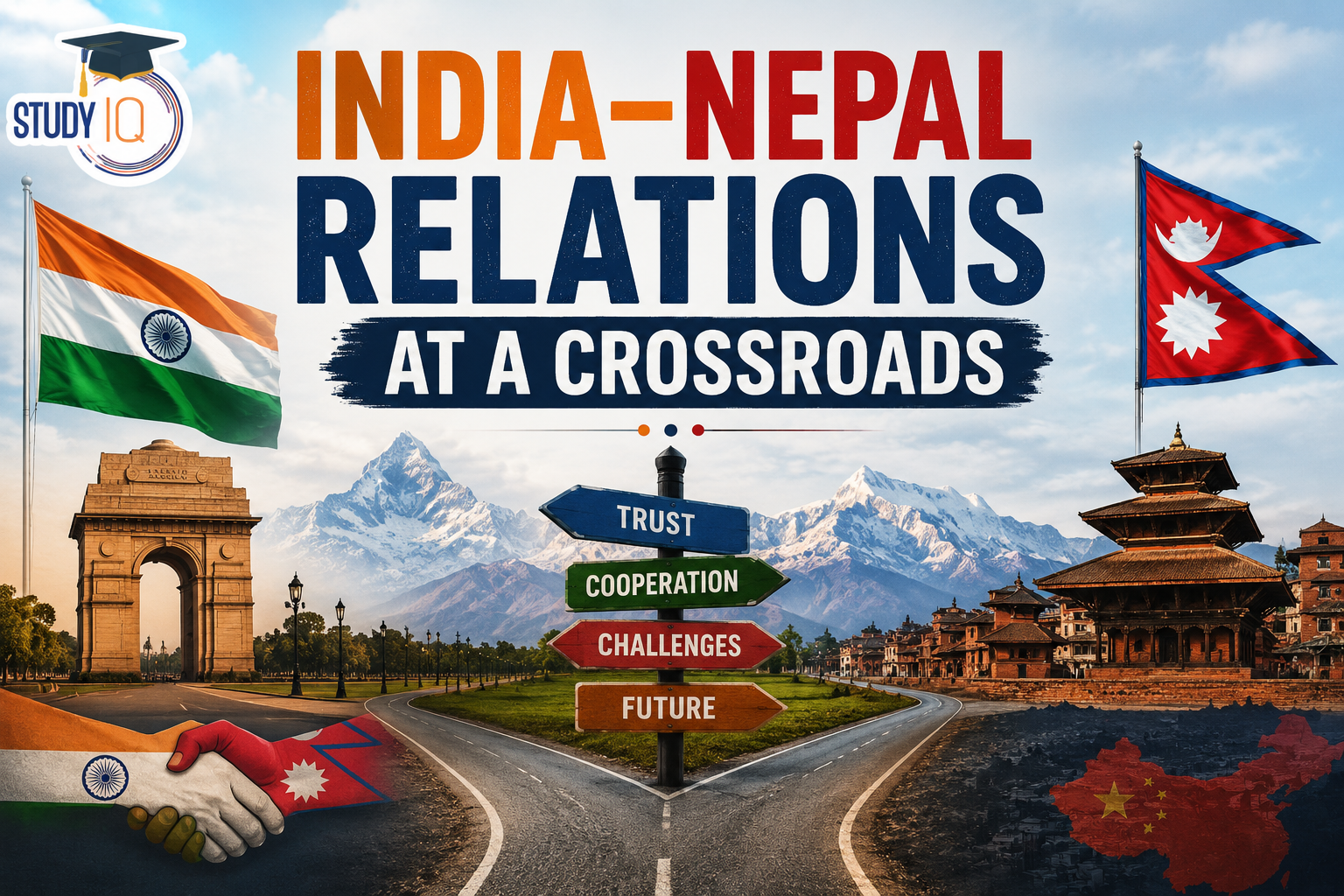
Nepal PM’s parliamentary acknowledgement that the Kalapani-Lipulekh-Limpiyadhura dispute may involve claims from both sides, coupled with a series of high-level diplomatic engagements during 2025-26, has opened a fresh opportunity to reset India-Nepal relations.
Read Also: UPSC Daily Current Affairs 2026
What Makes India-Nepal Relations Uniquely Important?
- Civilisational and Cultural Bonds: India and Nepal are linked by centuries-old cultural, religious, and familial ties, often described as the “Roti-Beti”
- Shared heritage sites such as Pashupatinath and Lumbini reinforce these connections.
- Strategic Geographic Importance: Nepal sits as a buffer state between India and China along India’s most sensitive northern frontier, bordering five Indian states, making its internal stability a direct Indian security concern.
- Strong Economic Interdependence: India drives over 64% of Nepal’s foreign trade and serves as its primary lifeline for energy, food security, and transit access.
- Open Border: The 1,700 km open border enables visa-free movement and daily cross-border livelihoods for millions.
- People-to-People Connectivity: Approximately 8 lakh Nepali citizens serve in Indian Army Gorkha regiments, a military bond with no parallel in any other bilateral relationship.
What Are the Key Pillars of Bilateral Cooperation?
- Energy Partnership: India has committed to purchasing up to 10,000 MW of Nepali hydropower, transforming Nepal’s water resources into a shared prosperity engine.
- g., Projects like Arun-III and Upper Karnali
- Connectivity Infrastructure: Significant progress has been made across physical, digital, and energy connectivity, including roads, bridges, cross-border railways, and Integrated Check Posts.
- g., The Motihari-Amlekhgunj petroleum pipeline, India’s first cross-border petroleum pipeline, directly supplies fuel to Nepal’s heartland.
- Digital and Financial Integration: India has extended UPI-based cross-border QR payments to Nepal, deepening daily economic integration far beyond formal trade statistics.
- g., RBI’s 2025 reforms permitting Indian banks to lend in INR to Nepalese entities
- Defence and Disaster Cooperation: Joint military exercises and India’s consistent role as first responder in crises establish India as Nepal’s most reliable security partner.
- g., Exercise Surya Kiran is held annually; India led relief operations during Nepal’s devastating 2015 earthquake,
What Are the Key Challenges Straining the Relationship?
- Border Dispute: Conflicting interpretations of historical treaties over Kalapani, Lipulekh, and Limpiyadhura, coupled with their political salience in Nepal, continue to hinder bilateral relations.
- China’s Growing footprint: After the 2015 trade disruption, Nepal joined China’s Belt and Road Initiative in 2017.
- Chinese-funded projects like Pokhara International Airport give China a visible strategic presence inside Nepal, directly challenging India’s traditional primacy.
- Nepal’s Political Instability: Frequent changes in government often lead to shifts in policy priorities, making long-term cooperation and implementation of agreements difficult.
- Anti-India Nationalism as a Political Tool: Issues such as the 2015 border disruption and the 2020 map controversy continue to influence public opinion and are occasionally used for domestic political mobilisation.
- Security Vulnerabilities of the Open Border: While the open border is a major strength, it also creates challenges related to smuggling, illegal migration, and transnational criminal activities.
Why Does the Current Diplomatic Phase Present a Unique Opportunity?
- Emergence of a Pragmatic Leadership: Nepal’s younger, development-oriented leadership appears more focused on economic growth and regional cooperation than historical disputes, creating space for constructive engagement.
- Renewed High-Level Engagement: A series of bilateral visits by senior Nepalese leaders during 2025–26 reflects a shared commitment to rebuild trust and deepen cooperation across sectors.
- A Strategic Opportunity for India: The current convergence of interests provides India with a valuable opportunity to strengthen ties before Nepal’s fluid domestic politics potentially alters the diplomatic environment.
What Is the Way Forward?
- Time-Bound Bilateral Border Resolution: A time-bound bilateral mechanism supported by technical and cartographic expertise should be established to resolve outstanding boundary issues without external involvement.
- Leverage the Indian Army-Nepal Army Bond: The long-standing institutional relationship between the Indian and Nepalese armies should be formally activated as a backchannel to facilitate practical boundary management.
- Fast-Track the Energy Partnership: Accelerating hydropower projects and electricity trade can create strong economic incentives for stability and long-term partnership.
- Modernise the 1950 Treaty Framework: The Treaty of Peace and Friendship should be modernised to reflect contemporary realities, ensuring greater reciprocity, sovereign equality, and mutual benefit.
- Treat Nepal as a Partner, Not a Protectorate: India should engage Nepal as an equal strategic partner, strengthening its influence through connectivity, investment, and development cooperation rather than relying on historical advantages alone.
|
Read More Notes |
|
| Environment Notes | Art and Culture Notes |
| Science and Tech | History Notes |
| Geography Notes | Indian Polity Notes |
| General Knowledge | International Relation |
|
Explore StudyIQ Courses |
|
 UPSC Recruitment 2026: 212 Vacancies Thr...
 Nyedar Namlo, Arunachal Pradesh: Sacred ...
 Daily Mains Articles 2026 – Updated Da...













 WhatsApp





