
Table of Contents
Context
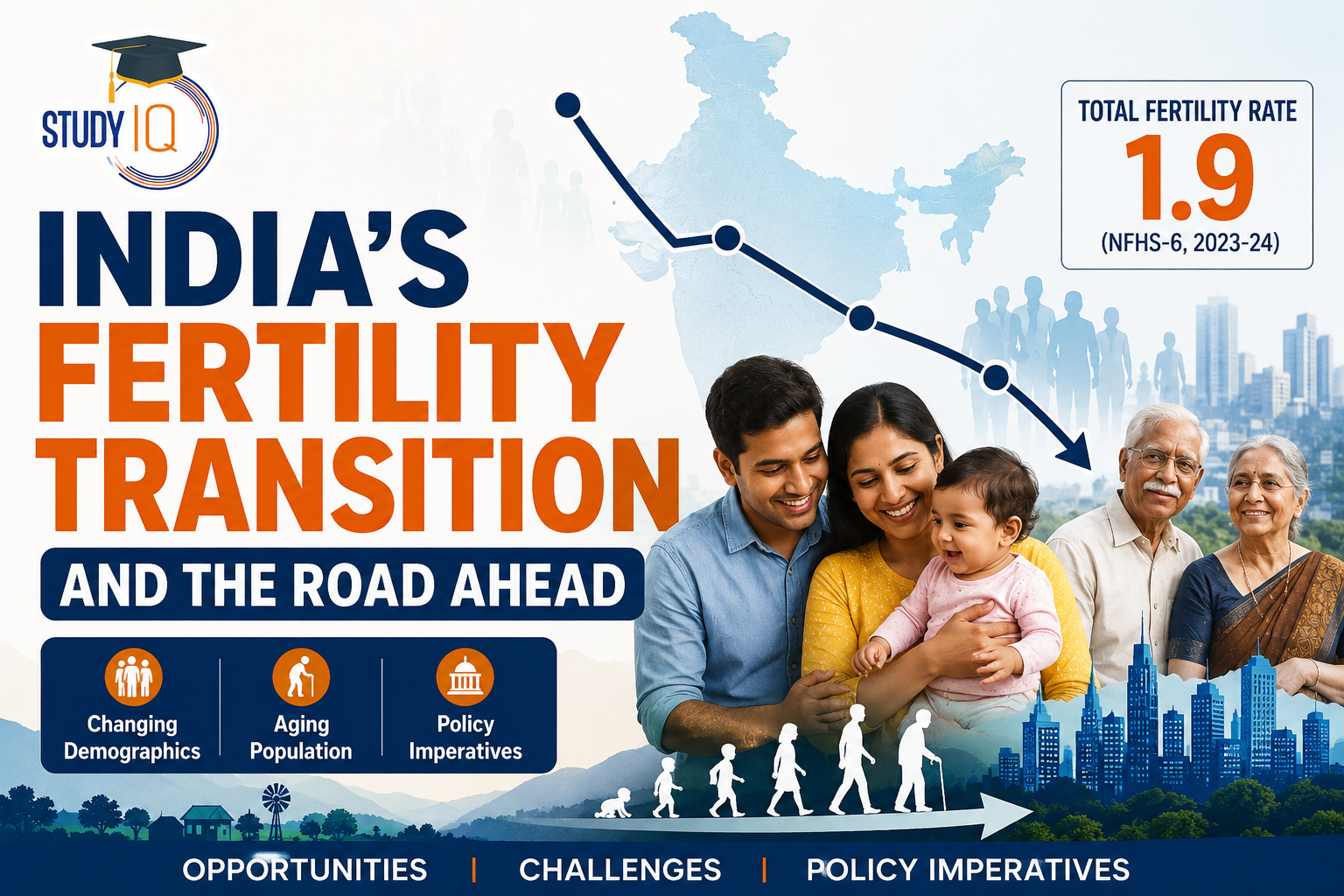
India’s Total Fertility Rate (TFR) has fallen to 1.9 in NFHS-6 (2023–24), below the replacement level of 2.1, signalling a significant demographic transition with important economic and social implications.
Read Also: UPSC Daily Current Affairs 2026
What Does the Global Picture of Falling Fertility Look Like?
- Sharp Global Decline in Fertility: According to UN World Population Prospects, the global TFR has collapsed from 4.68 in 1960 to 2.18 in 2024
- East Asia at the Epicentre of the Fertility Crisis:driven by urban cost pressures, hyper-competitive education systems, and weak parental support infrastructure.
- g., South Korea’s TFR has fallen to 0.72 – the world’s lowest.
- Sub-Saharan Africa as the Demographic Outlier: Sub-Saharan Africa will increasingly dominate global birth numbers, creating a stark “baby boom vs baby bust” geopolitical divide.
- Long-Term Global Transition: According to a Lancet projection, 198 of 204 countries and territories are expected to have below-replacement fertility by 2100, indicating that declining fertility is a structural global transformation rather than a temporary trend.
Why Are Fertility Rates Declining Across India?
- Rising Female Education and Workforce Participation: As women attain higher education and enter formal employment, the opportunity cost of childbearing rises, directly suppressing fertility decisions.
- g., Kerala and Tamil Nadu, with the highest female literacy rates, record TFRs of 1.8 and 1.7 respectively, among the lowest in India.
- Urbanisation and Rising Cost of Child-Rearing: Urban housing costs, private schooling fees, and competitive parenting norms make children economically burdensome, reversing the traditional rural calculus of children as economic assets.
- Expansion of Contraception and Declining Child Mortality: Modern contraceptive use has expanded significantly across income groups, while falling infant mortality has reduced the incentive to bear additional children as insurance against child death.
- Decline of the “Old-Age Security” Motive: As pension coverage expands and financial instruments grow, rural households no longer depend exclusively on children for old-age support, weakening a historically powerful fertility driver.
- Delayed Marriage: Women aged 20–24 married before 18 years declined from 23.3% in NFHS-5 to 16.7% in NFHS-6, shortening the effective reproductive window.
What Are the Key Implications of Sub-Replacement Fertility for India?
- Regional Demographic Imbalances: India’s fertility decline is not uniform; it creates a widening economic and political fault line between demographically advanced southern states and still-transitioning northern states (UP, Bihar).
- Narrowing Demographic Dividend: A declining fertility rate will gradually reduce the growth of the working-age population, limiting India’s demographic advantage in the coming decades.
- Fiscal Stress on Social Security Systems: A larger elderly population relative to the workforce will increase pressure on pensions, healthcare systems, and social security spending.
- By 2050, the proportion of elderly persons in India, is expected to increase to 20.8% of the population, ie, around 34.7crore.
- Delimitation and Federal Tensions: Future redistribution of Lok Sabha seats based on population may disadvantage states that successfully controlled population growth, intensifying North-South political debates.
- Risk of Adverse Sex Ratios: In regions where son preference persists, smaller family sizes may encourage sex-selective practices, affecting gender balance.
What Are the Concerns with Pro-Natalist Policy Interventions?
- One-Size-Fits-All Incentives Are Counterproductive: Financial incentives such as Andhra Pradesh’s third-child grant ignore that fertility decline has vastly different structural drivers in urban professional households versus poor rural families.
- Risk of Coercive Undertones: : Linking fertility norms to welfare benefits or electoral eligibility can disproportionately affect poor, marginalized, and minority communities.
- g., Andhra Pradesh shifted from disqualifying candidates with more than two children (till 2024) to proposing restrictions on those with fewer than two children (2025), highlighting the inconsistency of using electoral laws to influence fertility behaviour.
- Fertility Cannot Be Legislated Upward: International experience shows that fertility decline driven by education, urbanization, and women’s empowerment is difficult to reverse through cash incentives or regulatory measures alone.
What Is the Way Forward?
- Invest in Enabling Conditions, Not Incentives Alone: Expand affordable childcare infrastructure, paid parental leave for both parents, and flexible work arrangements to reduce the structural cost of childbearing for working women.
- g., Nordic countries sustain relatively higher TFRs (~1.7–1.8) by treating childcare as public infrastructure, not a private burden.
- Manage the Transition Through Productivity and Internal Migration: Rather than attempting to reverse fertility decline, India should accelerate skilling and technology adoption to sustain GDP growth with a smaller future workforce, and develop a structured internal migration policy to channel northern labour surpluses to labour-scarce southern states.
- Prioritise Elderly Care Infrastructure Now: Invest immediately in geriatric healthcare, portable pension systems, and community care models to prepare for the demographic shift already underway in southern and western India.
- g., Singapore’s ElderShield and Japan’s Long-Term Care Insurance Act provide scalable models for state-funded elderly support systems.
- Address Son Preference Proactively: Strengthen Beti Bachao Beti Padhao with community-level behavioural interventions in high son-preference districts to prevent fertility decline from triggering sex-selective outcomes and reversing gains in the child sex ratio.
|
Read More Notes |
|
| Environment Notes | Art and Culture Notes |
| Science and Tech | History Notes |
| Geography Notes | Indian Polity Notes |
| General Knowledge | International Relation |
|
Explore StudyIQ Courses |
|
 UPSC Recruitment 2026: 212 Vacancies Thr...
 Nyedar Namlo, Arunachal Pradesh: Sacred ...
 Daily Mains Articles 2026 – Updated Da...













 WhatsApp





