Table of Contents
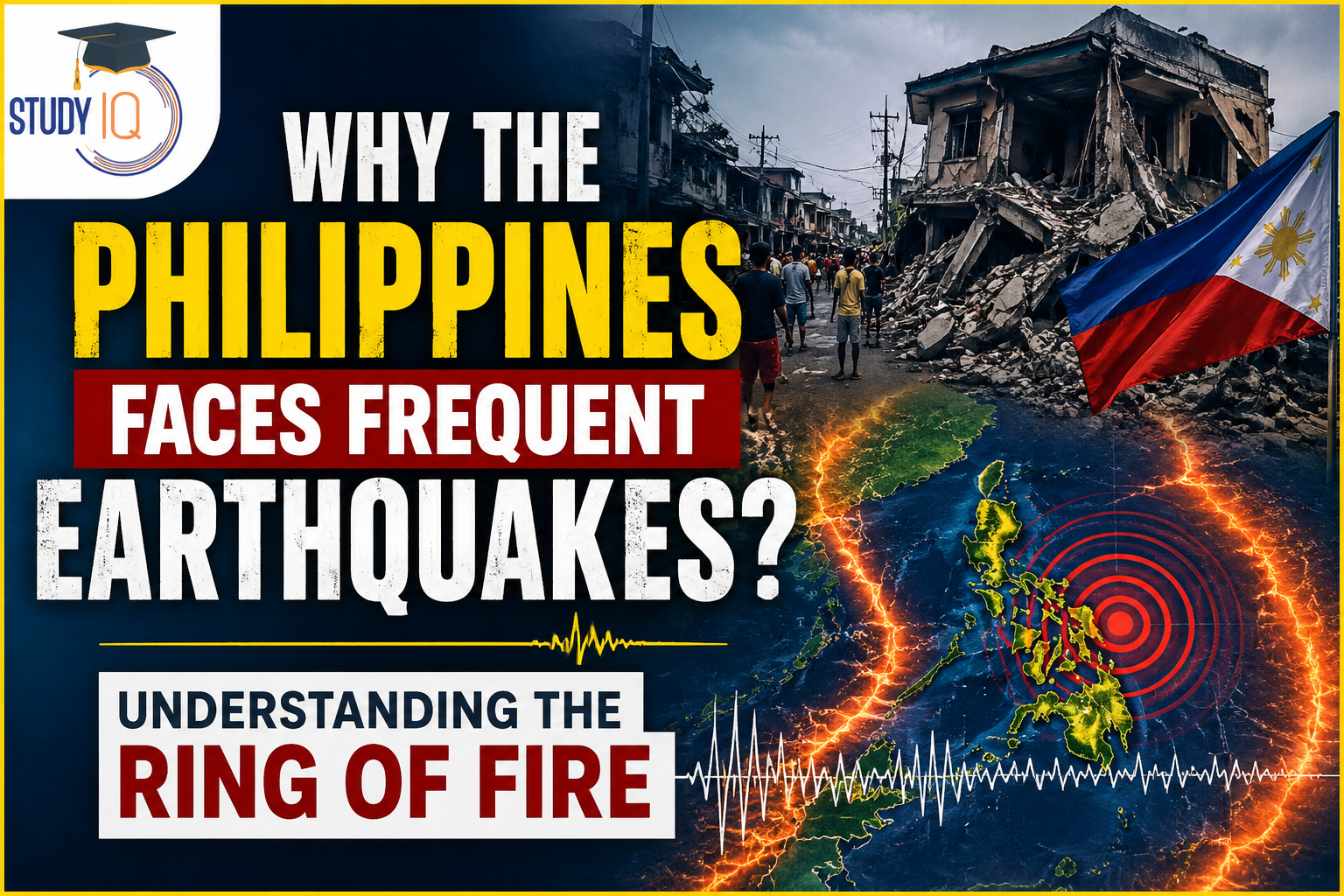
A powerful 7.8 magnitude earthquake struck southern Philippines on June 8, 2026, killing at least four people, injuring more than 200, damaging critical infrastructure, and triggering tsunami warnings across parts of Southeast Asia. The earthquake, centered near General Santos City in Mindanao, once again raised a critical question: Why does the Philippines experience so many earthquakes?
The answer lies in the country’s location within one of the most geologically active regions on Earth, the Pacific Ring of Fire.
Read Also: UPSC Daily Current Affairs 2026
Massive Earthquake Jolts Southern Philippines
The earthquake struck offshore near General Santos City, a major commercial and tuna-processing hub in Mindanao. Authorities reported collapsed structures, cracked bridges, airport disruptions, and widespread panic as residents rushed into open spaces.
Tsunami waves measuring up to one metre were recorded along parts of the southern Philippine coastline, prompting emergency evacuations. Neighboring Indonesia and Malaysia also issued tsunami advisories as authorities monitored sea-level changes.
While rescue and relief operations continue, geologists say the disaster is another reminder of the immense geological forces operating beneath the Philippine archipelago.
Why Does the Philippines Experience Frequent Earthquakes?
The Philippines is located on the Pacific Ring of Fire, a vast horseshoe-shaped zone that surrounds the Pacific Ocean and contains some of the world’s most active fault lines, volcanoes, and subduction zones.
This region accounts for:
- Nearly 90% of global earthquakes
- About 75% of active volcanoes worldwide
- Most of the world’s largest tsunami-generating earthquakes
Because the Philippines sits directly within this seismic belt, earthquakes are a regular occurrence rather than rare events.
The Tectonic Reality Beneath the Philippines
Beneath the Philippines, several tectonic plates are constantly moving and interacting.
These include:
- Philippine Sea Plate
- Eurasian Plate
- Sunda Plate
- Various microplates
As these massive slabs of the Earth’s crust collide, slide, and sink beneath one another, enormous stress builds up underground. When that stress is suddenly released, the result is an earthquake.
Scientists compare the process to a stretched rubber band snapping after reaching its breaking point.
Cotabato Trench: The Source of the 2026 Earthquake
According to Philippine seismological authorities, the June 2026 earthquake was linked to movement along the Cotabato Trench, a major undersea trench located south of Mindanao.
The trench is a classic subduction zone, where one tectonic plate is forced beneath another.
Subduction zones are among the most dangerous geological environments because they can generate:
- Extremely powerful earthquakes
- Tsunamis
- Volcanic activity
Many of the world’s deadliest earthquakes, including the 2004 Indian Ocean tsunami and the 2011 Japan earthquake, originated in similar tectonic settings.
How Did the Earthquake Trigger a Tsunami?
When a powerful earthquake occurs beneath the ocean floor, it can cause the seabed to rise or sink suddenly.
This vertical movement displaces massive volumes of seawater, creating waves that travel across the ocean at high speeds.
As the waves approach shallow coastal areas, they slow down and grow taller, resulting in tsunami surges capable of flooding coastal communities.
The June 2026 earthquake generated tsunami waves that were recorded in parts of the Philippines, Indonesia, and Malaysia, prompting authorities to issue warnings and evacuate vulnerable coastal populations.
A Country Constantly Living with Geological Risk
The Philippines is no stranger to devastating earthquakes.
Some of the country’s most destructive seismic disasters include:
Moro Gulf Earthquake (1976)
- Magnitude 8.0
- Triggered a deadly tsunami
- More than 5,000 fatalities
Luzon Earthquake (1990)
- Magnitude 7.7
- Extensive infrastructure damage
Bohol Earthquake (2013)
- Magnitude 7.2
- Historic structures destroyed
Mindanao Earthquake (2026)
- Magnitude 7.8
- Tsunami warnings issued
- Hundreds injured
These events illustrate the recurring threat posed by the country’s geography.
Why the Philippines Also Has Many Volcanoes
The same tectonic processes responsible for earthquakes also create volcanoes.
As oceanic plates sink into the Earth’s mantle, rocks melt and generate magma. This magma rises through the crust, forming volcanic systems.
The Philippines hosts more than 20 active volcanoes, including:
- Mayon Volcano
- Taal Volcano
- Kanlaon Volcano
- Bulusan Volcano
This combination of earthquakes, volcanoes, and tsunamis makes the country one of the most disaster-prone nations in the world.
What Can the World Learn from the Philippines?
Experts say the 2026 earthquake highlights the importance of:
- Early warning systems
- Earthquake-resistant infrastructure
- Coastal evacuation planning
- Public awareness campaigns
- Rapid disaster-response mechanisms
As urban populations continue to grow in hazard-prone regions, resilience and preparedness are becoming as important as scientific forecasting.
|
Read More Notes |
|
| Environment Notes | Art and Culture Notes |
| Science and Tech | History Notes |
| Geography Notes | Indian Polity Notes |
| General Knowledge | International Relation |
|
Explore StudyIQ Courses |
|
 Species in News: Cheetah | Project Cheet...
 Quantum Computing: RRI Scientists Demons...
 Artificial Intelligence in Warfare: How ...














 WhatsApp