
Table of Contents
Context
A deadly fire in South Delhi recently brought into focus the numerous fire safety gaps in India’s urban areas
Read Also: UPSC Daily Current Affairs 2026
What Are the Main Challenges in Urban Fire Management?
- Fire Services Are a State Subject: Fire services fall under Entry 6, State List, and Article 243(W), making them a state responsibility with no central enforcement mechanism.
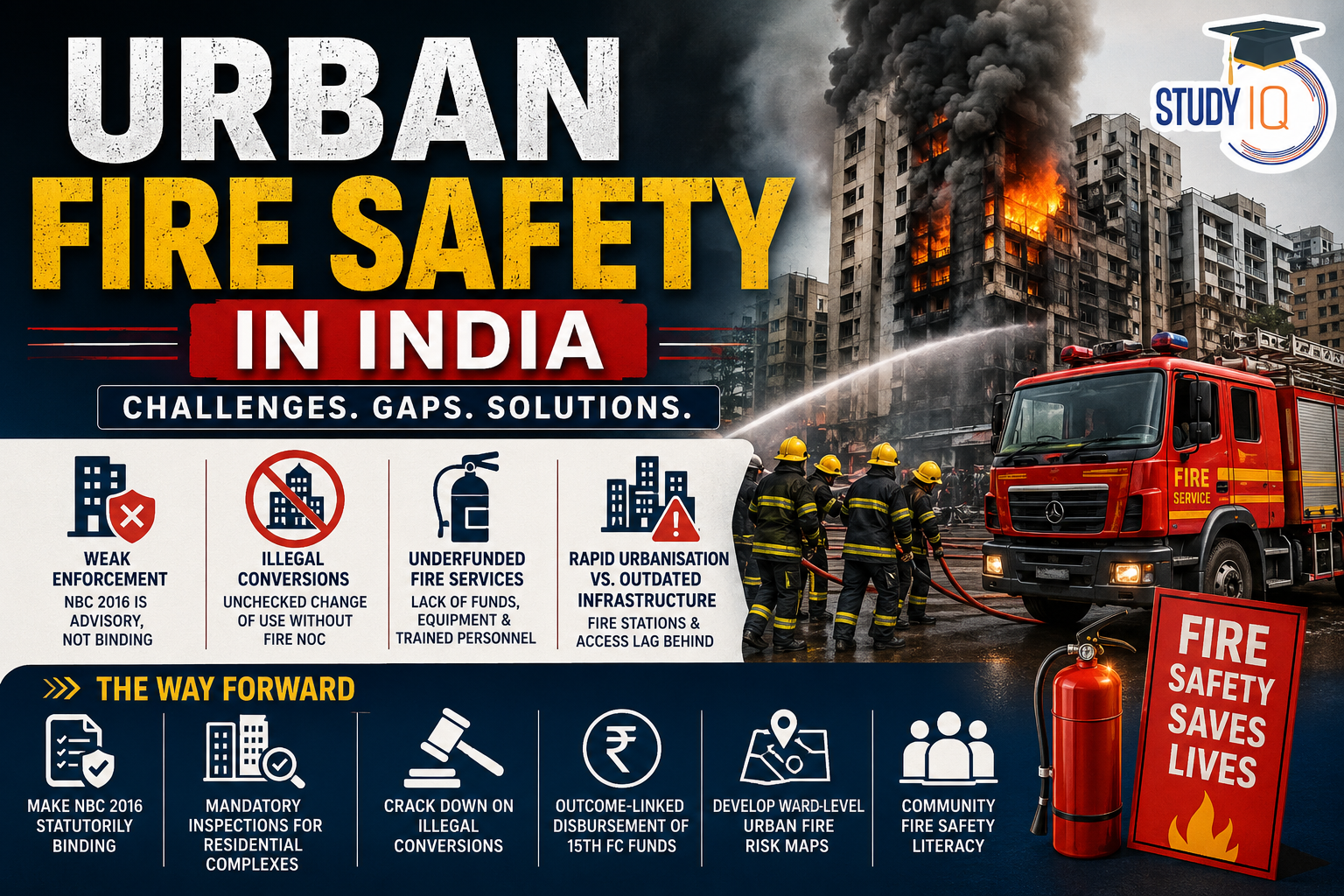
- NBC 2016 Is Advisory, Not Binding: The National Building Code carries no statutory force, ULBs face no legal obligation to enforce fire safety provisions at the building permission or occupancy certificate stage.
- The Delhi fire building had no NOC and no fire safety certificate, yet operated freely.
- Residential Buildings Outside Inspection Cycles: Unlike commercial establishments, residential structures, especially older ones, are not subject to routine fire safety inspections or mandatory audits.
- Unchecked Illegal Conversions: Commercial properties converted into residential or hospitality use without NOCs or fire safety upgrades.
- Unlike commercial buildings, residential structures have no mandated audit cycle to detect and rectify electrical short circuits, overloaded circuits, and LPG gas leaks
- Fire Services Are Grossly Underfunded: The 15th FC noted a critical “accidental gap” , fire services lack resources, trained personnel, and modern equipment, particularly in Tier-II and Tier-III cities.
- It recommended ₹5,000 crore for strengthening state fire services
- Firefighting Infrastructure Lags Urbanisation: As cities build upward and outward, fire station coverage, equipment capacity, and trained manpower have not kept pace
- Urban Density Compounds the Risk: Narrow lanes, congested layouts, and high-rise construction make access for fire tenders increasingly difficult in rapidly urbanising Indian cities.
What Is the Way Forward?
- Make NBC 2016 Statutorily Binding: Convert the National Building Code from an advisory document into a legally enforceable standard with mandatory compliance at building permission, construction, and occupancy certificate stages.
- g., UK’s Building Regulations Act makes fire safety compliance a legal prerequisite for any construction or change-of-use approval.
- Mandatory Inspection for Residential Complexes: Extend periodic fire safety inspections to all residential complexes above a defined floor area or height.
- g., Singapore’s Fire Safety Act mandates annual inspections for all building classes including residential towers above four storeys.
- Crack Down on Illegal Conversions: Create a fast-track regularisation-or-demolition framework for illegally converted properties; link property tax records and utility connections to fire NOC compliance.
- Outcome-Linked Disbursement of 15th FC Funds: Release the recommended ₹5,000 crore for fire services against measurable targets: fire station density, response time benchmarks, and equipment modernisation milestones.
- Develop Ward-Level Urban Fire Risk Maps: Map fire hazard zones for all cities above 5 lakh population based on building age, density, electrical load, and fire station proximity — enabling targeted resource deployment.
- g., Tokyo’s Urban Fire Risk Assessment ranks every city block by fire risk, driving pre-emptive infrastructure investment in high-risk wards.
- Community-Level Fire Safety Literacy: Given 60% of deaths occur in residential buildings, community awareness around electrical overloading and LPG handling is as critical as regulatory enforcement.
- g., Japan’s neighbourhood fire watch (Jishu-Bo) programme trains resident associations in fire prevention.
| Fire Safety Measures in India |
| National Building Code (NBC), published by the BIS in 1970 and updated in 2016-provide comprehensive guidelines for construction, maintenance, and fire safety protocols in buildings.
Model Building Bye Laws 2016-issued by the Ministry of Housing and Urban Affairs, offers guidance to states and Union Territories (UTs) in formulating building bylaws to address fire protection and safety requirements. Scheme for Expansion and Modernization of Fire Services: Launched from earmarked allocation of Preparedness and Capacity Building Funding Window under the NDRF for strengthening fire services in the states Fire and Life Safety Guidelines (2020): Issued by the Ministry of Health, these guidelines recommend measures such as third-party fire safety accreditation and the development of a Fire Response Plan (FRP). Other Laws: Section 37 of the Factories Act of 1948 establishes regulations to guard against fire and explosion hazards. |
|
Read More Notes |
|
| Environment Notes | Art and Culture Notes |
| Science and Tech | History Notes |
| Geography Notes | Indian Polity Notes |
| General Knowledge | International Relation |
|
Explore StudyIQ Courses |
|
 Why Do Stampedes Occur in India? Crowd P...
 Strategic Disinvestment in India: IDBI B...
 Women’s Livelihoods in India: Challeng...














 WhatsApp





